Wu Xiaohang, Liu Lixue, Zhao Lanqin, Guo Chong, Li Ruiyang, Wang Ting, Yang Xiaonan, Xie Peichen, Liu Yizhi, Lin Haotian
State Key Laboratory of Ophthalmology, Zhongshan Ophthalmic Center, Sun Yat-sen University, Guangzhou, China.
Zhongshan School of Medicine, Sun Yat-sen University, Guangzhou, China.
Ann Transl Med. 2020 Jun;8(11):714. doi: 10.21037/atm-20-976.
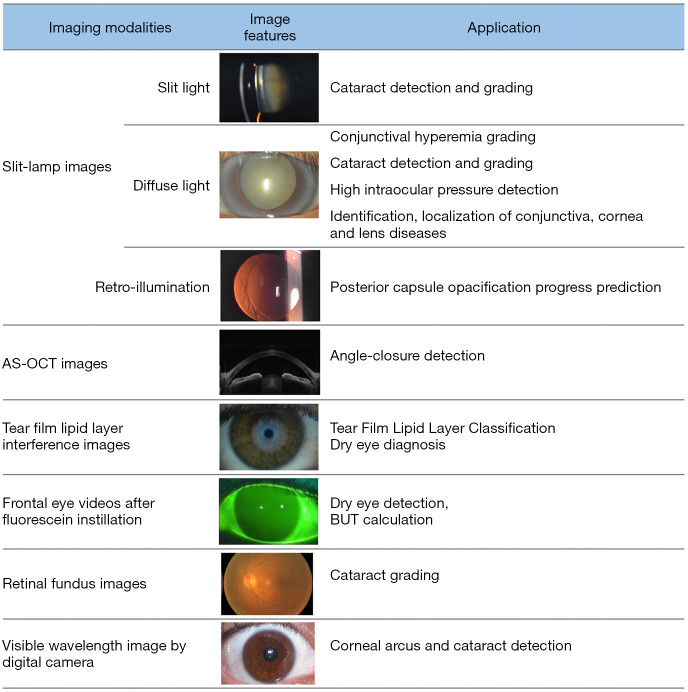
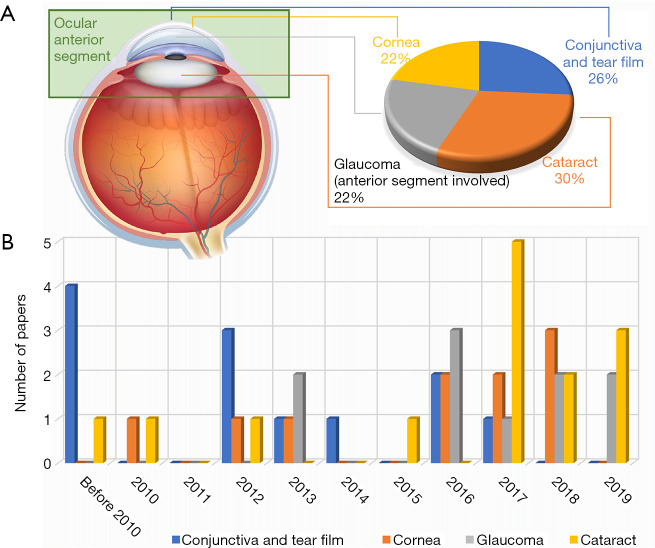
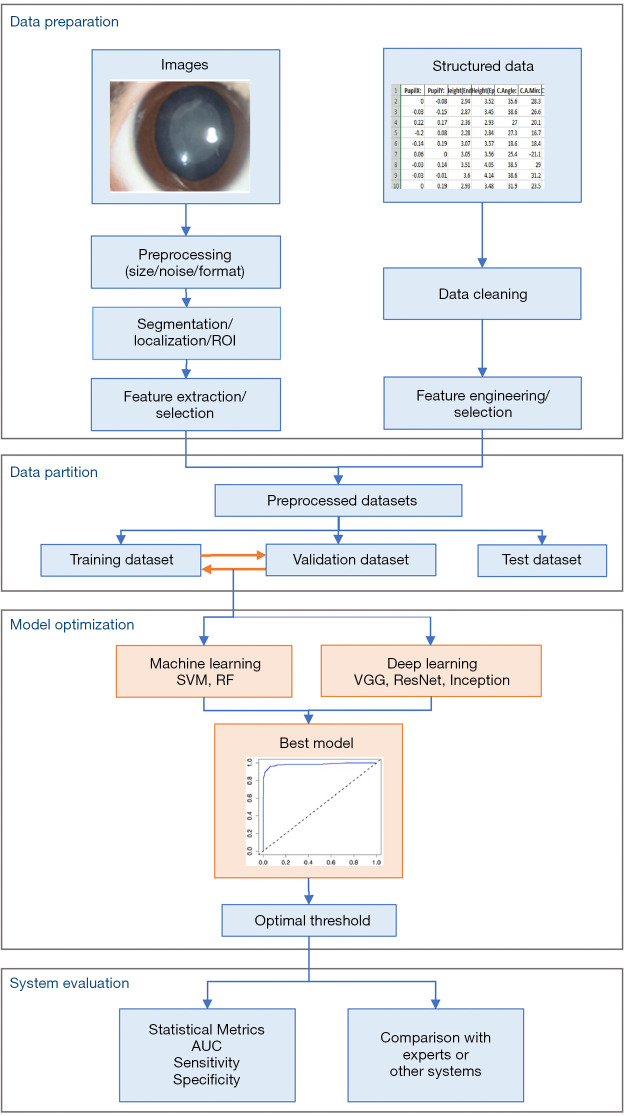
Artificial intelligence (AI) based on machine learning (ML) and deep learning (DL) techniques has gained tremendous global interest in this era. Recent studies have demonstrated the potential of AI systems to provide improved capability in various tasks, especially in image recognition field. As an image-centric subspecialty, ophthalmology has become one of the frontiers of AI research. Trained on optical coherence tomography, slit-lamp images and even ordinary eye images, AI can achieve robust performance in the detection of glaucoma, corneal arcus and cataracts. Moreover, AI models based on other forms of data also performed satisfactorily. Nevertheless, several challenges with AI application in ophthalmology have also arisen, including standardization of data sets, validation and applicability of AI models, and ethical issues. In this review, we provided a summary of the state-of-the-art AI application in anterior segment ophthalmic diseases, potential challenges in clinical implementation and our prospects.
在这个时代,基于机器学习(ML)和深度学习(DL)技术的人工智能(AI)已在全球引起了极大的关注。最近的研究表明,人工智能系统在各种任务中具有提供改进能力的潜力,尤其是在图像识别领域。作为以图像为中心的亚专业,眼科已成为人工智能研究的前沿领域之一。通过光学相干断层扫描、裂隙灯图像甚至普通眼部图像进行训练,人工智能在青光眼、角膜弓和白内障的检测中可以实现强大的性能。此外,基于其他形式数据的人工智能模型也表现令人满意。然而,人工智能在眼科应用中也出现了一些挑战,包括数据集的标准化、人工智能模型的验证和适用性以及伦理问题。在这篇综述中,我们总结了人工智能在眼前段眼科疾病中的最新应用、临床实施中的潜在挑战以及我们的展望。