• 文献检索
  • 文档翻译
  • 深度研究
  • 学术资讯
  • Suppr Zotero 插件Zotero 插件
  • 邀请有礼
  • 套餐&价格
  • 历史记录
应用&插件
Suppr Zotero 插件Zotero 插件浏览器插件Mac 客户端Windows 客户端微信小程序
定价
高级版会员购买积分包购买API积分包
服务
文献检索文档翻译深度研究API 文档MCP 服务
关于我们
关于 Suppr公司介绍联系我们用户协议隐私条款
关注我们

Suppr 超能文献

核心技术专利:CN118964589B侵权必究
粤ICP备2023148730 号-1Suppr @ 2026

文献检索

告别复杂PubMed语法,用中文像聊天一样搜索,搜遍4000万医学文献。AI智能推荐,让科研检索更轻松。

立即免费搜索

文件翻译

保留排版,准确专业,支持PDF/Word/PPT等文件格式,支持 12+语言互译。

免费翻译文档

深度研究

AI帮你快速写综述,25分钟生成高质量综述,智能提取关键信息,辅助科研写作。

立即免费体验

人工智能在近视中的应用:现状与未来方向

Applications of Artificial Intelligence in Myopia: Current and Future Directions.

作者信息

Zhang Chenchen, Zhao Jing, Zhu Zhe, Li Yanxia, Li Ke, Wang Yuanping, Zheng Yajuan

机构信息

Department of Ophthalmology, The Second Hospital of Jilin University, Changchun, China.

出版信息

Front Med (Lausanne). 2022 Mar 11;9:840498. doi: 10.3389/fmed.2022.840498. eCollection 2022.

DOI:10.3389/fmed.2022.840498
PMID:35360739
原文链接:https://pmc.ncbi.nlm.nih.gov/articles/PMC8962670/
Abstract

With the continuous development of computer technology, big data acquisition and imaging methods, the application of artificial intelligence (AI) in medical fields is expanding. The use of machine learning and deep learning in the diagnosis and treatment of ophthalmic diseases is becoming more widespread. As one of the main causes of visual impairment, myopia has a high global prevalence. Early screening or diagnosis of myopia, combined with other effective therapeutic interventions, is very important to maintain a patient's visual function and quality of life. Through the training of fundus photography, optical coherence tomography, and slit lamp images and through platforms provided by telemedicine, AI shows great application potential in the detection, diagnosis, progression prediction and treatment of myopia. In addition, AI models and wearable devices based on other forms of data also perform well in the behavioral intervention of myopia patients. Admittedly, there are still some challenges in the practical application of AI in myopia, such as the standardization of datasets; acceptance attitudes of users; and ethical, legal and regulatory issues. This paper reviews the clinical application status, potential challenges and future directions of AI in myopia and proposes that the establishment of an AI-integrated telemedicine platform will be a new direction for myopia management in the post-COVID-19 period.

摘要

随着计算机技术、大数据采集与成像方法的不断发展,人工智能(AI)在医学领域的应用正在不断拓展。机器学习和深度学习在眼科疾病诊治中的应用日益广泛。近视作为视力损害的主要原因之一,在全球具有很高的患病率。近视的早期筛查或诊断,结合其他有效的治疗干预措施,对于维持患者的视觉功能和生活质量非常重要。通过眼底摄影、光学相干断层扫描和裂隙灯图像的训练,以及借助远程医疗提供的平台,AI在近视的检测、诊断、进展预测和治疗方面展现出巨大的应用潜力。此外,基于其他形式数据的AI模型和可穿戴设备在近视患者的行为干预方面也表现出色。诚然,AI在近视实际应用中仍存在一些挑战,如数据集的标准化、用户的接受态度以及伦理、法律和监管问题。本文综述了AI在近视方面的临床应用现状、潜在挑战和未来方向,并提出建立整合AI的远程医疗平台将是新冠疫情后近视管理的新方向。
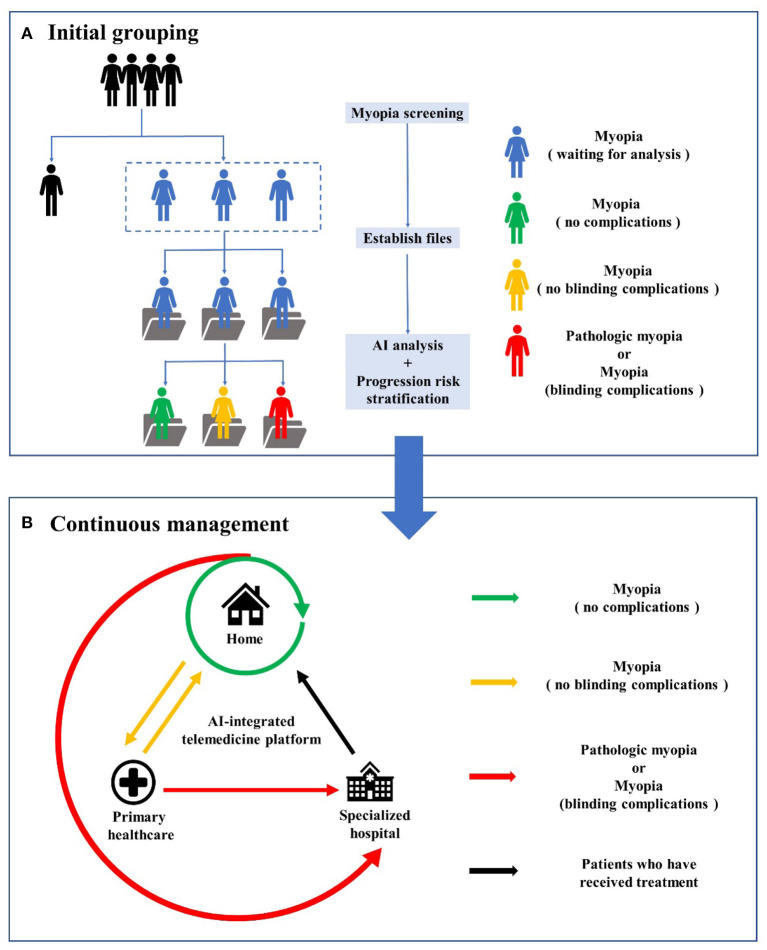
https://cdn.ncbi.nlm.nih.gov/pmc/blobs/044a/8962670/5a3bf8d105c6/fmed-09-840498-g0002.jpg
https://cdn.ncbi.nlm.nih.gov/pmc/blobs/044a/8962670/2d5275905470/fmed-09-840498-g0001.jpg
https://cdn.ncbi.nlm.nih.gov/pmc/blobs/044a/8962670/5a3bf8d105c6/fmed-09-840498-g0002.jpg
https://cdn.ncbi.nlm.nih.gov/pmc/blobs/044a/8962670/2d5275905470/fmed-09-840498-g0001.jpg
https://cdn.ncbi.nlm.nih.gov/pmc/blobs/044a/8962670/5a3bf8d105c6/fmed-09-840498-g0002.jpg

相似文献

1
Applications of Artificial Intelligence in Myopia: Current and Future Directions.人工智能在近视中的应用:现状与未来方向
Front Med (Lausanne). 2022 Mar 11;9:840498. doi: 10.3389/fmed.2022.840498. eCollection 2022.
2
Application of artificial intelligence in anterior segment ophthalmic diseases: diversity and standardization.人工智能在眼前段眼科疾病中的应用:多样性与标准化
Ann Transl Med. 2020 Jun;8(11):714. doi: 10.21037/atm-20-976.
3
Artificial intelligence and digital solutions for myopia.近视的人工智能与数字解决方案
Taiwan J Ophthalmol. 2023 May 16;13(2):142-150. doi: 10.4103/tjo.TJO-D-23-00032. eCollection 2023 Apr-Jun.
4
Insights into artificial intelligence in myopia management: from a data perspective.人工智能在近视管理中的应用:从数据角度的洞察。
Graefes Arch Clin Exp Ophthalmol. 2024 Jan;262(1):3-17. doi: 10.1007/s00417-023-06101-5. Epub 2023 May 25.
5
Artificial intelligence in myopia in children: current trends and future directions.人工智能在儿童近视中的应用:当前趋势与未来方向。
Curr Opin Ophthalmol. 2024 Nov 1;35(6):463-471. doi: 10.1097/ICU.0000000000001086. Epub 2024 Aug 26.
6
Application of artificial intelligence in cataract management: current and future directions.人工智能在白内障治疗中的应用:现状与未来方向。
Eye Vis (Lond). 2022 Jan 7;9(1):3. doi: 10.1186/s40662-021-00273-z.
7
Retinal photograph-based deep learning algorithms for myopia and a blockchain platform to facilitate artificial intelligence medical research: a retrospective multicohort study.基于视网膜照片的深度学习算法在近视中的应用和一个促进人工智能医学研究的区块链平台:一项回顾性多队列研究。
Lancet Digit Health. 2021 May;3(5):e317-e329. doi: 10.1016/S2589-7500(21)00055-8.
8
Artificial intelligence technology for myopia challenges: A review.人工智能技术应对近视挑战:综述
Front Cell Dev Biol. 2023 Jan 17;11:1124005. doi: 10.3389/fcell.2023.1124005. eCollection 2023.
9
Novel Uses and Challenges of Artificial Intelligence in Diagnosing and Managing Eyes with High Myopia and Pathologic Myopia.人工智能在高度近视和病理性近视眼睛诊断与管理中的新用途及挑战
Diagnostics (Basel). 2022 May 12;12(5):1210. doi: 10.3390/diagnostics12051210.
10
Artificial intelligence in myopia: current and future trends.人工智能与近视:现状与未来趋势
Curr Opin Ophthalmol. 2021 Sep 1;32(5):413-424. doi: 10.1097/ICU.0000000000000791.

引用本文的文献

1
Application of artificial intelligence in myopia prevention and control.人工智能在近视防控中的应用。
Pediatr Investig. 2025 Mar 18;9(2):114-124. doi: 10.1002/ped4.70001. eCollection 2025 Jun.
2
Global trends and hotspots in artificial intelligence for high myopia: a bibliometric analysis.高度近视人工智能的全球趋势与热点:文献计量分析
Front Med (Lausanne). 2025 May 9;12:1567440. doi: 10.3389/fmed.2025.1567440. eCollection 2025.
3
Applications of Artificial Intelligence in Choroid Visualization for Myopia: A Comprehensive Scoping Review.

本文引用的文献

1
Artificial intelligence in myopia: current and future trends.人工智能与近视:现状与未来趋势
Curr Opin Ophthalmol. 2021 Sep 1;32(5):413-424. doi: 10.1097/ICU.0000000000000791.
2
Artificial Intelligence in Cornea, Refractive Surgery, and Cataract: Basic Principles, Clinical Applications, and Future Directions.人工智能在角膜、屈光手术和白内障中的应用:基本原理、临床应用和未来方向。
Asia Pac J Ophthalmol (Phila). 2021 Jul 1;10(3):268-281. doi: 10.1097/APO.0000000000000394.
3
An Overview of Machine Learning within Embedded and Mobile Devices-Optimizations and Applications.
人工智能在近视脉络膜可视化中的应用:一项全面的范围综述。
Middle East Afr J Ophthalmol. 2024 Dec 2;30(4):189-202. doi: 10.4103/meajo.meajo_154_24. eCollection 2023 Oct-Dec.
4
Quantitative analysis of retinal vascular parameters changes in school-age children with refractive error using artificial intelligence.利用人工智能对屈光不正学龄儿童视网膜血管参数变化进行定量分析。
Front Med (Lausanne). 2024 Dec 31;11:1528772. doi: 10.3389/fmed.2024.1528772. eCollection 2024.
5
New Frontiers in Myopia Progression in Children.儿童近视进展的新前沿
J Clin Med. 2024 Dec 2;13(23):7314. doi: 10.3390/jcm13237314.
6
Viewing distance, font size and symptoms of eyestrain in non-presbyopic and presbyopic smartphone users.非老花眼和老花眼智能手机用户的观看距离、字体大小与眼疲劳症状
Ophthalmic Physiol Opt. 2025 Jan;45(1):269-279. doi: 10.1111/opo.13410. Epub 2024 Oct 25.
7
Association of outdoor artificial light at night with myopia among Chinese adolescents: a representative cross-sectional study.中国青少年夜间户外人造光与近视的关联:一项代表性横断面研究
Front Med (Lausanne). 2024 Sep 27;11:1469422. doi: 10.3389/fmed.2024.1469422. eCollection 2024.
8
Role of Machine Learning and Artificial Intelligence in the Diagnosis and Treatment of Refractive Errors for Enhanced Eye Care: A Systematic Review.机器学习和人工智能在屈光不正诊断与治疗中对强化眼保健的作用:一项系统综述
Cureus. 2024 Apr 6;16(4):e57706. doi: 10.7759/cureus.57706. eCollection 2024 Apr.
9
Understanding Posterior Staphyloma in Pathologic Myopia: Current Overview, New Input, and Perspectives.病理性近视后巩膜葡萄肿的认识:当前概述、新进展及展望
Clin Ophthalmol. 2023 Dec 12;17:3825-3853. doi: 10.2147/OPTH.S405202. eCollection 2023.
10
Quantitative analysis of optic disc changes in school-age children with ametropia based on artificial intelligence.基于人工智能的学龄期屈光不正儿童视盘变化的定量分析
Int J Ophthalmol. 2023 Nov 18;16(11):1727-1733. doi: 10.18240/ijo.2023.11.01. eCollection 2023.
机器学习在嵌入式和移动设备中的概述——优化与应用。
Sensors (Basel). 2021 Jun 28;21(13):4412. doi: 10.3390/s21134412.
4
Machine Learning-Guided Prediction of Central Anterior Chamber Depth Using Slit Lamp Images from a Portable Smartphone Device.基于便携智能手机裂隙灯图像的机器学习引导的中央前房深度预测
Biosensors (Basel). 2021 Jun 5;11(6):182. doi: 10.3390/bios11060182.
5
Retinal photograph-based deep learning algorithms for myopia and a blockchain platform to facilitate artificial intelligence medical research: a retrospective multicohort study.基于视网膜照片的深度学习算法在近视中的应用和一个促进人工智能医学研究的区块链平台:一项回顾性多队列研究。
Lancet Digit Health. 2021 May;3(5):e317-e329. doi: 10.1016/S2589-7500(21)00055-8.
6
Is artificial intelligence a solution to the myopia pandemic?人工智能是解决近视大流行的方法吗?
Br J Ophthalmol. 2021 Jun;105(6):741-744. doi: 10.1136/bjophthalmol-2021-319129. Epub 2021 Mar 12.
7
Deep Learning Approach for Automated Detection of Myopic Maculopathy and Pathologic Myopia in Fundus Images.深度学习方法在眼底图像中自动检测近视性黄斑病变和病理性近视
Ophthalmol Retina. 2021 Dec;5(12):1235-1244. doi: 10.1016/j.oret.2021.02.006. Epub 2021 Feb 18.
8
Progression of Myopia in School-Aged Children After COVID-19 Home Confinement.新冠居家隔离后学龄儿童近视进展。
JAMA Ophthalmol. 2021 Mar 1;139(3):293-300. doi: 10.1001/jamaophthalmol.2020.6239.
9
Pathological myopia classification with simultaneous lesion segmentation using deep learning.使用深度学习进行同时病变分割的病理性近视分类
Comput Methods Programs Biomed. 2021 Feb;199:105920. doi: 10.1016/j.cmpb.2020.105920. Epub 2020 Dec 28.
10
Development and validation of a deep learning system to screen vision-threatening conditions in high myopia using optical coherence tomography images.利用光学相干断层扫描图像开发和验证一种深度学习系统,以筛查高度近视的致盲性病变。
Br J Ophthalmol. 2022 May;106(5):633-639. doi: 10.1136/bjophthalmol-2020-317825. Epub 2020 Dec 21.