Eliasson Björn, Ekelund Jan, Miftaraj Mervete, Ranthe Mattis Flyvholm, Mårdby Ann-Charlotte, Da Rocha Fernandes João Diogo, Svensson Ann-Marie
Department of Molecular and Clinical Medicine, University of Gothenburg, Gothenburg, Sweden.
Department of Medicine, Sahlgrenska University Hospital, Gothenburg, Sweden.
Diabetes Ther. 2020 Aug;11(8):1807-1820. doi: 10.1007/s13300-020-00872-4. Epub 2020 Jul 3.
To explore persistence with insulin degludec/liraglutide (IDegLira) treatment, clinical characteristics and concomitant medications in a large population of patients in clinical practice.
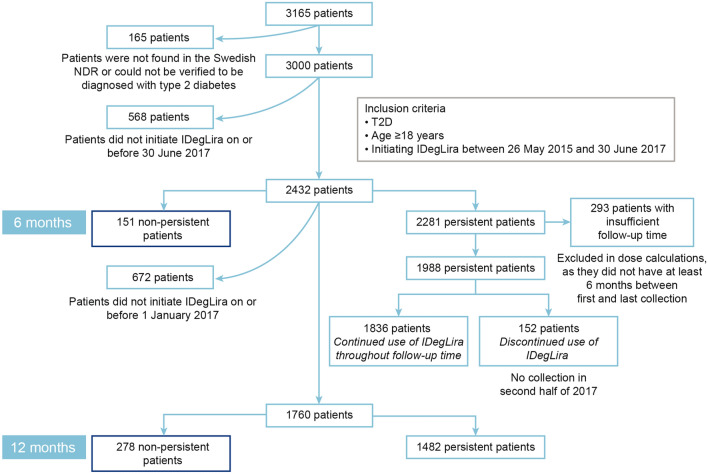
This was an observational study in patients with type 2 diabetes (n = 2432) who initiated IDegLira between 26 May 2015 and 31 December 2017. Data were obtained from Swedish nationwide registers and linked on an individual level using unique Swedish personal identifiers. Dose calculations were made for patients with ≥ 180 days between the first and last collections of IDegLira prescription. Changes in clinical parameters were evaluated as change from the last observation during 12 months prior to the initiation date until ± 90 days from the last collection of IDegLira.
Pre-index regimens (index date being the date of filling the first prescription of IDegLira) included: multiple daily insulin injections (45.1%); insulin and glucagon-like peptide-1 receptor agonist (GLP-1 RA) (19.7%); long-acting insulins (11.8%); non-injectable therapy only (11.4%); GLP-1 RA only (9.8%); and no collection of diabetes medication during the 6-month pre-index period (2.3%). The majority of patients (94 and 84%) were persistent with IDegLira at 6 and 12 months, respectively. The most commonly used concomitant medication was metformin (69.4%). Mean daily dose was 33 dose steps. Overall, there was a mean decrease in HbA1c (approx. 10 mmol/mol [1%]) and body weight (- 1.1 kg). Improvements in HbA1c were observed regardless of pre-index treatment.
After 12 months, 84% of patients were persistent on IDegLira, with improved glycaemic control and reductions in body weight.
在临床实践中的大量患者群体中,探究德谷胰岛素/利拉鲁肽(IDegLira)治疗的持续性、临床特征及合并用药情况。
这是一项针对2型糖尿病患者(n = 2432)的观察性研究,这些患者于2015年5月26日至2017年12月31日期间开始使用IDegLira。数据来自瑞典全国性登记处,并使用瑞典独特的个人标识符在个体层面进行关联。对首次和最后一次开具IDegLira处方之间间隔≥180天的患者进行剂量计算。临床参数的变化评估为从起始日期前12个月的最后一次观察到最后一次开具IDegLira处方后±90天的变化。
索引前治疗方案(索引日期为开具IDegLira首张处方的日期)包括:每日多次胰岛素注射(45.1%);胰岛素和胰高血糖素样肽-1受体激动剂(GLP-1 RA)(19.7%);长效胰岛素(11.8%);仅非注射治疗(11.4%);仅GLP-1 RA(9.8%);以及索引前6个月内未开具糖尿病药物(2.3%)。大多数患者(分别为94%和84%)在6个月和12个月时持续使用IDegLira。最常用的合并用药是二甲双胍(69.4%)。平均每日剂量为33个剂量单位。总体而言,糖化血红蛋白平均下降(约10 mmol/mol [1%]),体重下降(-1.1 kg)。无论索引前治疗如何,糖化血红蛋白均有改善。
12个月后,84%的患者持续使用IDegLira,血糖控制得到改善,体重减轻。