Section for Medical Statistics, Center for Medical Statistics, Informatics and Intelligent Systems, Medical University of Vienna, Spitalgasse 23, 1090, Vienna, Austria.
Wien Klin Wochenschr. 2020 Nov;132(21-22):685-689. doi: 10.1007/s00508-020-01707-9. Epub 2020 Jul 3.
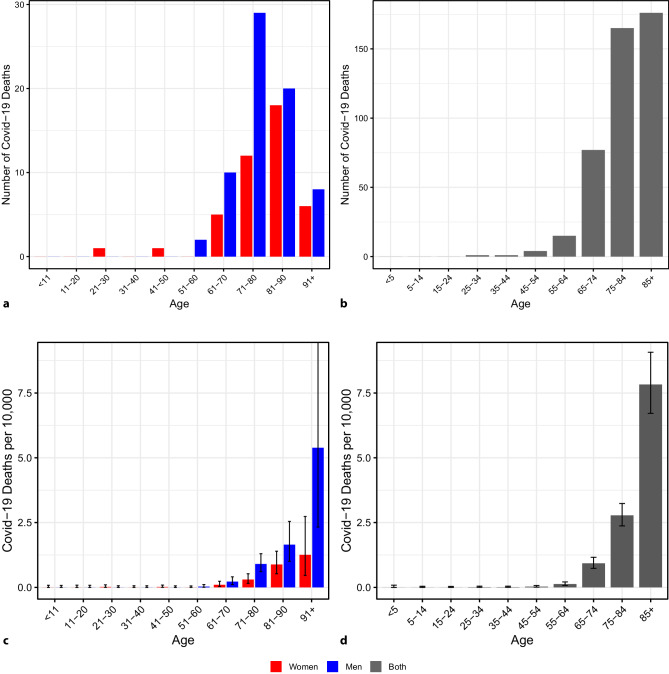
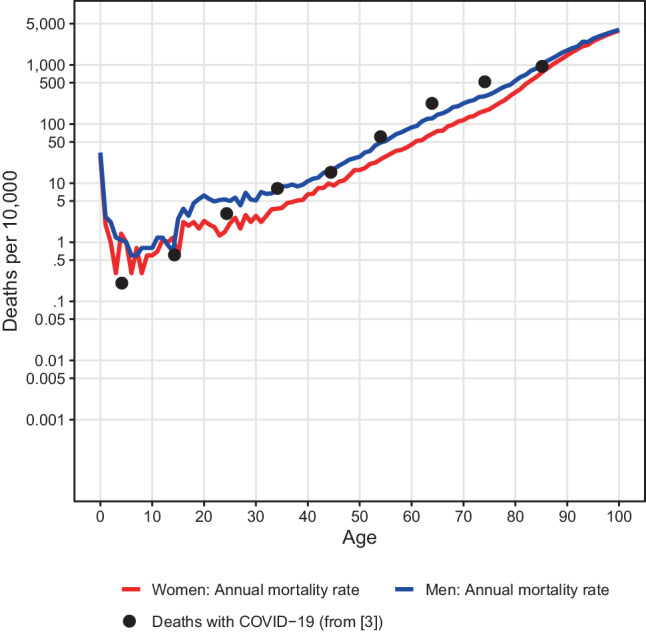
We analyze the age and sex distribution of the reported COVID-19 deaths in Austria. In accordance with international studies, the Austrian data also suggests that the risk of death increases substantially with age. The observed age dependency of the proportions of registered COVID-19 deaths in relation to the population sizes in the age groups is approximately exponential, similar to the age dependency of the general age specific mortality rate. Furthermore, we compare the general age specific mortality rate in Austria with the estimates of the SARS-CoV‑2 infection fatality rate by Ferguson et al. (2020). The parallels to the general age specific mortality rates do not imply that COVID-19 does not pose an additional risk. On the contrary, it follows from the structure and magnitude of the infection fatality rate that it is substantial, especially for higher age groups. However, since in many cases persons with severe pre-existing conditions are affected, it is not yet possible to estimate what effects COVID-19 will have on life expectancy.
我们分析了奥地利报告的 COVID-19 死亡病例的年龄和性别分布。与国际研究一致,奥地利的数据还表明,死亡风险随着年龄的增长而大幅增加。观察到的 COVID-19 死亡病例在各年龄段的人口比例与一般特定年龄死亡率的年龄依赖性大致呈指数关系。此外,我们将奥地利的一般特定年龄死亡率与 Ferguson 等人(2020 年)估计的 SARS-CoV-2 感染病死率进行了比较。与一般特定年龄死亡率的相似性并不意味着 COVID-19 不会带来额外的风险。相反,感染病死率的结构和幅度表明其相当大,特别是对于年龄较大的人群。然而,由于许多情况下患有严重的预先存在的疾病的人受到影响,因此目前还无法估计 COVID-19 对预期寿命的影响。