Department of Critical Care Medicine, Second Affiliated Hospital of Fujian Medical University, Fujian, China; Department of Infectious Disease, Wuhan Jinyintan Hospital, Wuhan, China.
Collaborative Innovation Center for Maternal and Infant Health Service Application Technology of Education Ministry, Quanzhou Medical College, Fujian, China; Department of Ultrasound Medicine, Second Affiliated Hospital of Fujian Medical University, Fujian, China.
Ultrasound Med Biol. 2020 Oct;46(10):2651-2658. doi: 10.1016/j.ultrasmedbio.2020.05.006. Epub 2020 Jun 5.
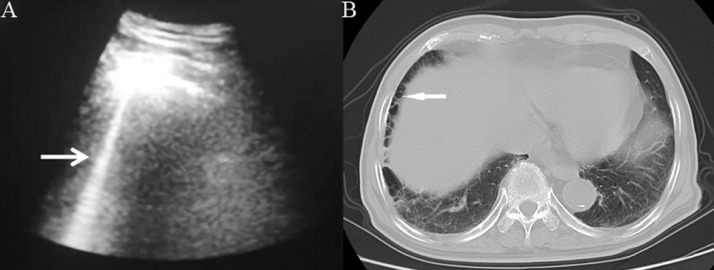
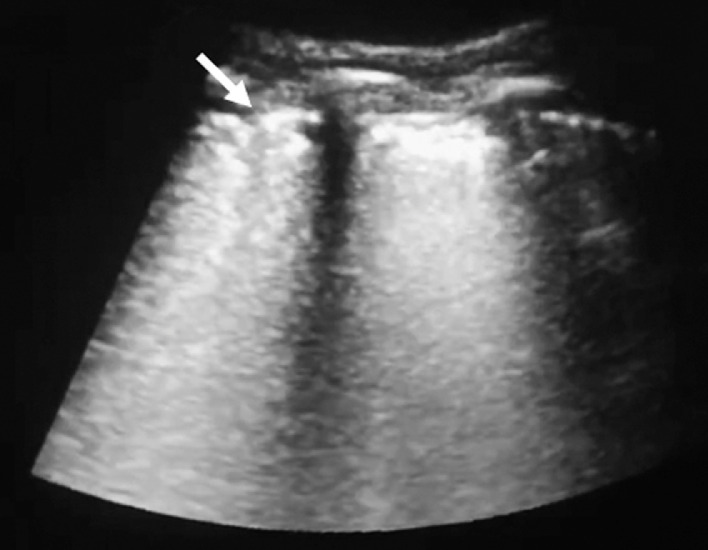
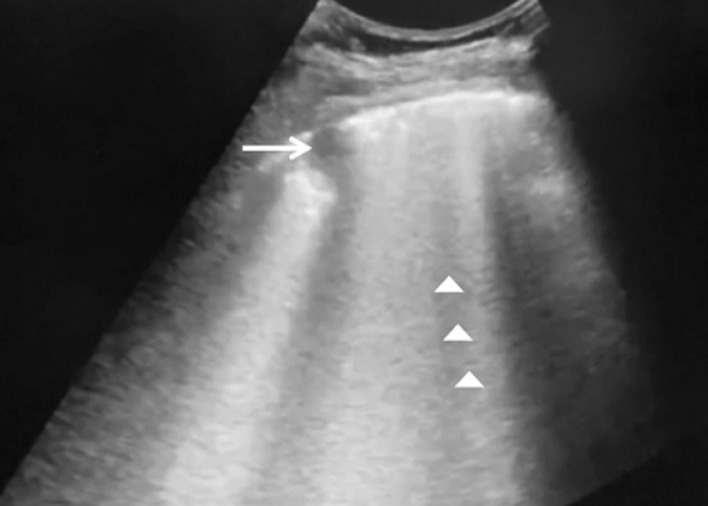
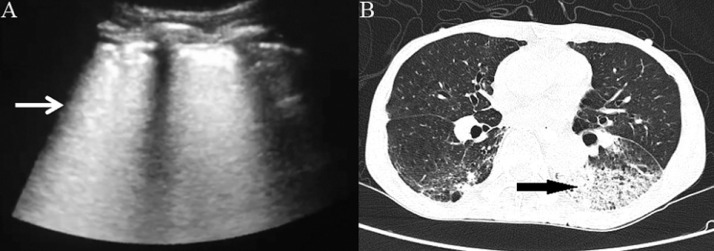
To investigate the feasibility of lung ultrasound in evaluating coronavirus disease 2019 (COVID-19) and distinguish the sonographic features between COVID-19 and community-acquired pneumonia (CAP), a total of 12 COVID-19 patients and 20 CAP patients were selected and underwent lung ultrasound. The modified Buda scoring system for interstitial lung disease was used to evaluate the severity and treatment effect of COVID-19 on ultrasonography. The differences between modified lung ultrasound (MLUS) score and high-resolution computed tomography (HRCT) Warrick score were analyzed to evaluate their correlation. COVID-19 showed the following sonographic features: thickening (12/12), blurred (9/12), discontinuous (6/12) pleural line; rocket sign (4/12), partially diffused B-line (12/12), completely diffused B-line (10/12), waterfall sign (4/12); C-line sign (5/12); pleural effusion (1/12) and pulmonary balloon (Am line, 1/12). The last two features were rarely seen. Differences of ultrasonic features, including lesion range, lung signs and pneumonia-related complications, between COVID-19 and CAP were statistically significant (p˂ 0.05 or 0.001). MLUS scores (p = 0.006) and HRCT Warrick scores (p = 0.015) increased as the severity of COVID-19 increased. The differences between moderate (29.00 [25.75-37.50]) and severe (43.00 [38.75-47.25]) (p = 0.022) or between moderate and critical (47.50 [44.25-50.00]) (p = 0.002) type COVID-19 were statistically significant, compared with those between severe and critical types. Correlation between MLUS scores and HRCT Warrick scores was positive (r = 0.54, p = 0.048). MLUS scores (Z = 2.61, p = 0.009) and HRCT Warrick scores (Z = 2.63, p = 0.009) of five severe or critical COVID-19 patients significantly decreased as their conditions improved after treatment. The differences of sonographic features between COVID-19 and CAP patients were notable. The MLUS scoring system could be used to evaluate the severity and treatment effect of COVID-19.
目的 探讨肺部超声在评估 2019 冠状病毒病(COVID-19)中的可行性,并区分 COVID-19 与社区获得性肺炎(CAP)的声像特征。选择了 12 例 COVID-19 患者和 20 例 CAP 患者进行肺部超声检查。采用改良的间质性肺疾病 Buda 评分系统评估 COVID-19 超声严重程度和治疗效果。分析改良肺部超声(MLUS)评分与高分辨率 CT(HRCT)Warrick 评分的差异,以评估其相关性。结果 COVID-19 的超声特征如下:增厚(12/12)、模糊(9/12)、不连续(6/12)胸膜线;火箭征(4/12)、部分弥漫性 B 线(12/12)、完全弥漫性 B 线(10/12)、瀑布征(4/12);C 线征(5/12);胸腔积液(1/12)和肺气囊(Am 线,1/12)。后两种特征很少见。COVID-19 与 CAP 之间的超声特征差异,包括病变范围、肺部征象和肺炎相关并发症,具有统计学意义(p˂0.05 或 0.001)。MLUS 评分(p=0.006)和 HRCT Warrick 评分(p=0.015)随 COVID-19 严重程度的增加而升高。中度(29.00[25.75-37.50])和重度(43.00[38.75-47.25])(p=0.022)或中度和危重症(47.50[44.25-50.00])(p=0.002)COVID-19 类型之间的差异有统计学意义,而重度和危重症 COVID-19 类型之间的差异无统计学意义。MLUS 评分与 HRCT Warrick 评分呈正相关(r=0.54,p=0.048)。治疗后,5 例重症或危重症 COVID-19 患者的 MLUS 评分(Z=2.61,p=0.009)和 HRCT Warrick 评分(Z=2.63,p=0.009)显著降低,病情改善。COVID-19 与 CAP 患者的超声特征差异显著。MLUS 评分系统可用于评估 COVID-19 的严重程度和治疗效果。