Jeger Michael, Bragard Claude, Caffier David, Candresse Thierry, Chatzivassiliou Elisavet, Dehnen-Schmutz Katharina, Gilioli Gianni, Jaques Miret Josep Anton, MacLeod Alan, Navajas Navarro Maria, Niere Björn, Parnell Stephen, Potting Roel, Rafoss Trond, Rossi Vittorio, Urek Gregor, Van Bruggen Ariena, Van der Werf Wopke, West Jonathan, Winter Stephan, Kertész Virág, Aukhojee Mitesha, Grégoire Jean-Claude
EFSA J. 2017 Oct 31;15(10):e05038. doi: 10.2903/j.efsa.2017.5038. eCollection 2017 Oct.
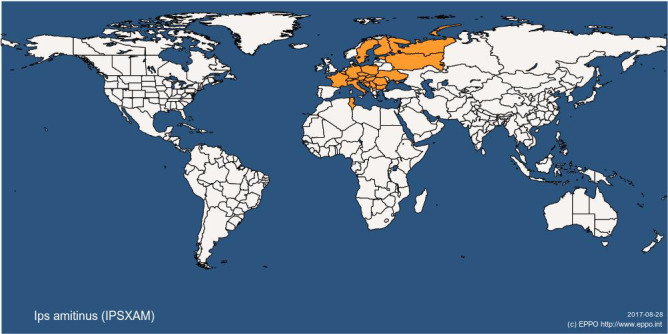
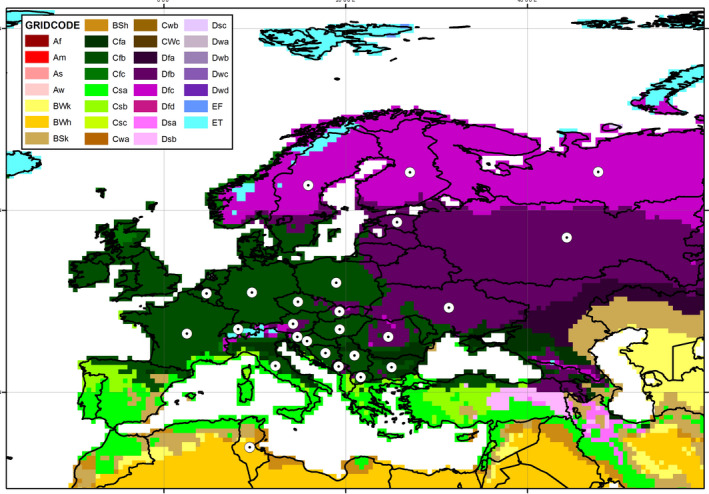
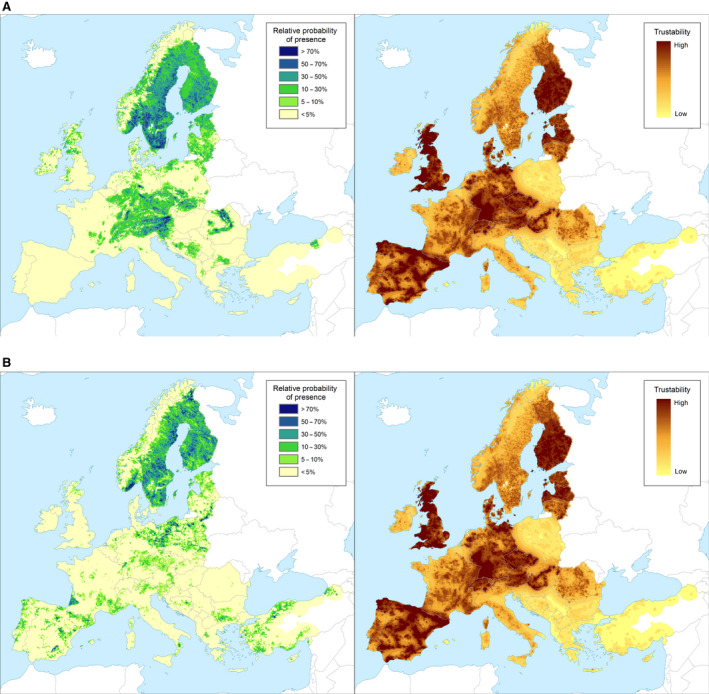
The Panel on Plant Health performed a pest categorisation of the small spruce bark beetle, (Eichhoff) (Coleoptera: Curculionidae, Scolytinae), for the EU. is a well-defined and distinguishable species, native to Europe and attacking mainly spruce ( spp.) and pine ( spp.) and sporadically fir ( spp.) and larch ( spp.). It is distributed in 16 EU Member States and is locally spreading in some. The pest is listed in Annex IIB of Council Directive 2000/29/EC. Protected zones are in place in Ireland, Greece and the United Kingdom. Wood, wood products, bark and wood packaging material are considered as pathways for this pest, which is also able to disperse by flight over tens of kilometres. The insects normally establish on fallen or weakened trees (e.g. after a fire or a drought) but can also occasionally mass-attack healthy trees, when population densities are high. The males produce pheromones that attract conspecifics of both sexes. Each male attracts one to seven females to establish a brood system; each female produces 1-60 offspring. The insects also inoculate their hosts with pathogenic fungi. There are one or two generations per year. The wide current geographic range of suggests that it is able to establish in most areas in the EU, including the protected zones, where its hosts are present. The damage due to is limited and usually does not require control. Sanitary thinning or clear-felling is the usual control methods, when necessary. Quarantine measures are implemented to prevent entry in protected zones. All criteria for consideration as a potential protected zone quarantine pest are met. The criteria for considering as a potential regulated non-quarantine pest are not met since plants for planting are not viewed as a pathway.
植物健康专家组针对欧盟对小云杉树皮甲虫(Eichhoff)(鞘翅目:象甲科,小蠹亚科)进行了有害生物分类。该物种定义明确且易于区分,原产于欧洲,主要侵害云杉(云杉属)和松树(松属),偶尔也会侵害冷杉(冷杉属)和落叶松(落叶松属)。它分布于16个欧盟成员国,且在一些国家呈局部扩散态势。该有害生物被列入理事会指令2000/29/EC的附件IIB。爱尔兰、希腊和英国设有保护区。木材、木制品、树皮和木质包装材料被视为该有害生物的传播途径,其还能通过飞行扩散数十公里。这些昆虫通常在倒伏或衰弱的树木上定殖(如火灾或干旱之后),但在种群密度较高时,偶尔也会大规模攻击健康树木。雄性会产生吸引两性同类的信息素。每只雄性会吸引1至7只雌性来建立繁殖系统;每只雌性会产下1至60只后代。这些昆虫还会将致病真菌接种到其寄主上。每年有一代或两代。目前广泛的地理分布范围表明,它能够在欧盟的大多数地区定殖,包括有其寄主存在的保护区。由该害虫造成的损害有限,通常无需防治。必要时,卫生疏伐或皆伐是常用的防治方法。实施检疫措施以防止其进入保护区。该害虫满足被视为潜在保护区检疫性有害生物的所有标准。由于不认为种植用植物是其传播途径,因此该害虫不满足被视为潜在管制的非检疫性有害生物的标准。