Younes Maged, Aggett Peter, Aguilar Fernando, Crebelli Riccardo, Dusemund Birgit, Filipič Metka, Frutos Maria Jose, Galtier Pierre, Gott David, Gundert-Remy Ursula, Kuhnle Gunter Georg, Lambré Claude, Leblanc Jean-Charles, Lillegaard Inger Therese, Moldeus Peter, Mortensen Alicja, Oskarsson Agneta, Stankovic Ivan, Waalkens-Berendsen Ine, Woutersen Rudolf Antonius, Andrade Raul J, Fortes Cristina, Mosesso Pasquale, Restani Patrizia, Pizzo Fabiola, Smeraldi Camilla, Wright Matthew
EFSA J. 2018 Aug 3;16(8):e05368. doi: 10.2903/j.efsa.2018.5368. eCollection 2018 Aug.
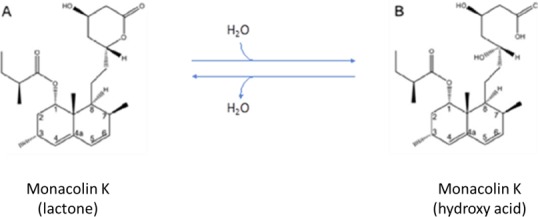
The Panel on Food Additives and Nutrient Sources added to Food (ANS) was asked to deliver a scientific opinion on the safety of monacolins in red yeast rice (RYR) and to provide advice on a dietary intake of monacolins that does not give rise to concerns about harmful effects to health. The Panel reviewed the scientific evidences available as well as the information provided by interested parties in response of a public 'Call for data' launched by EFSA. The Panel considered that monacolin K in lactone form is identical to lovastatin, the active ingredient of several medicinal products authorised for the treatment of hypercholesterolaemia in the EU. On the basis of the information available, the Panel concluded that intake of monacolins from RYR via food supplements, could lead to estimated exposure to monacolin K within the range of the therapeutic doses of lovastatin. The Panel considered that the available information on the adverse effects reported in humans were judged to be sufficient to conclude that monacolins from RYR when used as food supplements were of significant safety concern at the use level of 10 mg/day. The Panel further considered that individual cases of severe adverse reactions have been reported for monacolins from RYR at intake levels as low as 3 mg/day. The Panel concluded that exposure to monacolin K from RYR could lead to severe adverse effects on musculoskeletal system, including rhabdomyolysis, and on the liver. In the reported cases, the product contained other ingredients in addition to RYR. However, these reported effects in particular musculoskeletal effects, have both occurred after ingestion of monacolin K and lovastatin independently. On the basis of the information available and several uncertainties highlighted in this opinion, the Panel was unable to identify a dietary intake of monacolins from RYR that does not give rise to concerns about harmful effects to health, for the general population, and as appropriate, for vulnerable subgroups of the population.
食品添加剂及营养源添加物专家委员会(ANS)被要求就红曲米(RYR)中莫纳可林的安全性发表科学意见,并就不会引起健康有害影响担忧的莫纳可林膳食摄入量提供建议。该专家委员会审查了现有科学证据以及利益相关方针对欧洲食品安全局发起的“数据征集”所提供的信息。专家委员会认为内酯形式的莫纳可林K与洛伐他汀相同,洛伐他汀是欧盟批准用于治疗高胆固醇血症的几种药品的活性成分。根据现有信息,专家委员会得出结论,通过食品补充剂从红曲米中摄入莫纳可林,可能导致莫纳可林K的估计暴露量处于洛伐他汀治疗剂量范围内。专家委员会认为,关于人类报告的不良反应的现有信息足以得出结论,即红曲米中的莫纳可林用作食品补充剂时,在10毫克/天的使用水平下存在重大安全问题。专家委员会进一步认为,已报告红曲米中的莫纳可林在低至3毫克/天的摄入水平下出现个别严重不良反应病例。专家委员会得出结论,从红曲米中接触莫纳可林K可能会对肌肉骨骼系统(包括横纹肌溶解)和肝脏产生严重不良反应。在报告的病例中,产品除红曲米外还含有其他成分。然而,这些报告的影响,特别是肌肉骨骼影响,在摄入莫纳可林K和洛伐他汀后均独立发生。基于现有信息以及本意见中强调的若干不确定性,专家委员会无法确定红曲米中莫纳可林的膳食摄入量,该摄入量不会引起对一般人群以及适当时对该人群的脆弱亚组的健康有害影响的担忧。