Langerholc T, Lindqvist R, Sand S
EFSA J. 2018 Aug 27;16(Suppl 1):e160813. doi: 10.2903/j.efsa.2018.e160813. eCollection 2018 Aug.
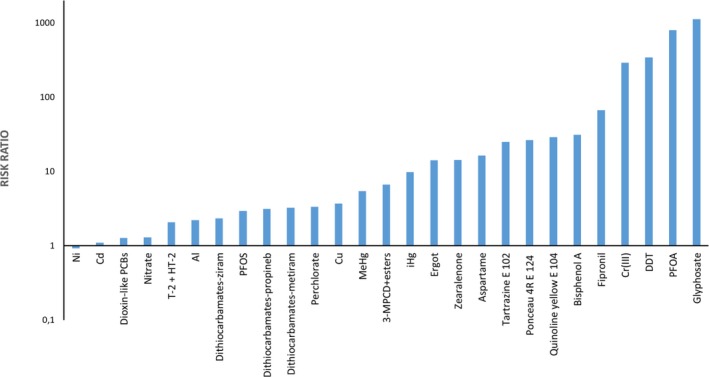
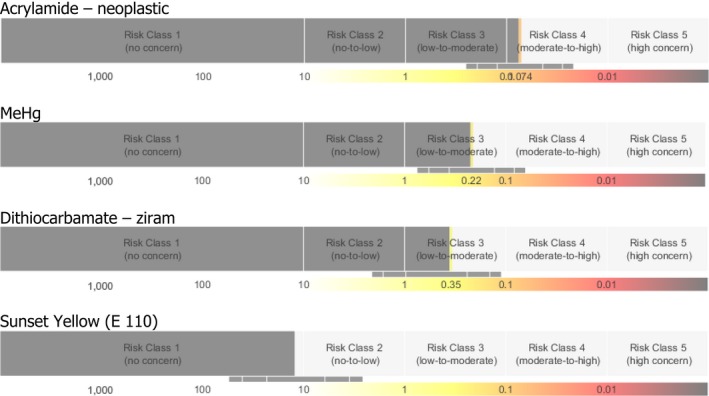
Risk ranking is a versatile tool used to prioritise activities performed by public health regulatory bodies. It also allows efficient communication between all stakeholders in the process of risk analysis. However, risk ranking methods are still not optimal. Because of the different approaches employed in the risk assessment of microbiological agents and chemicals, it is difficult to rank them together using the same metrics. In our work, we first discuss differences and commonalities between chemical and microbiological risk assessment to provide a starting point for consideration of a common risk ranking platform. In the second part, we perform risk ranking of contaminants and regulated chemicals using the recently developed Risk Thermometer tool. In this approach, chemicals are not ranked solely on the basis of the margin of exposure between a reference value and the exposure, but also by considering the severity of the critical health effects used. The results show that ranking using both methods provides different results from the use of either method alone. Overall, specific chemical groups (i.e. heavy metals, pesticides, etc.) do not generally rank higher or lower, but individual compounds are scattered in the rankings from low to high. Risk ranking methods demand further development to gain wide acceptability and recognition.
风险排序是一种通用工具,用于对公共卫生监管机构开展的活动进行优先级排序。它还能在风险分析过程中实现所有利益相关方之间的有效沟通。然而,风险排序方法仍未达到最优。由于微生物制剂和化学物质的风险评估采用了不同方法,因此很难使用相同的指标对它们进行统一排序。在我们的工作中,我们首先讨论化学和微生物风险评估之间的差异和共性,为考虑建立一个通用的风险排序平台提供出发点。在第二部分中,我们使用最近开发的风险温度计工具对污染物和受监管化学品进行风险排序。在这种方法中,化学品的排序不仅基于参考值与暴露量之间的暴露边际,还考虑所使用的关键健康影响的严重程度。结果表明,两种方法结合使用得出的排序结果与单独使用任何一种方法都不同。总体而言,特定化学类别(如重金属、农药等)通常不会普遍排名更高或更低,但个别化合物在排序中从低到高分散分布。风险排序方法需要进一步发展,以获得广泛的可接受性和认可度。