Ricco Anthony, Slade Alexander, Canada Justin M, Grizzard John, Dana Franklin, Rezai Gharai Leila, Neiderer Keith, Vera Armando, Abbate Antonio, Weiss Elisabeth
Department of Radiation Oncology, Virginia Commonwealth University Health System, 401 College Street, Richmond, VA 23298 USA.
Department of Cardiology, Virginia Commonwealth University Health System, Richmond, VA USA.
Cardiooncology. 2020 Jul 1;6:6. doi: 10.1186/s40959-020-00061-z. eCollection 2020.
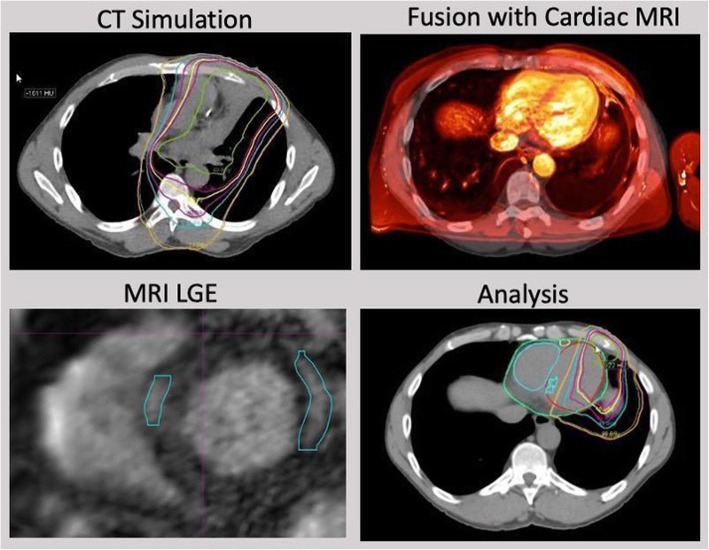
Radiotherapy has been associated with late dose-dependent cardiovascular toxicity. In this cross-sectional pilot study, radiation dose distributions were correlated with areas of localized and diffuse myocardial fibrosis as measured by novel cardiac MRI (CMR) sequences including late gadolinium enhancement (LGE) and T1 mapping with the goal to identify early markers of myocardial damage.
Twenty-eight patients with chest tumors including lung, breast, esophagus, and lymphoma underwent CMR per study protocol on average 46.4 months (range 1.7-344.5) after radiotherapy. Patients without pretreatment cardiac history were included if the volume of heart receiving 5 Gy or more was at least 10% (V5Gy ≥ 10%). The association of LGE with cardiac dosimetric factors, clinical factors (e.g., tumor type, smoking history, BMI), and T1 values was analyzed.
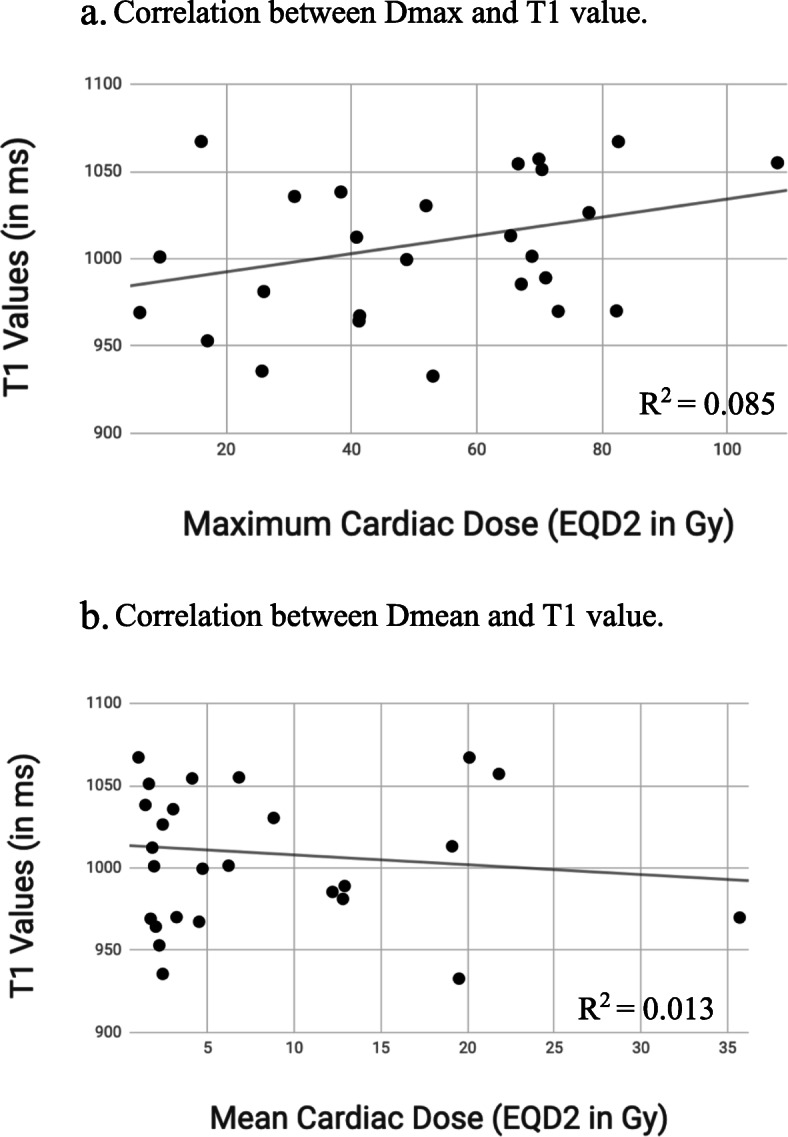
Cardiac maximum (Dmax) and mean dose (Dmean) equivalent to doses delivered in 2 Gy fractions (EQD2) were on average 50.9 Gy (range 6.2-108.0) and 8.2 Gy (range 1.0-35.7), respectively, compared to 60.8 Gy (40.8-108.0) and 6.8 Gy (1.8-21.8) among the 9 patients with LGE. Doses were not different between patients with and without LGE ( = 0.16 and 0.56, respectively). The average T1 value of the left ventricle myocardium was 1009 ms (range 933-1117). No significant correlation was seen for heart Dmax and Dmean and T1 values ( = 0.14 and 0.58, respectively). In addition, no significant association between clinical factors and the development of LGE was identified.
No relation between cardiac doses, the presence of LGE or T1 values was observed. Further study is needed to determine the benefit of CMR for detecting radiotherapy-related myocardial fibrosis.
放射治疗与晚期剂量依赖性心血管毒性相关。在这项横断面试点研究中,通过新型心脏磁共振成像(CMR)序列(包括延迟钆增强(LGE)和T1映射)测量的放射剂量分布与局部和弥漫性心肌纤维化区域相关,目的是识别心肌损伤的早期标志物。
28例患有胸部肿瘤(包括肺癌、乳腺癌、食管癌和淋巴瘤)的患者按照研究方案在放疗后平均46.4个月(范围1.7 - 344.5个月)接受CMR检查。如果接受5 Gy或更高剂量照射的心脏体积至少为10%(V5Gy≥10%),则纳入无预处理心脏病史的患者。分析LGE与心脏剂量学因素、临床因素(如肿瘤类型、吸烟史、体重指数)和T1值之间的关联。
与9例出现LGE的患者相比,相当于2 Gy分次剂量的心脏最大剂量(Dmax)和平均剂量(Dmean)(EQD2)平均分别为50.9 Gy(范围6.2 - 108.0)和8.2 Gy(范围1.0 - 35.7),而这9例患者的相应剂量分别为60.8 Gy(40.8 - 108.0)和6.8 Gy(1.8 - 21.8)。有LGE和无LGE的患者之间剂量无差异(分别为 = 0.16和0.56)。左心室心肌的平均T1值为1009 ms(范围933 - 1117)。未观察到心脏Dmax和Dmean与T1值之间存在显著相关性(分别为 = 0.14和0.58)。此外,未发现临床因素与LGE的发生之间存在显著关联。
未观察到心脏剂量、LGE的存在或T1值之间存在关联。需要进一步研究以确定CMR在检测放疗相关心肌纤维化方面的益处。