Park Young Sik, Park Sangshin, Lee Chang-Hoon
Division of Pulmonary and Critical Care Medicine, Department of Internal Medicine, Seoul National University Hospital, Seoul, Korea.
Department of Pediatrics, Center for International Health Research, Rhode Island Hospital, The Warren Alpert Medical School of Brown University, Providence, RI, USA.
Tuberc Respir Dis (Seoul). 2020 Oct;83(4):268-275. doi: 10.4046/trd.2020.0006. Epub 2020 Jul 6.
It is not evident that the attributable risk of smoking on mortality in Korea has decreased. We investigated the impact of smoking on all-cause mortality and estimated the attributable risk of smoking in Korean adults.
Those aged ≥20 years with smoking history in the Korean National Health and Nutrition Examination Surveys (KNHANES) 2007-2015 were enrolled. We categorized the participants into three groups as follows: never smoker, <20 pack-years (PY) smokers, and ≥20 PY smokers. We applied inverse probability weighting using propensity scores to control various confounders between the groups. All-cause mortality risks were compared between the groups using the Kaplan-Meier log-rank test. The effects of smoking-attributable risks (ARs) on mortality were also calculated.
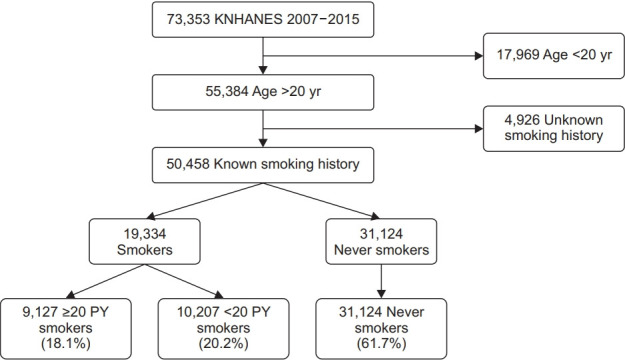
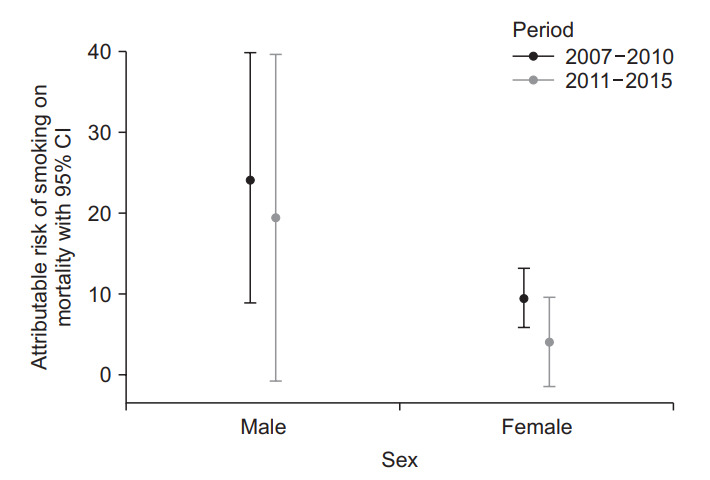
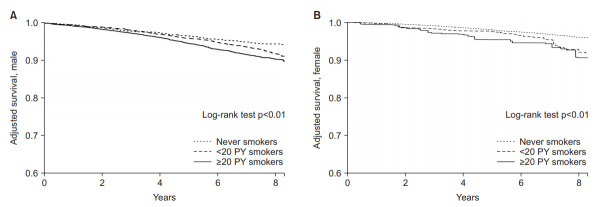
A total of 50,458 participants were included. Among them, 19,334 (38.3%) were smokers and 31,124 (61.7%) were never smokers. Those with a smoking history of 20 PY or more (≥20 PY smokers), those with a smoking history of less than 20 PY (<20 PY smokers), and never smokers were 18.1%, 20.2%, and 61.7%, respectively, of the study population. Smokers had a higher risk of all-cause mortality compared to never smokers (log-rank test p<0.01). The ARs of smoking were 21.8% (95% confidence interval [CI], 5.7%-37.9%) and 9.0% (95% CI, 6.1%-12.0%) in males and females, respectively. ARs decreased from 24.2% to 19.5% in males and from 9.5% to 4.1% in females between 2007-2010 and 2011-2015.
Our study using KNHANES IV-VI data demonstrated that smoking increased the risk of all-cause mortality in a dose-response manner and the ARs of smoking on mortality were 21.8% in males and 9.0% in females during 2007- 2015. This suggests that the ARs of smoking on mortality have decreased since around 2010.
在韩国,吸烟对死亡率的归因风险是否降低尚不明确。我们调查了吸烟对全因死亡率的影响,并估计了韩国成年人中吸烟的归因风险。
纳入2007 - 2015年韩国国民健康与营养检查调查(KNHANES)中有吸烟史且年龄≥20岁的人群。我们将参与者分为三组:从不吸烟者、吸烟量<20包年(PY)者和吸烟量≥20 PY者。我们使用倾向得分进行逆概率加权,以控制各组之间的各种混杂因素。使用Kaplan - Meier对数秩检验比较各组之间的全因死亡风险。还计算了吸烟归因风险(ARs)对死亡率的影响。
共纳入50458名参与者。其中,19334名(38.3%)为吸烟者,31124名(61.7%)为从不吸烟者。吸烟史达20 PY或以上者(≥20 PY吸烟者)、吸烟史少于20 PY者(<20 PY吸烟者)和从不吸烟者分别占研究人群的18.1%、20.2%和61.7%。与从不吸烟者相比,吸烟者的全因死亡风险更高(对数秩检验p<0.01)。男性和女性吸烟的ARs分别为21.8%(95%置信区间[CI],5.7% - 37.9%)和9.0%(95% CI,6.1% - 12.0%)。2007 - 2010年至2011 - 2015年期间,男性的ARs从24.2%降至19.5%,女性从9.5%降至4.1%。
我们使用KNHANES IV - VI数据的研究表明,吸烟以剂量反应方式增加全因死亡风险,2007 - 2015年期间吸烟对死亡率的ARs男性为21.8%,女性为9.0%。这表明自2010年左右以来,吸烟对死亡率的ARs有所下降。