• 文献检索
  • 文档翻译
  • 深度研究
  • 学术资讯
  • Suppr Zotero 插件Zotero 插件
  • 邀请有礼
  • 套餐&价格
  • 历史记录
应用&插件
Suppr Zotero 插件Zotero 插件浏览器插件Mac 客户端Windows 客户端微信小程序
定价
高级版会员购买积分包购买API积分包
服务
文献检索文档翻译深度研究API 文档MCP 服务
关于我们
关于 Suppr公司介绍联系我们用户协议隐私条款
关注我们

Suppr 超能文献

核心技术专利:CN118964589B侵权必究
粤ICP备2023148730 号-1Suppr @ 2026

文献检索

告别复杂PubMed语法,用中文像聊天一样搜索,搜遍4000万医学文献。AI智能推荐,让科研检索更轻松。

立即免费搜索

文件翻译

保留排版,准确专业,支持PDF/Word/PPT等文件格式,支持 12+语言互译。

免费翻译文档

深度研究

AI帮你快速写综述,25分钟生成高质量综述,智能提取关键信息,辅助科研写作。

立即免费体验

缺血性卒中后新发房颤的风险分层评分系统:一项全国队列研究。

A risk stratification scoring system for new-onset atrial fibrillation after ischemic stroke: A National cohort study.

作者信息

Chen Yung-Lung, Wang Hui-Ting, Chen Huang-Chung, Liu Wen-Hao, Hsueh Shukai, Chung Wen-Jung, Wu Po-Jui, Liu Chi-Hung, Chung Chang-Ming, Lin Yu-Sheng

机构信息

Division of Cardiology and Department of Internal Medicine, Kaohsiung Chang Gung Memorial Hospital, Chang Gung University College of Medicine.

Graduate Institute of Clinical Medical Sciences, College of Medicine, Chang Gung University.

出版信息

Medicine (Baltimore). 2020 Jul 2;99(27):e20881. doi: 10.1097/MD.0000000000020881.

DOI:10.1097/MD.0000000000020881
PMID:32629677
原文链接:https://pmc.ncbi.nlm.nih.gov/articles/PMC7337555/
Abstract

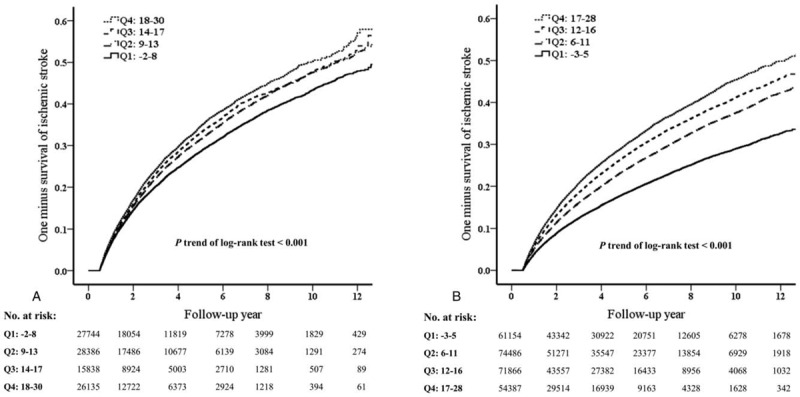
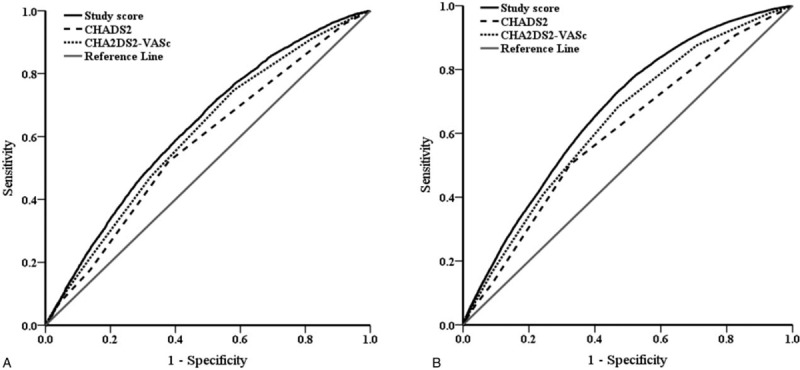
Atrial fibrillation (AF) is a major independent risk factor of stroke and anticoagulation therapy is needed in patients with AF after ischemic stroke. However, the detection rate of AF is low after ischemic stroke. Developing a prediction model for newly diagnosed AF after ischemic stroke will help to assess the subclinical AF.We identified 98,103 patients with diabetes mellitus (DM) and 261,893 patients without DM, who were not AF history and admitted for newly ischemic stroke from the National Health Insurance Research Database in Taiwan. The prediction model for 3-year incidence of AF after ischemic stroke was derived from multivariate logistic regression and also the accuracy rate of the prediction model was compared with CHA2DS2-VASC and CHADS2 scores as a reference.Four thousand nine hundred seventy six patients in the DM cohort and 16,127 patients in the non-DM cohort developed AF during 3 years of follow-up. The variables in the point-based prediction model for non-DM patients (range: -3-28), included age, heart failure, coronary artery disease, gout, obstructive pulmonary disease, hypertension, female, and statin use, while those for DM patients (range: -2-30) included age, heart failure, coronary artery disease, chronic kidney disease, hypertension, obstructive pulmonary disease, and statin use. Compared to the CHADS2 and CHA2DS2-VASc scoring systems, this scoring system was better at predicting 3-year risk of AF after ischemic stroke in both cohorts.This model might be useful in evaluating the benefit of insertable cardiac monitor implantation and anticoagulation agents in individual patients after ischemic stroke.

摘要

心房颤动(AF)是卒中的主要独立危险因素,缺血性卒中后房颤患者需要进行抗凝治疗。然而,缺血性卒中后房颤的检出率较低。建立缺血性卒中后新诊断房颤的预测模型将有助于评估亚临床房颤。我们从台湾国民健康保险研究数据库中识别出98103例糖尿病(DM)患者和261893例非糖尿病患者,这些患者均无房颤病史且因新发缺血性卒中入院。缺血性卒中后房颤3年发病率的预测模型来自多因素逻辑回归分析,并将该预测模型的准确率与CHA2DS2-VASC和CHADS2评分进行比较作为参考。糖尿病队列中的4976例患者和非糖尿病队列中的16127例患者在3年随访期间发生了房颤。非糖尿病患者基于点数的预测模型(范围:-3至28)中的变量包括年龄、心力衰竭、冠状动脉疾病、痛风、阻塞性肺疾病、高血压、女性和他汀类药物使用情况,而糖尿病患者(范围:-2至30)的变量包括年龄、心力衰竭、冠状动脉疾病、慢性肾脏疾病、高血压、阻塞性肺疾病和他汀类药物使用情况。与CHADS2和CHA2DS2-VASc评分系统相比,该评分系统在预测两个队列缺血性卒中后房颤3年风险方面表现更佳。该模型可能有助于评估缺血性卒中后个体患者植入式心脏监测器植入和抗凝药物的获益情况。
https://cdn.ncbi.nlm.nih.gov/pmc/blobs/e007/7337555/4f84670dbb27/medi-99-e20881-g005.jpg
https://cdn.ncbi.nlm.nih.gov/pmc/blobs/e007/7337555/4ae5e88a77cc/medi-99-e20881-g002.jpg
https://cdn.ncbi.nlm.nih.gov/pmc/blobs/e007/7337555/4f84670dbb27/medi-99-e20881-g005.jpg
https://cdn.ncbi.nlm.nih.gov/pmc/blobs/e007/7337555/4ae5e88a77cc/medi-99-e20881-g002.jpg
https://cdn.ncbi.nlm.nih.gov/pmc/blobs/e007/7337555/4f84670dbb27/medi-99-e20881-g005.jpg

相似文献

1
A risk stratification scoring system for new-onset atrial fibrillation after ischemic stroke: A National cohort study.缺血性卒中后新发房颤的风险分层评分系统:一项全国队列研究。
Medicine (Baltimore). 2020 Jul 2;99(27):e20881. doi: 10.1097/MD.0000000000020881.
2
The HAS-BLED score has better prediction accuracy for major bleeding than CHADS2 or CHA2DS2-VASc scores in anticoagulated patients with atrial fibrillation.在接受抗凝治疗的房颤患者中,HAS-BLED 评分对大出血的预测准确性优于 CHADS2 或 CHA2DS2-VASc 评分。
J Am Coll Cardiol. 2013 Dec 10;62(23):2199-204. doi: 10.1016/j.jacc.2013.08.1623. Epub 2013 Sep 18.
3
CHADS-VASc Score (Congestive Heart Failure, Hypertension, Age ≥75 [Doubled], Diabetes Mellitus, Prior Stroke or Transient Ischemic Attack [Doubled], Vascular Disease, Age 65-74, Female) for Stroke in Asian Patients With Atrial Fibrillation: A Korean Nationwide Sample Cohort Study.亚洲房颤患者卒中的CHADS-VASc评分(充血性心力衰竭、高血压、年龄≥75岁[加倍]、糖尿病、既往卒中或短暂性脑缺血发作[加倍]、血管疾病、年龄65 - 74岁、女性):一项韩国全国性样本队列研究。
Stroke. 2017 Jun;48(6):1524-1530. doi: 10.1161/STROKEAHA.117.016926. Epub 2017 Apr 28.
4
Patients With Ischemic Stroke and Incident Atrial Fibrillation: A Nationwide Cohort Study.缺血性中风与新发房颤患者:一项全国性队列研究。
Stroke. 2015 Sep;46(9):2432-7. doi: 10.1161/STROKEAHA.115.010270. Epub 2015 Aug 6.
5
Incidence and prediction of ischemic stroke among atrial fibrillation patients with end-stage renal disease requiring dialysis.需要透析的终末期肾病房颤患者缺血性卒中的发病率及预测
Heart Rhythm. 2014 Oct;11(10):1752-9. doi: 10.1016/j.hrthm.2014.06.021. Epub 2014 Jun 18.
6
Comparisons of CHADS2 and CHA2DS2-VASc scores for stroke risk stratification in atrial fibrillation: Which scoring system should be used for Asians?用于心房颤动中风风险分层的CHADS2和CHA2DS2-VASc评分比较:亚洲人应使用哪种评分系统?
Heart Rhythm. 2016 Jan;13(1):46-53. doi: 10.1016/j.hrthm.2015.08.017. Epub 2015 Aug 12.
7
Assessment of the CHA2DS2-VASc Score in Predicting Ischemic Stroke, Thromboembolism, and Death in Patients With Heart Failure With and Without Atrial Fibrillation.评估 CHA2DS2-VASc 评分在伴有和不伴有心房颤动的心力衰竭患者中预测缺血性卒、血栓栓塞和死亡的价值。
JAMA. 2015 Sep 8;314(10):1030-8. doi: 10.1001/jama.2015.10725.
8
Should atrial fibrillation patients with 1 additional risk factor of the CHA2DS2-VASc score (beyond sex) receive oral anticoagulation?对于 CHA2DS2-VASc 评分(除性别以外)有 1 个额外危险因素的房颤患者,是否应接受口服抗凝治疗?
J Am Coll Cardiol. 2015 Feb 24;65(7):635-42. doi: 10.1016/j.jacc.2014.11.046.
9
C HEST Score and Prediction of Incident Atrial Fibrillation in Poststroke Patients: A French Nationwide Study.CHEST 评分与中风后患者心房颤动事件的预测:一项法国全国性研究。
J Am Heart Assoc. 2019 Jul 2;8(13):e012546. doi: 10.1161/JAHA.119.012546. Epub 2019 Jun 25.
10
Stroke risk in hypertrophic cardiomyopathy patients with atrial fibrillation: a nationwide database study.肥厚型心肌病伴心房颤动患者的卒中风险:全国数据库研究。
Aging (Albany NY). 2020 Nov 23;12(23):24219-24227. doi: 10.18632/aging.104133.

引用本文的文献

1
Prevalence of atrial fibrillation in ischemic stroke and associated risk factors: A hospital-based study in Indonesia.缺血性卒中中心房颤动的患病率及相关危险因素:印度尼西亚一项基于医院的研究。
Brain Circ. 2024 Dec 28;10(4):316-323. doi: 10.4103/bc.bc_36_24. eCollection 2024 Oct-Dec.
2
Automated risk assessment of newly detected atrial fibrillation poststroke from electronic health record data using machine learning and natural language processing.利用机器学习和自然语言处理技术,通过电子健康记录数据对中风后新检测出的心房颤动进行自动风险评估。
Front Cardiovasc Med. 2022 Jul 29;9:941237. doi: 10.3389/fcvm.2022.941237. eCollection 2022.
3

本文引用的文献

1
Rivaroxaban for Stroke Prevention after Embolic Stroke of Undetermined Source.利伐沙班预防来源不明的栓塞性卒中后卒中
N Engl J Med. 2018 Jun 7;378(23):2191-2201. doi: 10.1056/NEJMoa1802686. Epub 2018 May 16.
2
The 2018 European Heart Rhythm Association Practical Guide on the use of non-vitamin K antagonist oral anticoagulants in patients with atrial fibrillation: executive summary.2018 年欧洲心脏病学会实用指南:非维生素 K 拮抗剂口服抗凝剂在心房颤动患者中的应用:执行摘要。
Europace. 2018 Aug 1;20(8):1231-1242. doi: 10.1093/europace/euy054.
3
Safety and efficacy of persistent atrial fibrillation ablation using the second-generation cryoballoon.
Validation of Risk Scores for Predicting Atrial Fibrillation Detected After Stroke Based on an Electronic Medical Record Algorithm: A Registry-Claims-Electronic Medical Record Linked Data Study.
基于电子病历算法预测卒中后检测到的心房颤动的风险评分验证:一项登记-索赔-电子病历关联数据研究。
Front Cardiovasc Med. 2022 Apr 29;9:888240. doi: 10.3389/fcvm.2022.888240. eCollection 2022.
4
Colchicine Use and Risks of Stroke Recurrence in Acute Non-Cardiogenic Ischemic Stroke Patients: A Population-Based Cohort Study.秋水仙碱在急性非心源性缺血性卒中患者中的应用与卒中复发风险:一项基于人群的队列研究。
J Pers Med. 2021 Sep 19;11(9):935. doi: 10.3390/jpm11090935.
使用第二代冷冻球囊进行持续性心房颤动消融的安全性和有效性。
Clin Res Cardiol. 2018 Jul;107(7):570-577. doi: 10.1007/s00392-018-1219-1. Epub 2018 Feb 28.
4
Combined Cryoballoon and Radiofrequency Ablation Versus Radiofrequency Ablation Alone for Long-Standing Persistent Atrial Fibrillation.联合冷冻球囊与射频消融术对比单纯射频消融术治疗长期持续性心房颤动
Am J Med Sci. 2017 Dec;354(6):586-596. doi: 10.1016/j.amjms.2017.08.010. Epub 2017 Aug 19.
5
Incidence and risk factors of atrial fibrillation in Asian COPD patients.亚洲慢性阻塞性肺疾病患者心房颤动的发病率及危险因素
Int J Chron Obstruct Pulmon Dis. 2017 Aug 23;12:2523-2530. doi: 10.2147/COPD.S143691. eCollection 2017.
6
Incidence of Previously Undiagnosed Atrial Fibrillation Using Insertable Cardiac Monitors in a High-Risk Population: The REVEAL AF Study.使用可植入式心脏监测器在高危人群中检测到先前未诊断的心房颤动的发生率:REVEAL AF 研究。
JAMA Cardiol. 2017 Oct 1;2(10):1120-1127. doi: 10.1001/jamacardio.2017.3180.
7
Different Implications of Heart Failure, Ischemic Stroke, and Mortality Between Nonvalvular Atrial Fibrillation and Atrial Flutter-a View From a National Cohort Study.非瓣膜性心房颤动与心房扑动之间心力衰竭、缺血性卒中及死亡率的不同影响——一项全国队列研究的视角
J Am Heart Assoc. 2017 Jul 21;6(7):e006406. doi: 10.1161/JAHA.117.006406.
8
The CHADS and CHADS-VASc scores predict atrial fibrillation in dyslipidemic individuals: Role of incorporating low high-density lipoprotein cholesterol levels.CHADS和CHADS-VASc评分可预测血脂异常个体的房颤:纳入低高密度脂蛋白胆固醇水平的作用。
Int J Cardiol. 2017 Aug 15;241:194-199. doi: 10.1016/j.ijcard.2017.04.062. Epub 2017 Apr 20.
9
Holter-electrocardiogram-monitoring in patients with acute ischaemic stroke (Find-AF): an open-label randomised controlled trial.急性缺血性脑卒中患者的动态心电图监测(Find-AF):一项开放标签随机对照试验。
Lancet Neurol. 2017 Apr;16(4):282-290. doi: 10.1016/S1474-4422(17)30002-9. Epub 2017 Feb 8.
10
2016 ESC Guidelines for the management of atrial fibrillation developed in collaboration with EACTS.2016年欧洲心脏病学会(ESC)与欧洲心胸外科学会(EACTS)合作制定的心房颤动管理指南。
Europace. 2016 Nov;18(11):1609-1678. doi: 10.1093/europace/euw295. Epub 2016 Aug 27.