Division of Cell Biology, Histology and Embryology, Gottfried Schatz Research Center, Medical University of Graz, Neue Stiftingtalstraße 6, F/03/38, 8010 Graz, Austria.
Int J Mol Sci. 2020 Jun 30;21(13):4666. doi: 10.3390/ijms21134666.
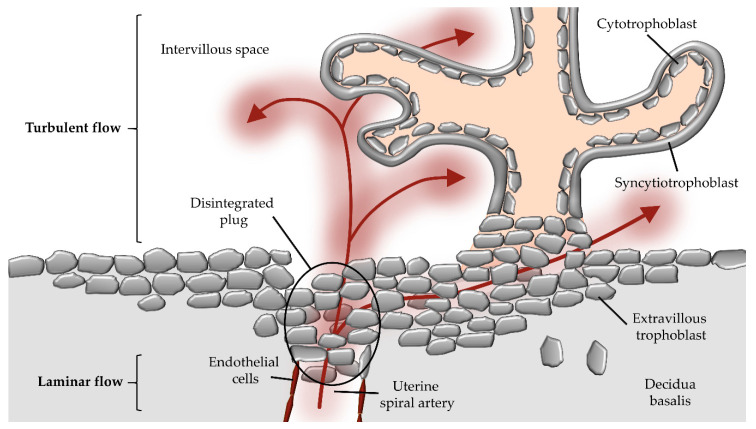
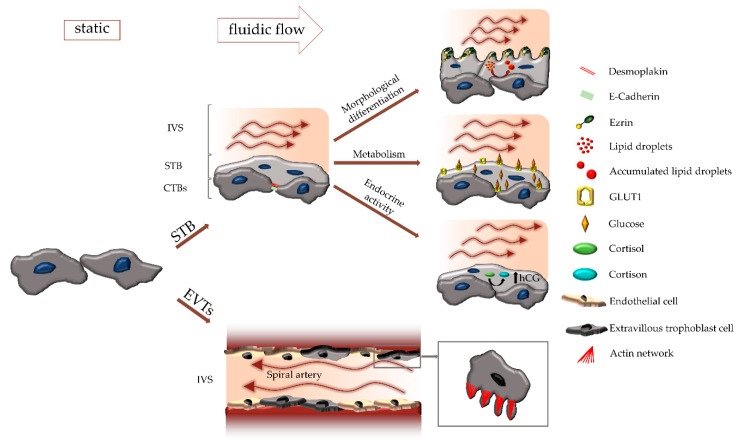
With establishment of uteroplacental blood flow, the perfused fetal chorionic tissue has to deal with fluid shear stress that is produced by hemodynamic forces across different trophoblast subtypes. Amongst many other cell types, trophoblasts are able to sense fluid shear stress through mechanotransduction. Failure in the adaption of trophoblasts to fluid shear stress is suggested to contribute to pregnancy disorders. Thus, in the past twenty years, a significant body of work has been devoted to human- and animal-derived trophoblast culture under microfluidic conditions, using a rather broad range of different fluid shear stress values as well as various different flow systems, ranging from commercially 2D to customized 3D flow culture systems. The great variations in the experimental setup reflect the general heterogeneity in blood flow through different segments of the uteroplacental circulation. While fluid shear stress is moderate in invaded uterine spiral arteries, it drastically declines after entrance of the maternal blood into the wide cavity of the intervillous space. Here, we provide an overview of the increasing body of evidence that substantiates an important influence of maternal blood flow on several aspects of trophoblast physiology, including cellular turnover and differentiation, trophoblast metabolism, as well as endocrine activity, and motility. Future trends in trophoblast flow culture will incorporate the physiological low oxygen conditions in human placental tissue and pulsatile blood flow in the experimental setup. Investigation of trophoblast mechanotransduction and development of mechanosome modulators will be another intriguing future direction.
随着子宫胎盘血流的建立,灌注的胎儿绒毛组织必须应对跨不同滋养层亚型的血液动力产生的流体剪切力。在许多其他细胞类型中,滋养层能够通过机械转导来感知流体剪切力。滋养层不能适应流体剪切力被认为是导致妊娠疾病的原因之一。因此,在过去的二十年中,人们致力于在微流控条件下培养人源和动物源的滋养层,使用了相当广泛的不同流体剪切力值以及各种不同的流动系统,从商业上的 2D 到定制的 3D 流动培养系统。实验设置的巨大差异反映了不同子宫胎盘循环段的血流的普遍异质性。虽然在侵入性的子宫螺旋动脉中,流体剪切力适中,但在母体血液进入绒毛间隙的宽阔腔后,它会急剧下降。在这里,我们概述了越来越多的证据,这些证据证实了母体血流对滋养层生理学的几个方面的重要影响,包括细胞更新和分化、滋养层代谢以及内分泌活动和运动。滋养层流动培养的未来趋势将包括人类胎盘组织中的生理低氧条件和实验设置中的脉动血流。对滋养层机械转导的研究和机械体调节剂的开发将是另一个有趣的未来方向。