Department of Bioenergetics, Adam Mickiewicz University, 61-614 Poznan, Poland.
Department of Physics and Biophysics, Institute of Biology, Warsaw University of Life Sciences-SGGW, 02-776 Warsaw, Poland.
Molecules. 2020 Jun 30;25(13):3010. doi: 10.3390/molecules25133010.
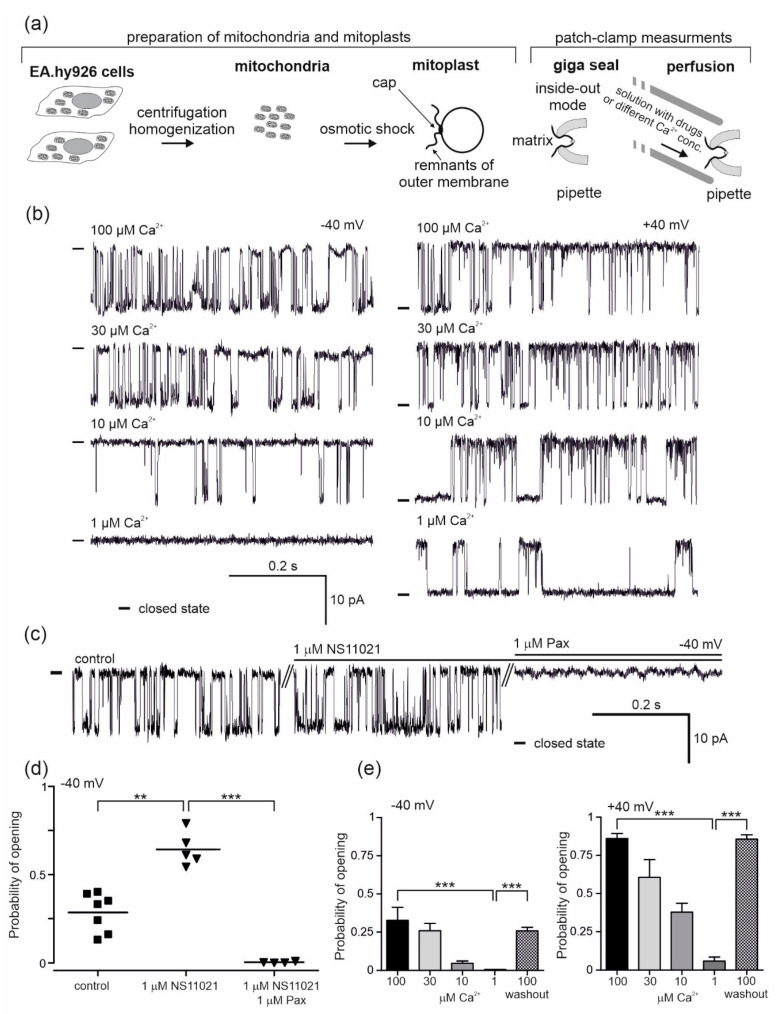
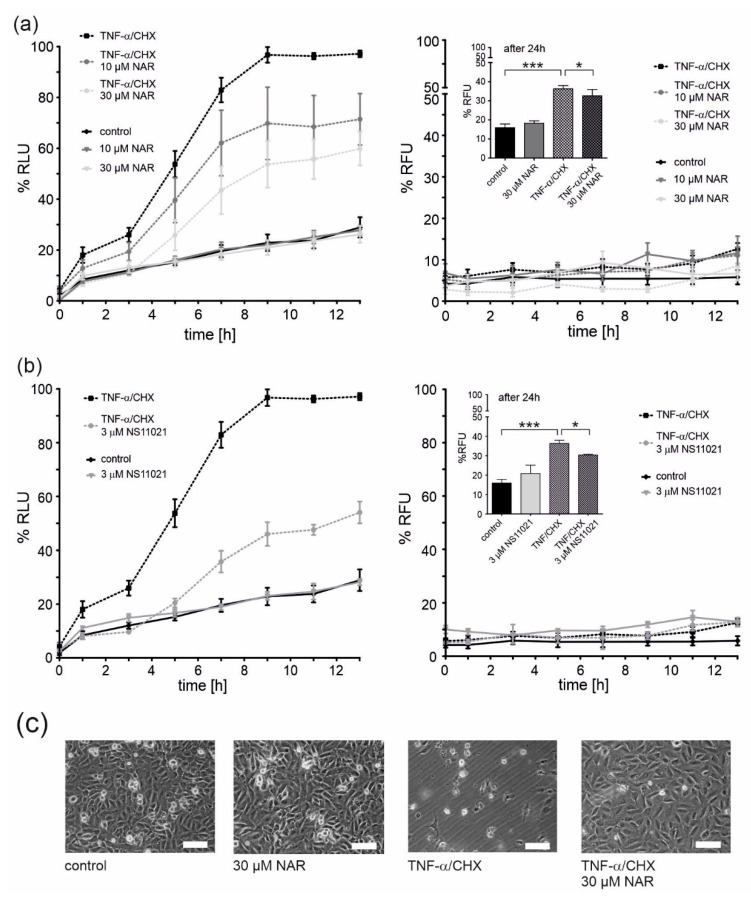
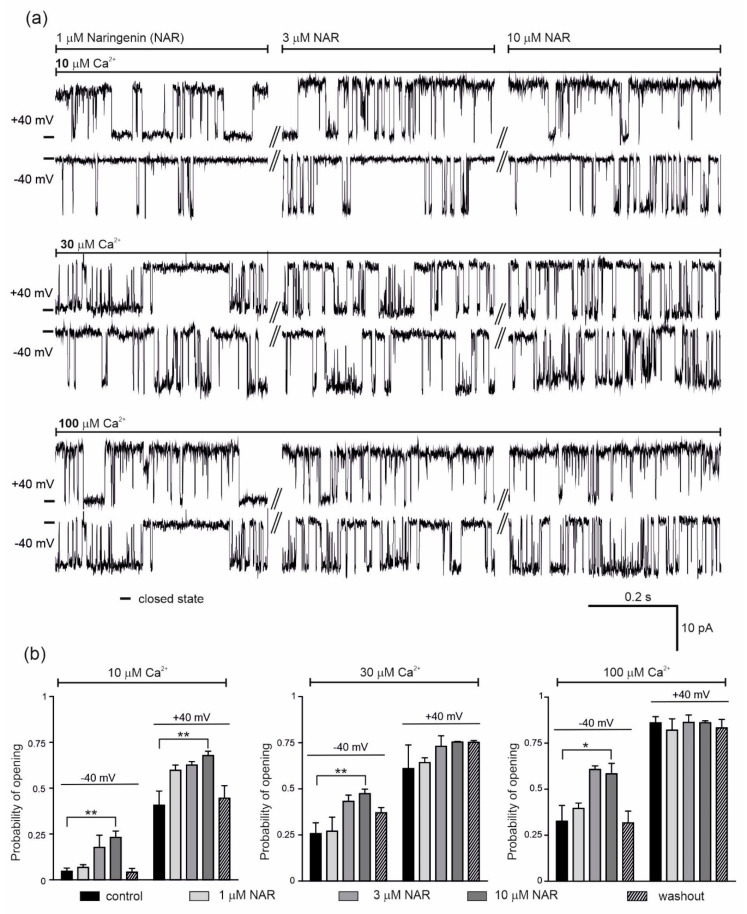
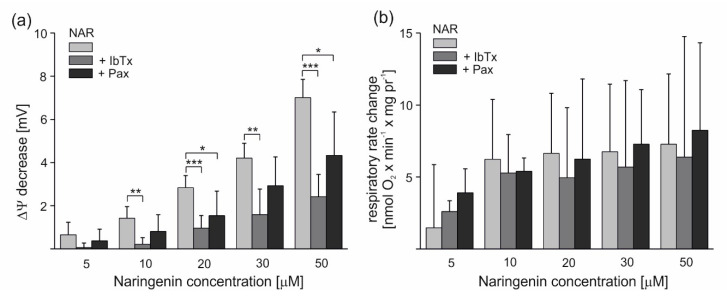
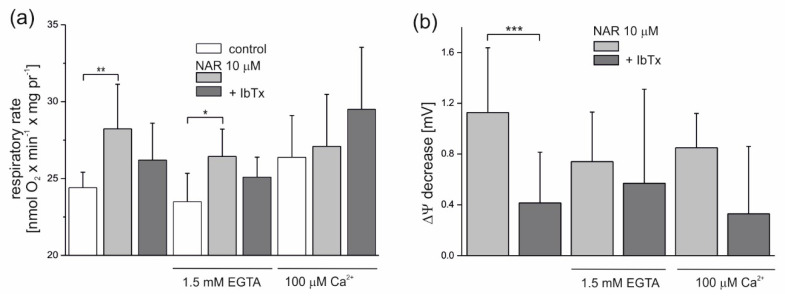
Naringenin, a flavanone obtained from citrus fruits and present in many traditional Chinese herbal medicines, has been shown to have various beneficial effects on cells both in vitro and in vivo. Although the antioxidant activity of naringenin has long been believed to be crucial for its effects on cells, mitochondrial pathways (including mitochondrial ion channels) are emerging as potential targets for the specific pharmacological action of naringenin in cardioprotective strategies. In the present study, we describe interactions between the mitochondrial large-conductance calcium-regulated potassium channel (mitoBK channel) and naringenin. Using the patch-clamp method, we showed that 10 µM naringenin activated the mitoBK channel present in endothelial cells. In the presence of 30 µM Ca, the increase in the mitoBK channel probability of opening from approximately 0.25 to 0.50 at -40 mV was observed. In addition, regulation of the mitoBK channel by naringenin was dependent on the concentration of calcium ions. To confirm our data, physiological studies on the mitochondria were performed. An increase in oxygen consumption and a decrease in membrane potential was observed after naringenin treatment. In addition, contributions of the mitoBK channel to apoptosis and necrosis were investigated. Naringenin protected cells against damage induced by tumor necrosis factor (TNF-) in combination with cycloheximide. In this study, we demonstrated that the flavonoid naringenin can activate the mitoBK channel present in the inner mitochondrial membrane of endothelial cells. Our studies describing the regulation of the mitoBK channel by this natural, plant-derived substance may help to elucidate flavonoid-induced cytoprotective mechanisms.
柚皮素是一种从柑橘类水果中提取的类黄酮,存在于许多传统中药中,已被证明对体外和体内细胞具有多种有益作用。尽管柚皮素的抗氧化活性长期以来被认为对其细胞作用至关重要,但线粒体途径(包括线粒体离子通道)正成为柚皮素在心脏保护策略中特定药理作用的潜在靶点。在本研究中,我们描述了线粒体大电导钙调节钾通道(mitoBK 通道)与柚皮素之间的相互作用。使用膜片钳技术,我们表明 10µM 柚皮素激活了内皮细胞中存在的 mitoBK 通道。在 30µM Ca 的存在下,观察到-40 mV 时 mitoBK 通道开放概率从约 0.25 增加到 0.50。此外,柚皮素对 mitoBK 通道的调节依赖于钙离子的浓度。为了证实我们的数据,对线粒体进行了生理研究。在用柚皮素处理后,观察到耗氧量增加和膜电位降低。此外,还研究了 mitoBK 通道对细胞凋亡和坏死的贡献。柚皮素可保护细胞免受肿瘤坏死因子(TNF-)与环已酰亚胺联合诱导的损伤。在这项研究中,我们证明了类黄酮柚皮素可以激活内皮细胞线粒体内膜中存在的 mitoBK 通道。我们描述了这种天然植物来源的物质对 mitoBK 通道的调节,这可能有助于阐明黄酮类化合物诱导的细胞保护机制。