Pérez-Velázquez Judith, Rejniak Katarzyna A
Mathematical Modeling of Biological Systems, Centre for Mathematical Science, Technical University of Munich, Garching, Germany.
Integrated Mathematical Oncology Department, H. Lee Moffitt Cancer Center & Research Institute, Tampa, FL, United States.
Front Physiol. 2020 Apr 17;11:319. doi: 10.3389/fphys.2020.00319. eCollection 2020.
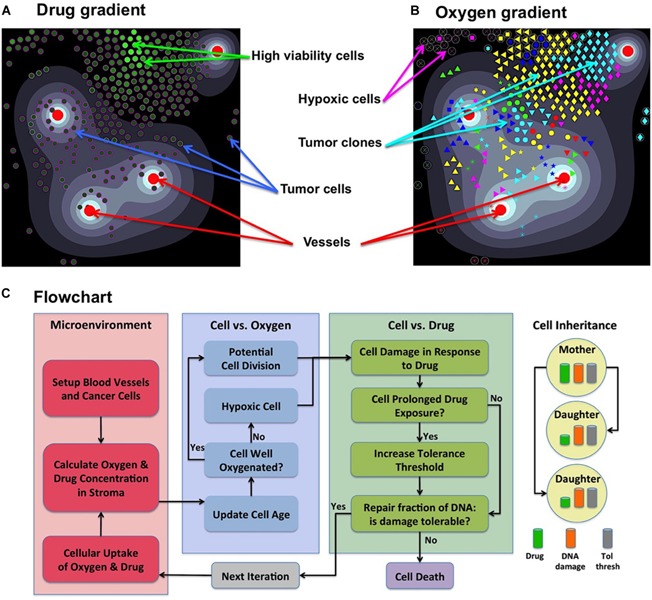
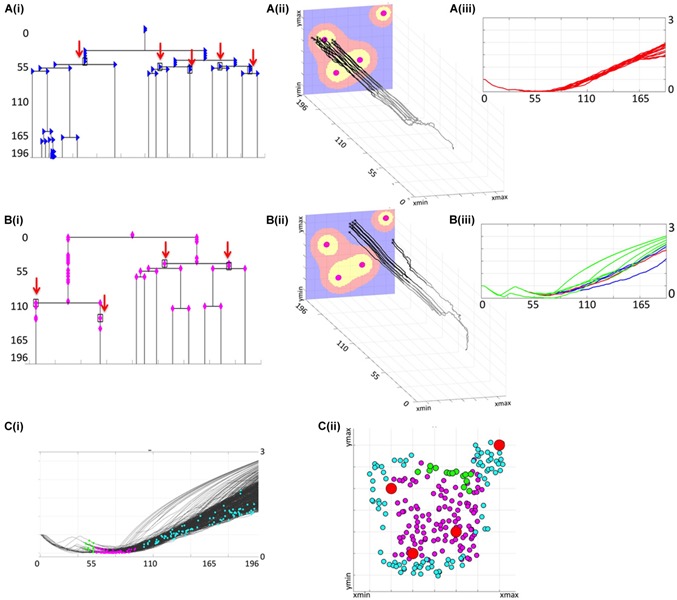
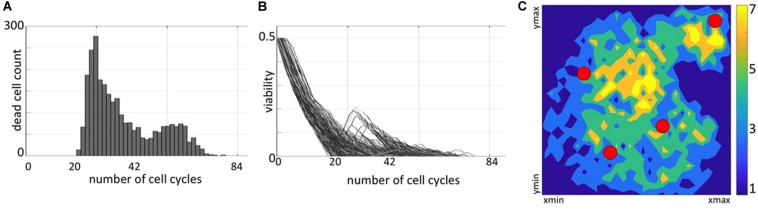
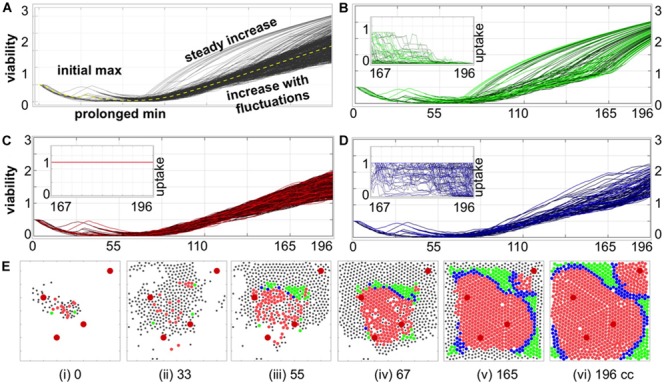
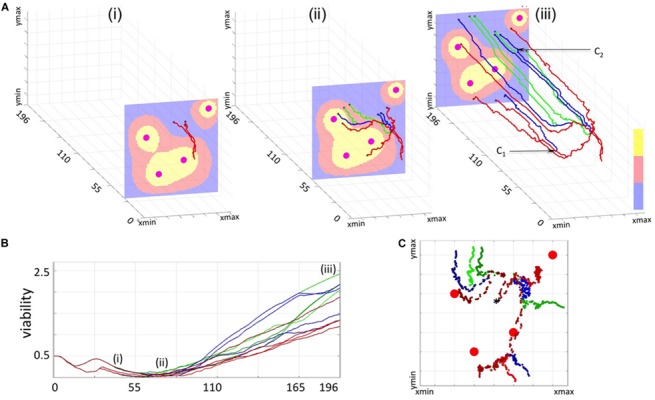
Resistance to anti-cancer drugs is a major cause of treatment failure. While several intracellular mechanisms of resistance have been postulated, the role of extrinsic factors in the development of resistance in individual tumor cells is still not fully understood. Here we used a hybrid agent-based model to investigate how sensitive tumor cells develop drug resistance in the heterogeneous tumor microenvironment. We characterized the spatio-temporal evolution of lineages of the resistant cells and examined how resistance at the single-cell level contributes to the overall tumor resistance. We also developed new methods to track tumor cell adaptation, to trace cell viability trajectories and to examine the three-dimensional spatio-temporal lineage trees. Our findings indicate that drug-induced resistance can result from cells adaptation to the changes in drug distribution. Two modes of cell adaptation were identified that coincide with microenvironmental niches-areas sheltered by cell micro-communities (protectorates) or regions with limited drug penetration (refuga or sanctuaries). We also recognized that certain cells gave rise to lineages of resistant cells (precursors of resistance) and pinpointed three temporal periods and spatial locations at which such cells emerged. This supports the hypothesis that tumor micrometastases do not need to harbor cell populations with pre-existing resistance, but that individual tumor cells can adapt and develop resistance induced by the drug during the treatment.
抗癌药物耐药性是治疗失败的主要原因。虽然已经提出了几种细胞内耐药机制,但外在因素在单个肿瘤细胞耐药性发展中的作用仍未完全了解。在这里,我们使用了一种基于混合代理的模型来研究敏感肿瘤细胞如何在异质性肿瘤微环境中产生耐药性。我们描述了耐药细胞谱系的时空演变,并研究了单细胞水平的耐药性如何导致整体肿瘤耐药性。我们还开发了新的方法来追踪肿瘤细胞的适应性、追踪细胞活力轨迹以及检查三维时空谱系树。我们的研究结果表明,药物诱导的耐药性可能源于细胞对药物分布变化的适应。确定了两种细胞适应模式,它们与微环境生态位相吻合——由细胞微群落(保护区)庇护的区域或药物渗透有限的区域(避难所或庇护所)。我们还认识到,某些细胞产生了耐药细胞谱系(耐药前体),并确定了这些细胞出现的三个时间段和空间位置。这支持了这样一种假设,即肿瘤微转移不需要含有预先存在耐药性的细胞群体,而是单个肿瘤细胞可以在治疗过程中适应并产生由药物诱导的耐药性。