Cintio Michela, Polacchini Giulia, Scarsella Elisa, Montanari Tommaso, Stefanon Bruno, Colitti Monica
Department of Agriculture, Food, Environmental and Animal Science, University of Udine, 33100 Udine, Italy.
Animals (Basel). 2020 Jul 2;10(7):1126. doi: 10.3390/ani10071126.
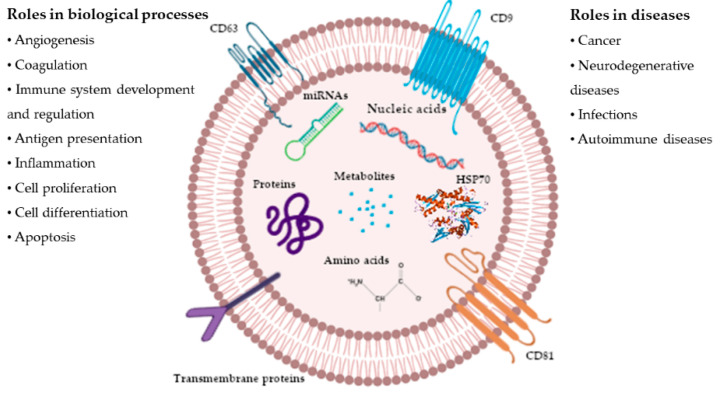
Recent advances in ruminants' milk-derived exosomes (EXO) have indicated a role of microRNAs (miRNAs) in cell-to-cell communication in dairy ruminants. The miRNAs EXO retain peculiar mechanisms of uptake from recipient cells, which enables the selective delivery of cargos, with a specific regulation of target genes. Although many studies have been published on the miRNAs contained in milk, less information is available on the role of miRNAs EXO, which are considered stable over time and resistant to digestion and milk processing. Several miRNAs EXO have been implicated in the cellular signaling pathway, as in the regulation of immune response. Moreover, they exert epigenetic control, as extenuating the expression of DNA methyltransferase 1. However, the study of miRNAs EXO is still challenging due to the difficulty of isolating EXO. In fact, there are not agreed protocols, and different methods, often time-consuming, are used, making it difficult to routinely process a large number of samples. The regulation of cell functions in mammary glands by miRNAs EXO, and their applications as genomic markers in livestock, is presented.
反刍动物乳源外泌体(EXO)的最新进展表明,微小RNA(miRNA)在反刍动物乳制品的细胞间通讯中发挥作用。miRNA EXO保留了从受体细胞摄取的独特机制,这使得货物能够选择性递送,并对靶基因进行特异性调控。尽管已经发表了许多关于牛奶中所含miRNA的研究,但关于miRNA EXO的作用的信息较少,miRNA EXO被认为随时间推移是稳定的,并且对消化和牛奶加工具有抗性。几种miRNA EXO已参与细胞信号通路,如免疫反应的调节。此外,它们还发挥表观遗传控制作用,如减弱DNA甲基转移酶1的表达。然而,由于分离EXO存在困难,miRNA EXO的研究仍然具有挑战性。事实上,目前尚无统一的方案,人们使用的方法各不相同,且通常耗时较长,这使得常规处理大量样本变得困难。本文介绍了miRNA EXO对乳腺细胞功能的调节及其作为家畜基因组标记的应用。