Department of Systems Biology, Harvard Medical School, Boston, MA 02115.
Department of Systems Biology, Harvard Medical School, Boston, MA 02115
Proc Natl Acad Sci U S A. 2020 Jul 21;117(29):17041-17048. doi: 10.1073/pnas.2000238117. Epub 2020 Jul 6.
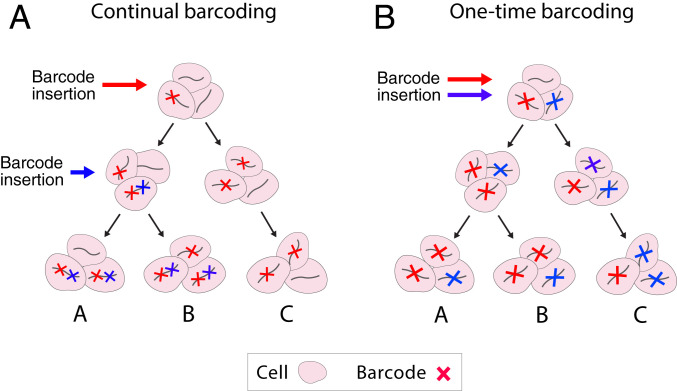
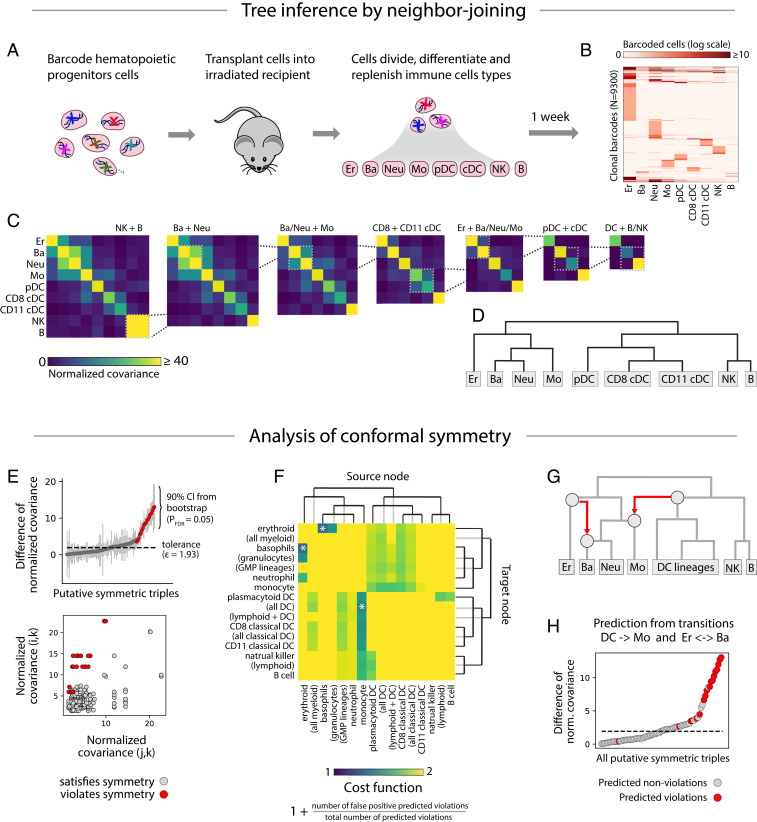
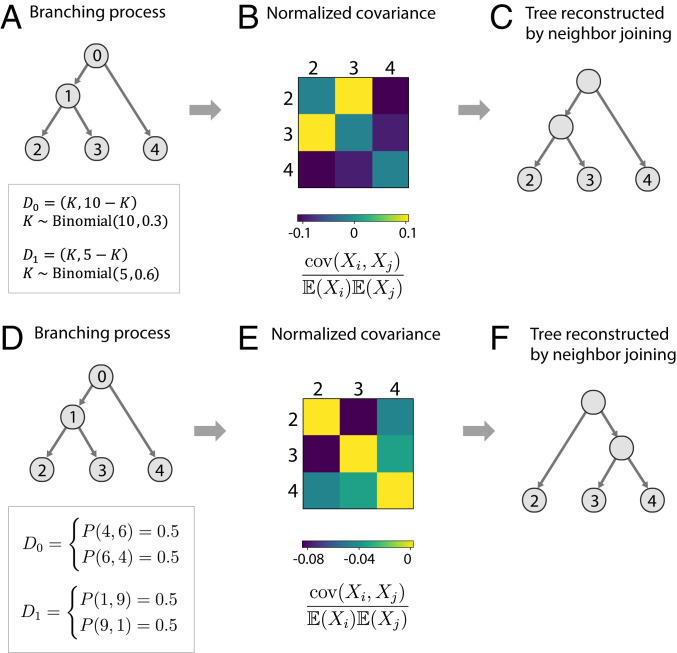
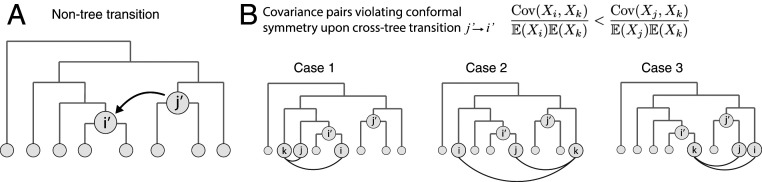
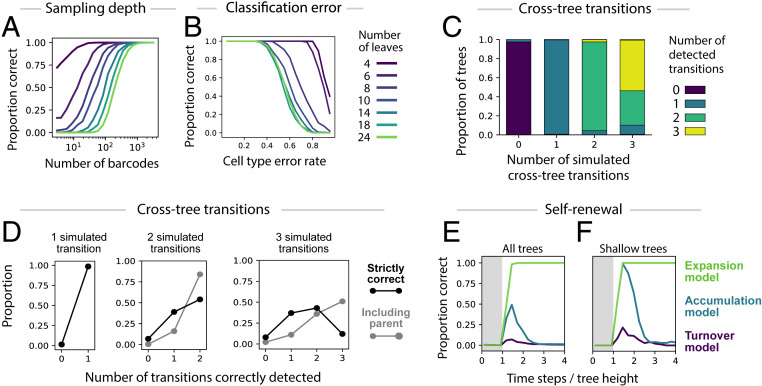
A central task in developmental biology is to learn the sequence of fate decisions that leads to each mature cell type in a tissue or organism. Recently, clonal labeling of cells using DNA barcodes has emerged as a powerful approach for identifying cells that share a common ancestry of fate decisions. Here we explore the idea that stochasticity of cell fate choice during tissue development could be harnessed to read out lineage relationships after a single step of clonal barcoding. By considering a generalized multitype branching process, we determine the conditions under which the final distribution of barcodes over observed cell types encodes their bona fide lineage relationships. We then propose a method for inferring the order of fate decisions. Our theory predicts a set of symmetries of barcode covariance that serves as a consistency check for the validity of the method. We show that broken symmetries may be used to detect multiple paths of differentiation to the same cell types. We provide computational tools for general use. When applied to barcoding data in hematopoiesis, these tools reconstruct the classical hematopoietic hierarchy and detect couplings between monocytes and dendritic cells and between erythrocytes and basophils that suggest multiple pathways of differentiation for these lineages.
在发育生物学中,一个核心任务是了解导致组织或生物体中每种成熟细胞类型的命运决定的顺序。最近,使用 DNA 条码对细胞进行克隆标记已成为一种强大的方法,可用于识别具有共同命运决定祖先的细胞。在这里,我们探讨了这样一种想法,即在组织发育过程中细胞命运选择的随机性可以被利用,以便在单个克隆条码步骤后读出谱系关系。通过考虑广义的多类型分支过程,我们确定了最终观察到的细胞类型中条码分布编码其真实谱系关系的条件。然后,我们提出了一种推断命运决定顺序的方法。我们的理论预测了条码协方差的一组对称,作为该方法有效性的一致性检查。我们表明,破坏的对称性可用于检测到相同细胞类型的多个分化路径。我们提供了通用的计算工具。当将这些工具应用于造血的条码数据时,它们重建了经典的造血层次结构,并检测到单核细胞和树突状细胞之间以及红细胞和嗜碱性粒细胞之间的耦合,这表明这些谱系存在多种分化途径。