• 文献检索
  • 文档翻译
  • 深度研究
  • 学术资讯
  • Suppr Zotero 插件Zotero 插件
  • 邀请有礼
  • 套餐&价格
  • 历史记录
应用&插件
Suppr Zotero 插件Zotero 插件浏览器插件Mac 客户端Windows 客户端微信小程序
定价
高级版会员购买积分包购买API积分包
服务
文献检索文档翻译深度研究API 文档MCP 服务
关于我们
关于 Suppr公司介绍联系我们用户协议隐私条款
关注我们

Suppr 超能文献

核心技术专利:CN118964589B侵权必究
粤ICP备2023148730 号-1Suppr @ 2026

文献检索

告别复杂PubMed语法,用中文像聊天一样搜索,搜遍4000万医学文献。AI智能推荐,让科研检索更轻松。

立即免费搜索

文件翻译

保留排版,准确专业,支持PDF/Word/PPT等文件格式,支持 12+语言互译。

免费翻译文档

深度研究

AI帮你快速写综述,25分钟生成高质量综述,智能提取关键信息,辅助科研写作。

立即免费体验

新冠疫情封锁:印度人在推特上的情绪健康视角

COVID-19 pandemic lockdown: An emotional health perspective of Indians on Twitter.

作者信息

Chehal Dimple, Gupta Parul, Gulati Payal

机构信息

Department of Computer Engineering, J.C. Bose University of Science and Technology, YMCA, Faridabad, India.

出版信息

Int J Soc Psychiatry. 2021 Feb;67(1):64-72. doi: 10.1177/0020764020940741. Epub 2020 Jul 7.

DOI:10.1177/0020764020940741
PMID:32633185
原文链接:https://pmc.ncbi.nlm.nih.gov/articles/PMC7342932/
Abstract

BACKGROUND

Novel corona virus (2019-nCoV) has spread in the world since its first human infection in December 2019. India has also witnessed a rising number of infections since March 2020. The Indian government imposed lockdowns in the nation to control the movement of its citizens thereby confining the spread of the virus. Tweeters resorted to usage of social media platform to express their mind.

AIM

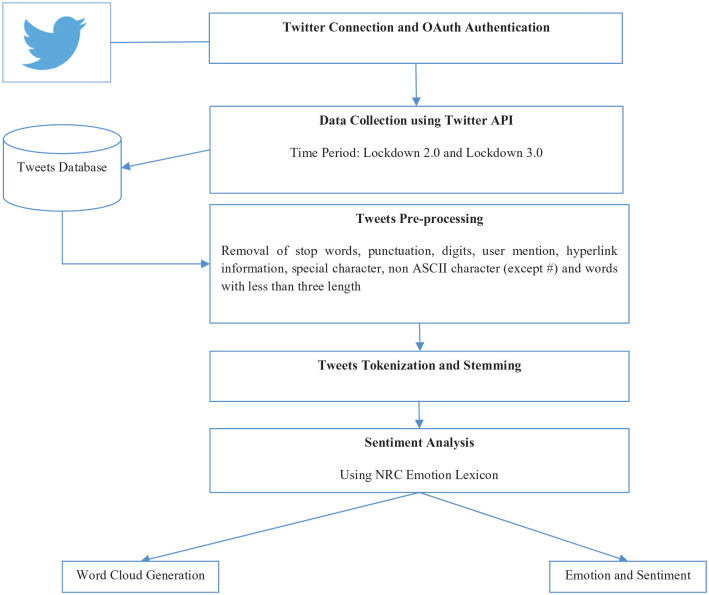
Through this article, an attempt has been made to understand the mind-set of Indian people using Python and R statistical software, during the recent lockdown 2.0 (15 April 2020 to 3 May 2020) and lockdown 3.0 (4 May 2020 to 17 May 2020) through their tweets on the social media platform Twitter. Also, opinion on e-commerce during this pandemic has been analysed.

METHOD

Analysis has been performed using Python and R statistical software. Also, recent articles related to COVID-19 have been considered and reviewed.

RESULT

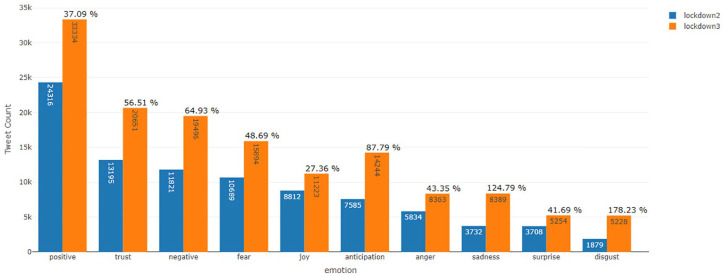
Although the country had a positive approach in lockdown 2.0 with only few instances of sadness, disgust and others, the majority of the people had a negative approach in lockdown 3.0.

CONCLUSION

This analysis can help the health specialists to understand people's mind-set, the authorities to take further corresponding measures in washing out the virus and the e-commerce stakeholders to adapt to the changing attitudes by adjusting demand and supply plans accordingly.

摘要

背景

新型冠状病毒(2019 - nCoV)自2019年12月首次感染人类以来已在全球传播。自2020年3月以来,印度的感染人数也在不断上升。印度政府在全国实施封锁,以控制公民的流动,从而遏制病毒传播。推特用户借助社交媒体平台表达自己的想法。

目的

通过本文,试图利用Python和R统计软件,通过印度民众在社交媒体平台推特上发布的推文,了解他们在最近的2.0版封锁(2020年4月15日至2020年5月3日)和3.0版封锁(2020年5月4日至2020年5月17日)期间的心态。此外,还分析了疫情期间对电子商务的看法。

方法

使用Python和R统计软件进行分析。同时,参考并回顾了近期与COVID - 19相关的文章。

结果

尽管该国在2.0版封锁期间态度积极,仅有少数悲伤、厌恶等情绪的例子,但在3.0版封锁期间,大多数人的态度是消极的。

结论

该分析有助于健康专家了解民众心态,有助于当局采取进一步相应措施以消除病毒,也有助于电子商务利益相关者通过相应调整供需计划来适应不断变化的态度。
https://cdn.ncbi.nlm.nih.gov/pmc/blobs/ddc2/8191168/6e5ba5b59343/10.1177_0020764020940741-fig7.jpg
https://cdn.ncbi.nlm.nih.gov/pmc/blobs/ddc2/8191168/a31cef5e20aa/10.1177_0020764020940741-fig1.jpg
https://cdn.ncbi.nlm.nih.gov/pmc/blobs/ddc2/8191168/7a7a0c63708d/10.1177_0020764020940741-fig2.jpg
https://cdn.ncbi.nlm.nih.gov/pmc/blobs/ddc2/8191168/0d6eb1ff6476/10.1177_0020764020940741-fig3.jpg
https://cdn.ncbi.nlm.nih.gov/pmc/blobs/ddc2/8191168/8a79cf6d61bd/10.1177_0020764020940741-fig4.jpg
https://cdn.ncbi.nlm.nih.gov/pmc/blobs/ddc2/8191168/71b70809dfae/10.1177_0020764020940741-fig5.jpg
https://cdn.ncbi.nlm.nih.gov/pmc/blobs/ddc2/8191168/a1f0f653166a/10.1177_0020764020940741-fig6.jpg
https://cdn.ncbi.nlm.nih.gov/pmc/blobs/ddc2/8191168/6e5ba5b59343/10.1177_0020764020940741-fig7.jpg
https://cdn.ncbi.nlm.nih.gov/pmc/blobs/ddc2/8191168/a31cef5e20aa/10.1177_0020764020940741-fig1.jpg
https://cdn.ncbi.nlm.nih.gov/pmc/blobs/ddc2/8191168/7a7a0c63708d/10.1177_0020764020940741-fig2.jpg
https://cdn.ncbi.nlm.nih.gov/pmc/blobs/ddc2/8191168/0d6eb1ff6476/10.1177_0020764020940741-fig3.jpg
https://cdn.ncbi.nlm.nih.gov/pmc/blobs/ddc2/8191168/8a79cf6d61bd/10.1177_0020764020940741-fig4.jpg
https://cdn.ncbi.nlm.nih.gov/pmc/blobs/ddc2/8191168/71b70809dfae/10.1177_0020764020940741-fig5.jpg
https://cdn.ncbi.nlm.nih.gov/pmc/blobs/ddc2/8191168/a1f0f653166a/10.1177_0020764020940741-fig6.jpg
https://cdn.ncbi.nlm.nih.gov/pmc/blobs/ddc2/8191168/6e5ba5b59343/10.1177_0020764020940741-fig7.jpg

相似文献

1
COVID-19 pandemic lockdown: An emotional health perspective of Indians on Twitter.新冠疫情封锁:印度人在推特上的情绪健康视角
Int J Soc Psychiatry. 2021 Feb;67(1):64-72. doi: 10.1177/0020764020940741. Epub 2020 Jul 7.
2
Emotions of COVID-19: Content Analysis of Self-Reported Information Using Artificial Intelligence.COVID-19 情绪:使用人工智能进行自我报告信息的内容分析。
J Med Internet Res. 2021 Apr 30;23(4):e27341. doi: 10.2196/27341.
3
Twitter Discussions and Emotions About the COVID-19 Pandemic: Machine Learning Approach.关于新冠疫情的推特讨论与情绪:机器学习方法
J Med Internet Res. 2020 Nov 25;22(11):e20550. doi: 10.2196/20550.
4
Top Concerns of Tweeters During the COVID-19 Pandemic: Infoveillance Study.新冠疫情期间推特用户的主要担忧:信息监测研究
J Med Internet Res. 2020 Apr 21;22(4):e19016. doi: 10.2196/19016.
5
Increased Online Aggression During COVID-19 Lockdowns: Two-Stage Study of Deep Text Mining and Difference-in-Differences Analysis.在 COVID-19 封锁期间在线攻击性增加:深度文本挖掘和双重差分分析的两阶段研究。
J Med Internet Res. 2022 Aug 9;24(8):e38776. doi: 10.2196/38776.
6
Using Twitter Comments to Understand People's Experiences of UK Health Care During the COVID-19 Pandemic: Thematic and Sentiment Analysis.利用推特评论了解新冠疫情期间英国人对英国医疗保健的体验:主题和情感分析。
J Med Internet Res. 2021 Oct 25;23(10):e31101. doi: 10.2196/31101.
7
Mental health effects of COVID-19 lockdowns: A Twitter-based analysis.COVID-19 封锁对心理健康的影响:基于 Twitter 的分析。
Econ Hum Biol. 2023 Dec;51:101307. doi: 10.1016/j.ehb.2023.101307. Epub 2023 Sep 26.
8
Effects of the COVID-19 Emergency and National Lockdown on Italian Citizens' Economic Concerns, Government Trust, and Health Engagement: Evidence From a Two-Wave Panel Study.COVID-19 紧急状态和全国封锁对意大利公民经济担忧、政府信任和健康参与的影响:来自两轮面板研究的证据。
Milbank Q. 2021 Jun;99(2):369-392. doi: 10.1111/1468-0009.12506. Epub 2021 Apr 6.
9
The Resurgence of Cyber Racism During the COVID-19 Pandemic and its Aftereffects: Analysis of Sentiments and Emotions in Tweets.新冠疫情期间网络种族主义的死灰复燃及其余波:推特中情绪的分析
JMIR Public Health Surveill. 2020 Oct 15;6(4):e19833. doi: 10.2196/19833.
10
Analyzing Indian general public's perspective on anxiety, stress and trauma during Covid-19 - A machine learning study of 840,000 tweets.分析印度公众在新冠疫情期间对焦虑、压力和创伤的看法 - 对 84 万条推文的机器学习研究。
Diabetes Metab Syndr. 2021 May-Jun;15(3):667-671. doi: 10.1016/j.dsx.2021.03.016. Epub 2021 Mar 24.

引用本文的文献

1
Analysis of Pharmaceutical Companies' Social Media Activity during the COVID-19 Pandemic and Its Impact on the Public.新冠疫情期间制药公司社交媒体活动分析及其对公众的影响
Behav Sci (Basel). 2024 Feb 9;14(2):128. doi: 10.3390/bs14020128.
2
Detecting COVID-19 vaccine hesitancy in India: a multimodal transformer based approach.检测印度对新冠疫苗的犹豫态度:一种基于多模态变压器的方法。
J Intell Inf Syst. 2023;60(1):157-173. doi: 10.1007/s10844-022-00745-1. Epub 2022 Sep 7.
3
A tale of two applications: lessons learned from national LMIC COVID applications.

本文引用的文献

1
COVID-19 and lockdown: Delayed effects on health.新冠疫情与封锁:对健康的延迟影响。
Indian J Psychiatry. 2020 May-Jun;62(3):247-249. doi: 10.4103/psychiatry.IndianJPsychiatry_379_20. Epub 2020 May 15.
2
Sentiment analysis of nationwide lockdown due to COVID 19 outbreak: Evidence from India.关于因新冠疫情爆发实施全国封锁的情绪分析:来自印度的证据。
Asian J Psychiatr. 2020 Jun;51:102089. doi: 10.1016/j.ajp.2020.102089. Epub 2020 Apr 12.
3
COVID-19 pandemic in India: challenges and silver linings.印度的新冠疫情:挑战与一线希望
两个应用程序的故事:从国家中低收入国家 COVID 应用程序中吸取的教训。
J Am Med Inform Assoc. 2023 Mar 16;30(4):781-786. doi: 10.1093/jamia/ocac146.
4
Comparison of Public Responses to Containment Measures During the Initial Outbreak and Resurgence of COVID-19 in China: Infodemiology Study.中国 COVID-19 初始爆发和复燃期间公众对遏制措施的反应比较:信息流行病学研究。
J Med Internet Res. 2021 Apr 5;23(4):e26518. doi: 10.2196/26518.
5
Temporal Dynamics of Public Emotions During the COVID-19 Pandemic at the Epicenter of the Outbreak: Sentiment Analysis of Weibo Posts From Wuhan.新冠疫情期间疫情中心地区公众情绪的时间动态:来自武汉微博帖子的情感分析。
J Med Internet Res. 2021 Mar 18;23(3):e27078. doi: 10.2196/27078.
6
An Emotion Care Model using Multimodal Textual Analysis on COVID-19.一种基于多模态文本分析的新冠肺炎情感关怀模型。
Chaos Solitons Fractals. 2021 Mar;144:110708. doi: 10.1016/j.chaos.2021.110708. Epub 2021 Jan 22.
7
What social media told us in the time of COVID-19: a scoping review.社交媒体在 COVID-19 大流行期间告诉了我们什么:范围综述。
Lancet Digit Health. 2021 Mar;3(3):e175-e194. doi: 10.1016/S2589-7500(20)30315-0. Epub 2021 Jan 28.
8
Has loneliness and poor resilient coping influenced the magnitude of psychological distress among apparently healthy Indian adults during the lockdown? Evidence from a rapid online nation-wide cross-sectional survey.在封锁期间,孤独和应对能力差是否影响了明显健康的印度成年人的心理困扰程度?来自全国范围内快速在线横断面调查的证据。
PLoS One. 2021 Jan 14;16(1):e0245509. doi: 10.1371/journal.pone.0245509. eCollection 2021.
Postgrad Med J. 2020 Jul;96(1137):422-423. doi: 10.1136/postgradmedj-2020-137780. Epub 2020 Apr 16.
4
All about COVID-19 in brief.关于新冠病毒的简要介绍。
New Microbes New Infect. 2020 Apr 13;35:100678. doi: 10.1016/j.nmni.2020.100678. eCollection 2020 May.