Department of Psychology, University of Bielefeld, Bielefeld, Germany.
Epilepsy Centre Bethel, Krankenhaus Mara, Bielefeld, Germany.
Hum Brain Mapp. 2020 Oct 15;41(15):4332-4354. doi: 10.1002/hbm.25128. Epub 2020 Jul 7.
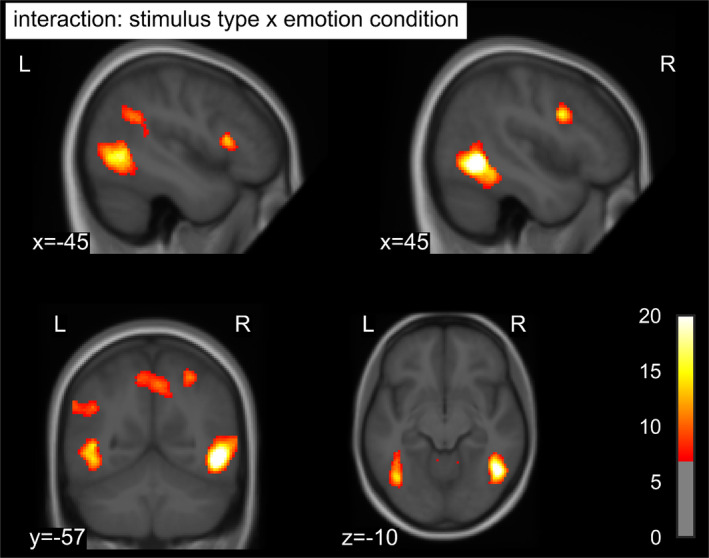
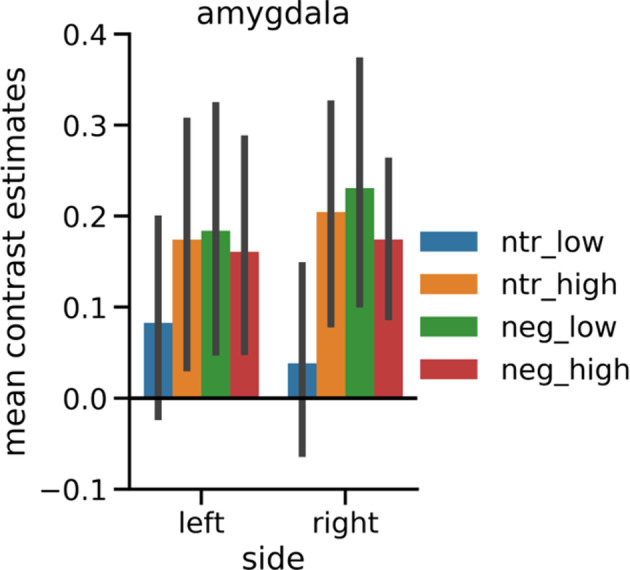
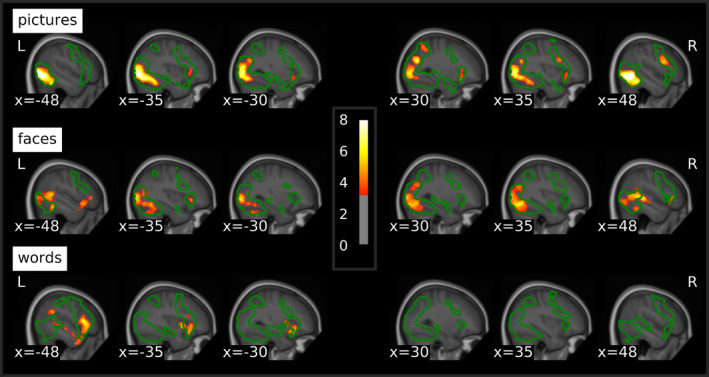
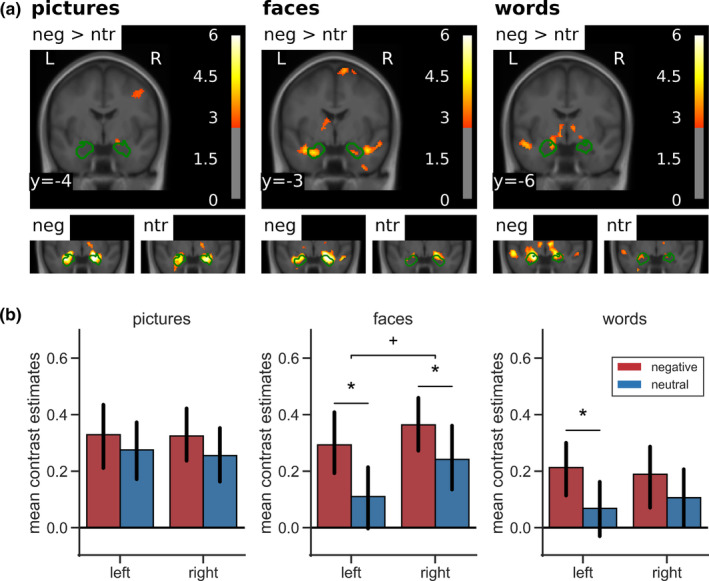
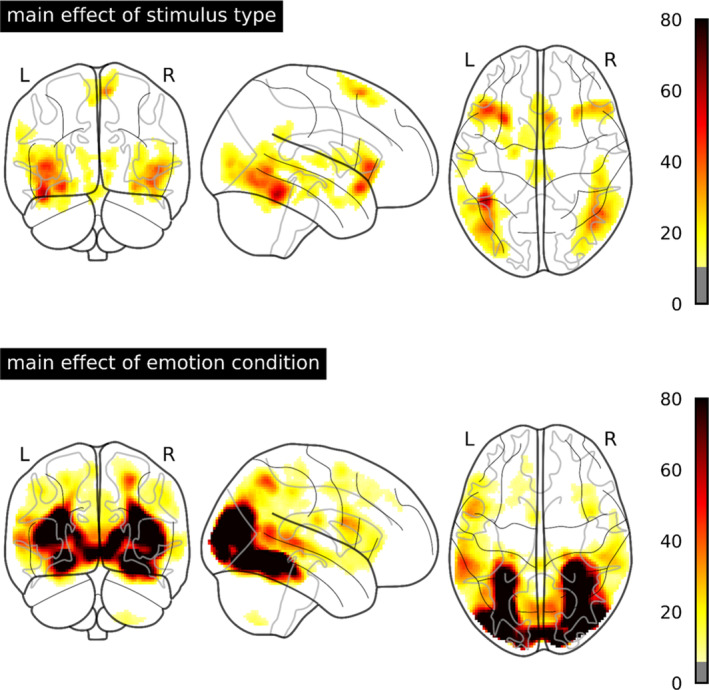
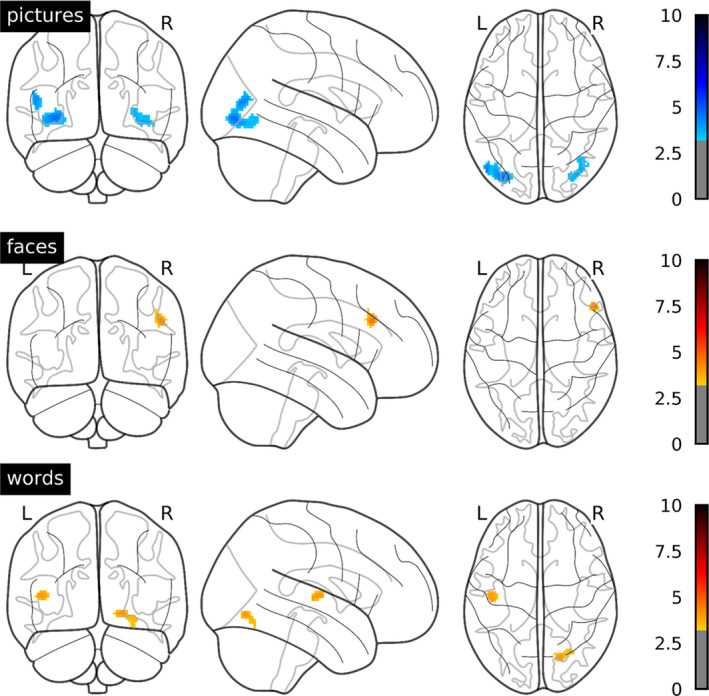
Negative visual stimuli have been found to elicit stronger brain activation than do neutral stimuli. Such emotion effects have been shown for pictures, faces, and words alike, but the literature suggests stimulus-specific differences regarding locus and lateralization of the activity. In the current functional magnetic resonance imaging study, we directly compared brain responses to passively viewed negative and neutral pictures of complex scenes, faces, and words (nouns) in 43 healthy participants (21 males) varying in age and demographic background. Both negative pictures and faces activated the extrastriate visual cortices of both hemispheres more strongly than neutral ones, but effects were larger and extended more dorsally for pictures, whereas negative faces additionally activated the superior temporal sulci. Negative words differentially activated typical higher-level language processing areas such as the left inferior frontal and angular gyrus. There were small emotion effects in the amygdala for faces and words, which were both lateralized to the left hemisphere. Although pictures elicited overall the strongest amygdala activity, amygdala response to negative pictures was not significantly stronger than to neutral ones. Across stimulus types, emotion effects converged in the left anterior insula. No gender effects were apparent, but age had a small, stimulus-specific impact on emotion processing. Our study specifies similarities and differences in effects of negative emotional content on the processing of different types of stimuli, indicating that brain response to negative stimuli is specifically enhanced in areas involved in processing of the respective stimulus type in general and converges across stimuli in the left anterior insula.
负面视觉刺激被发现比中性刺激引起更强的大脑激活。这种情绪效应已经在图片、面孔和单词上得到了证明,但文献表明,活动的位置和侧化存在刺激特异性差异。在当前的功能磁共振成像研究中,我们直接比较了 43 名健康参与者(21 名男性)在观看复杂场景、面孔和单词(名词)的被动负面和中性图片时的大脑反应,这些参与者在年龄和人口统计学背景上存在差异。负面图片和面孔比中性图片更强烈地激活了两个半球的外纹状皮质,但图片的效果更大,向背部延伸更远,而负面面孔则额外激活了颞上回。负面单词则以左侧下额叶和角回等典型的高级语言处理区域为靶点,产生了不同的激活。面孔和单词在杏仁核中都存在较小的情绪效应,而且都偏向于左侧。虽然图片总体上引起了最强的杏仁核活动,但负面图片的杏仁核反应并不比中性图片更强。在不同的刺激类型中,情绪效应在左侧前岛叶汇聚。没有明显的性别效应,但年龄对情绪处理有较小的、刺激特异性的影响。我们的研究具体说明了不同类型的刺激对负面情绪内容的处理的相似性和差异性,表明大脑对负面刺激的反应在一般情况下会在涉及处理相应刺激类型的区域中得到增强,并且在左侧前岛叶中汇聚。