Lincoln University College, Selangor.
Afr J Prim Health Care Fam Med. 2020 Jun 17;12(1):e1-e8. doi: 10.4102/phcfm.v12i1.2212.
Malaria diagnosis using microscopy is currently the gold standard. However, malaria rapid diagnostic tests (mRDTs) were developed to simplify the diagnosis in regions without access to functional microscopy.
The objective of this study was to compare the diagnostic accuracy of mRDT CareStatTM with microscopy.
This study was conducted in the paediatric primary care clinic of the Federal Medical Centre, Asaba, Nigeria.
A cross-sectional study for diagnostic accuracy was conducted from May 2016 to October 2016. Ninety-eight participants were involved to obtain a precision of 5%, sensitivity of mRDT CareStatTM of 95% from published work and 95% level of confidence after adjusting for 20% non-response rate or missing data. Consecutive participants were tested using both microscopy and mRDT. The results were analysed using EPI Info Version 7.
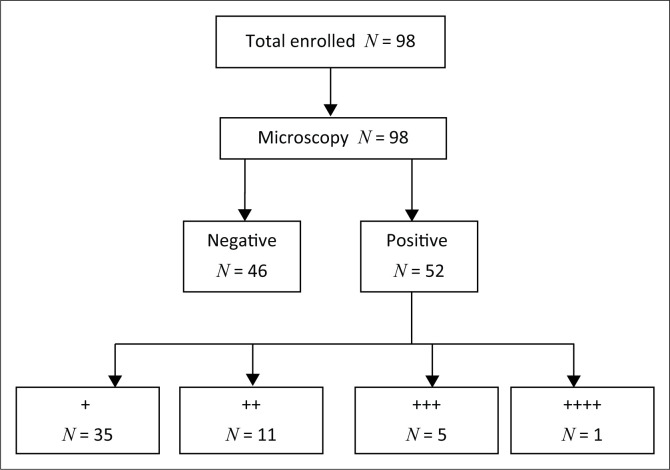
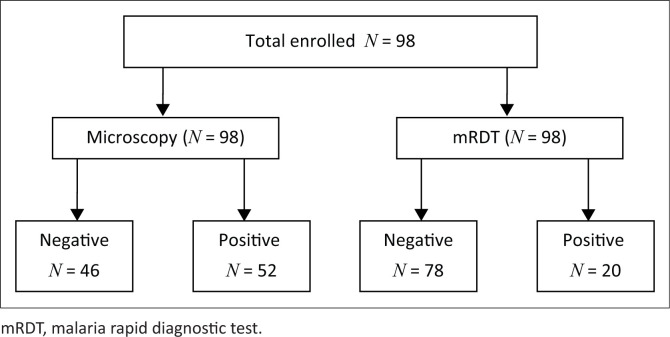
A total of 98 children aged 3-59 months were enrolled. Malaria prevalence was found to be 53% (95% confidence interval [CI] = 46% - 60%), whilst sensitivity and specificity were 29% (95% CI = 20% - 38%) and 89% (95% CI = 83% - 95%), respectively. The positive and negative predictive values were 75% (95% CI = 66.4% - 83.6%) and 53% (95% CI = 46% - 60%), respectively.
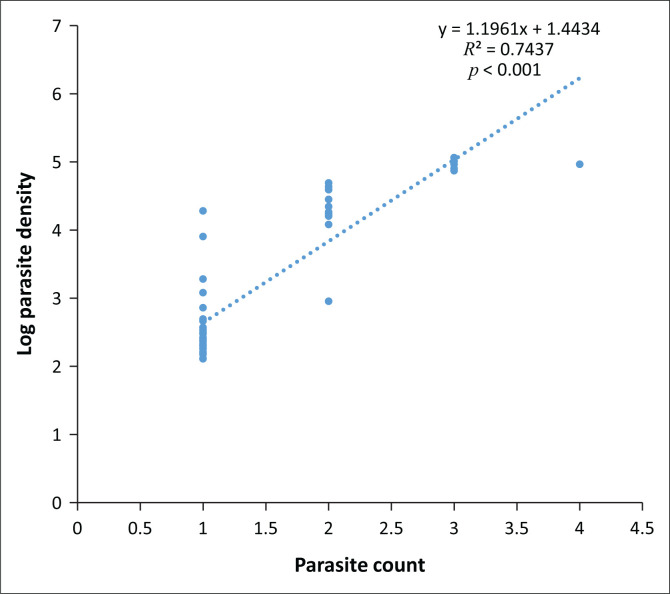
Agreement between malaria parasitaemia using microscopy and mRDT positivity increased with increase in the parasite density. The mRDT might be negative when malaria parasite density using microscopy is low.
目前,显微镜检查是诊断疟疾的金标准。然而,疟疾快速诊断检测(mRDT)的开发是为了简化在没有功能显微镜的地区的诊断。
本研究旨在比较 CareStatTM mRDT 与显微镜检查的诊断准确性。
本研究在尼日利亚奥萨巴联邦医疗中心的儿科初级保健诊所进行。
一项横断面研究用于诊断准确性,于 2016 年 5 月至 2016 年 10 月进行。为了从已发表的工作中获得 mRDT CareStatTM 的 95%敏感性和 5%精度,以及在调整了 20%的无应答率或缺失数据后 95%的置信水平,共纳入 98 名参与者。对连续参与者同时进行显微镜检查和 mRDT 检查。使用 EPI Info 版本 7 分析结果。
共纳入 98 名 3-59 个月的儿童。发现疟疾的患病率为 53%(95%置信区间 [CI] = 46% - 60%),而敏感性和特异性分别为 29%(95% CI = 20% - 38%)和 89%(95% CI = 83% - 95%)。阳性和阴性预测值分别为 75%(95% CI = 66.4% - 83.6%)和 53%(95% CI = 46% - 60%)。
随着寄生虫密度的增加,使用显微镜检查发现的疟原虫血症与 mRDT 阳性之间的一致性增加。当使用显微镜检查发现的疟原虫密度较低时,mRDT 可能为阴性。