Guangdong Provincial Key Laboratory of Tropical Disease Research, Department of Toxicology, School of Public Health, Southern Medical University, 1023-1063 Shatai Nan Road, Guangzhou 510515, China.
Faculty of Preventive Medicine, School of Public Health, Guangdong Pharmaceutical University, Guangzhou 510006, China.
J Infect. 2020 Oct;81(4):e18-e25. doi: 10.1016/j.jinf.2020.07.002. Epub 2020 Jul 4.
Coronavirus Disease 2019 (COVID-19) is a pandemic. This systematic review compares mortality risk factors including clinical, demographic and laboratory features of COVID-19, Severe Acute Respiratory Syndrome (SARS) and Middle East Respiratory Syndrome (MERS). The aim is to provide new strategies for COVID-19 prevention and treatment.
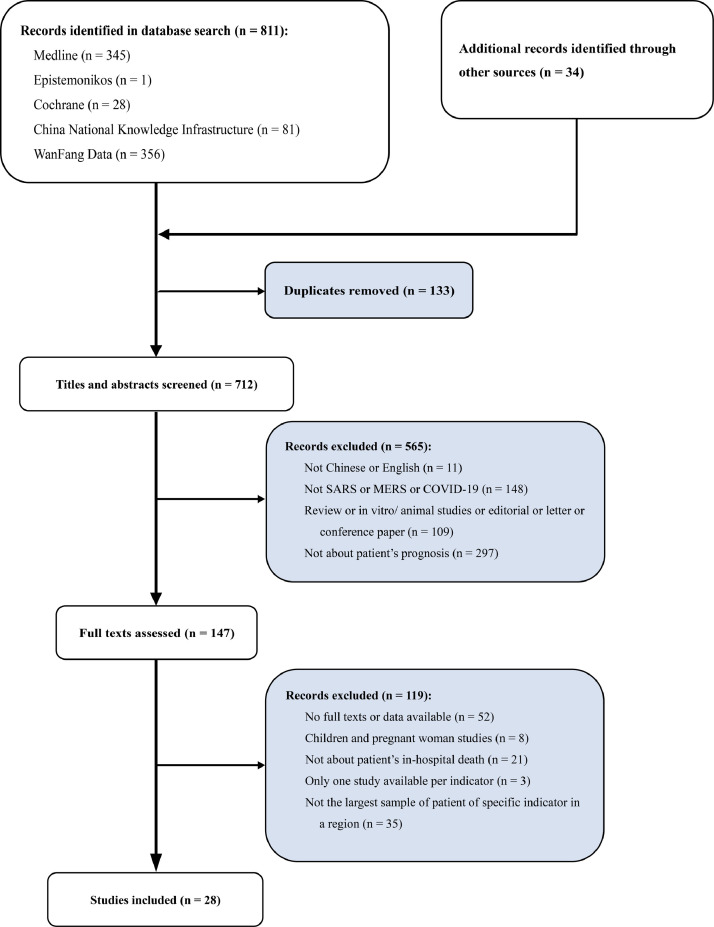
We performed a systematic review with meta-analysis, using five databases to compare the predictors of death for COVID-19, SARS and MERS. A random-effects model meta-analysis calculated odds ratios (OR) and 95% confidence intervals (95% CI).
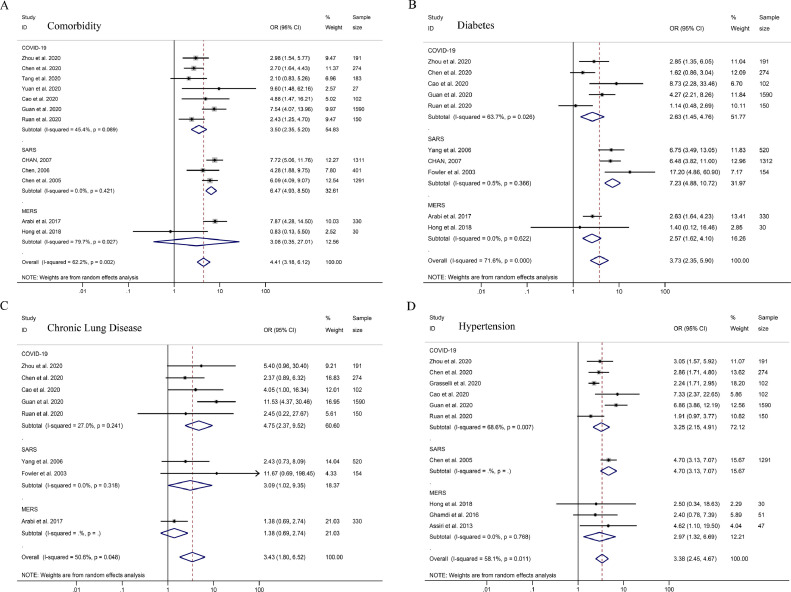
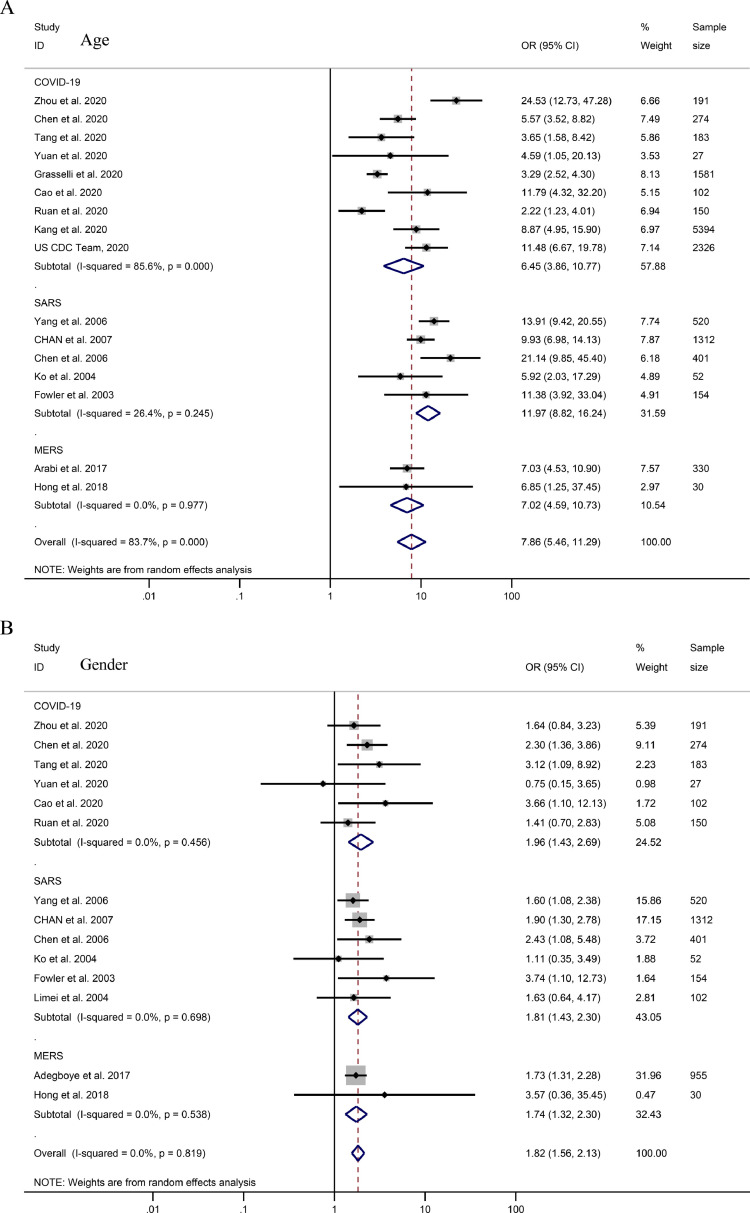
845 articles up through 11/4/2020 were retrieved, but only 28 studies were included in this meta-analysis. The results showed that males had a higher likelihood of death than females (OR = 1.82, 95% CI 1.56-2.13). Age (OR = 7.86, 95% CI 5.46-11.29), diabetes comorbidity (OR = 3.73, 95% CI 2.35-5.90), chronic lung disease (OR = 3.43, 95% CI 1.80-6.52) and hypertension (OR = 3.38, 95% CI 2.45-4.67) were the mortality risk factors. The laboratory indicators lactic dehydrogenase (OR = 37.52, 95% CI 24.68-57.03), C-reactive protein (OR = 12.11, 95% CI 5.24-27.98), and neutrophils (OR = 17.56, 95% CI 10.67-28.90) had stronger correlations with COVID-19 mortality than with SARS or MERS mortality. Consolidation and ground-glass opacity imaging features were similar among COVID-19, SARS, and MERS patients.
COVID-19's mortality factors are similar to those of SARS and MERS. Age and laboratory indicators could be effective predictors of COVID-19 mortality outcomes.
2019 年冠状病毒病(COVID-19)是一种大流行疾病。本系统综述比较了 COVID-19、严重急性呼吸综合征(SARS)和中东呼吸综合征(MERS)的死亡率危险因素,包括临床、人口统计学和实验室特征。目的是为 COVID-19 的预防和治疗提供新的策略。
我们进行了系统综述和荟萃分析,使用五个数据库比较 COVID-19、SARS 和 MERS 死亡预测因子。随机效应模型荟萃分析计算了比值比(OR)和 95%置信区间(95%CI)。
截至 2020 年 11 月 4 日,共检索到 845 篇文章,但仅有 28 项研究纳入荟萃分析。结果表明,男性死亡的可能性高于女性(OR=1.82,95%CI 1.56-2.13)。年龄(OR=7.86,95%CI 5.46-11.29)、糖尿病合并症(OR=3.73,95%CI 2.35-5.90)、慢性肺部疾病(OR=3.43,95%CI 1.80-6.52)和高血压(OR=3.38,95%CI 2.45-4.67)是死亡的危险因素。实验室指标乳酸脱氢酶(OR=37.52,95%CI 24.68-57.03)、C 反应蛋白(OR=12.11,95%CI 5.24-27.98)和中性粒细胞(OR=17.56,95%CI 10.67-28.90)与 COVID-19 死亡率的相关性强于与 SARS 或 MERS 死亡率的相关性。COVID-19、SARS 和 MERS 患者的实变和磨玻璃影影像学特征相似。
COVID-19 的死亡危险因素与 SARS 和 MERS 相似。年龄和实验室指标可能是 COVID-19 死亡率的有效预测因子。