Department of Food Science and Technology, The Ohio State University, 110 Parker Food Science and Technology Building, 2015 Fyffe Road, Columbus, OH 43210, USA.
Department of Nutrition and Dietetics, Bayburt University, 69000 Bayburt, Turkey.
Sensors (Basel). 2020 Jul 3;20(13):3723. doi: 10.3390/s20133723.
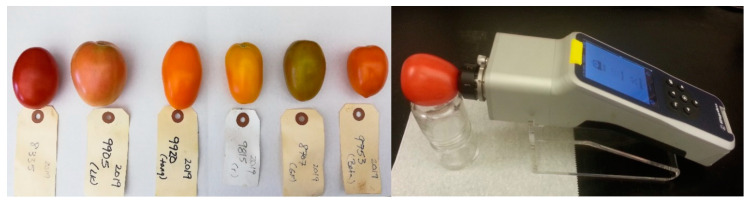
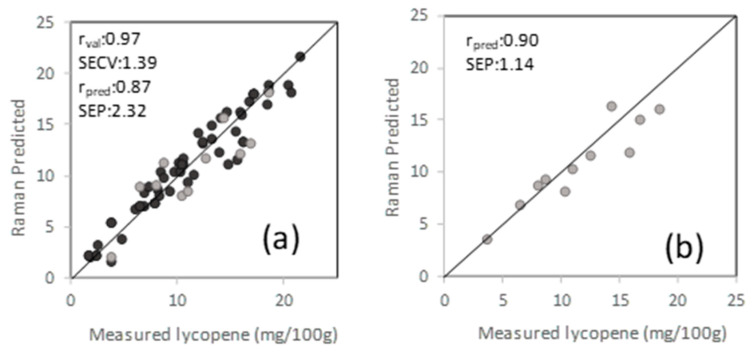
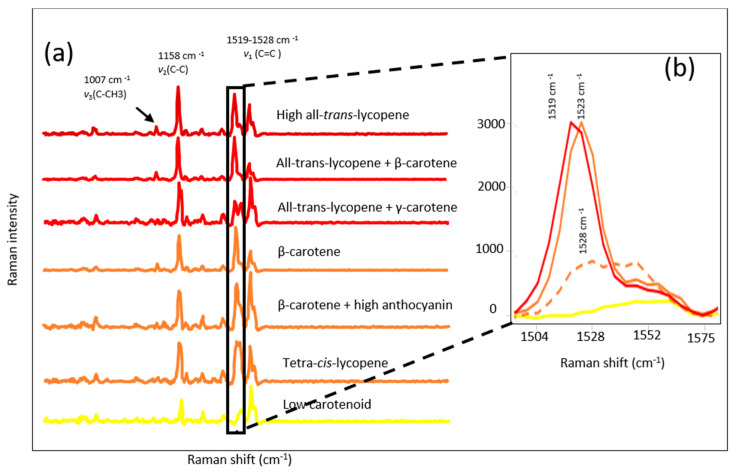
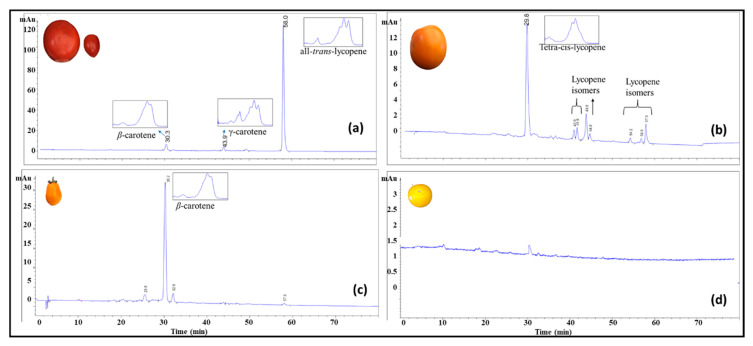
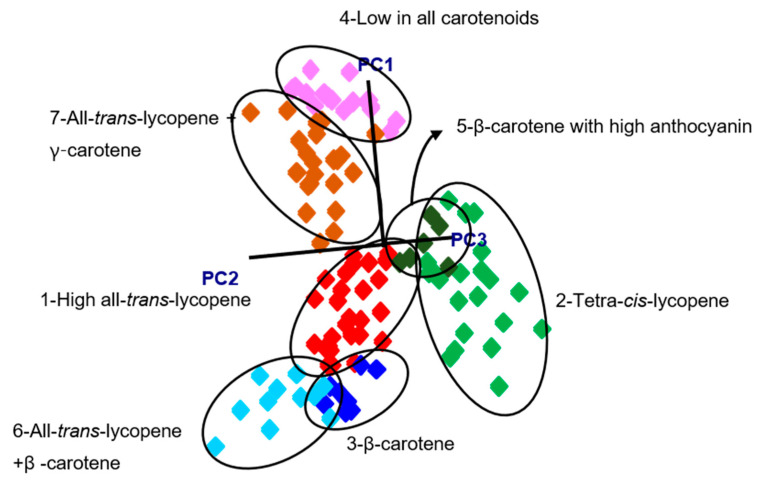
Our objective was to develop a rapid technique for the non-invasive profiling and quantification of major tomato carotenoids using handheld Raman spectroscopy combined with pattern recognition techniques. A total of 106 samples with varying carotenoid profiles were provided by the Ohio State University Tomato Breeding and Genetics program and Lipman Family Farms (Naples, FL, USA). Non-destructive measurement from the surface of tomatoes was performed by a handheld Raman spectrometer equipped with a 1064 nm excitation laser, and data analysis was performed using soft independent modelling of class analogy (SIMCA)), artificial neural network (ANN), and partial least squares regression (PLSR) for classification and quantification purposes. High-performance liquid chromatography (HPLC) and UV/visible spectrophotometry were used for profiling and quantification of major carotenoids. Seven groups were identified based on their carotenoid profile, and supervised classification by SIMCA and ANN clustered samples with 93% and 100% accuracy based on a validation test data, respectively. All--lycopene and β-carotene levels were measured with a UV-visible spectrophotometer, and prediction models were developed using PLSR and ANN. Regression models developed with Raman spectra provided excellent prediction performance by ANN (r = 0.9, SEP = 1.1 mg/100 g) and PLSR (r = 0.87, SEP = 2.4 mg/100 g) for non-invasive determination of all--lycopene in fruits. Although the number of samples were limited for β-carotene quantification, PLSR modeling showed promising results (r = 0.99, SECV = 0.28 mg/100 g). Non-destructive evaluation of tomato carotenoids can be useful for tomato breeders as a simple and rapid tool for developing new varieties with novel profiles and for separating orange varieties with distinct carotenoids (high in β-carotene and high in -lycopene).
我们的目标是开发一种快速技术,使用手持式拉曼光谱结合模式识别技术,对主要的番茄类胡萝卜素进行非侵入式分析和定量。俄亥俄州立大学番茄育种和遗传学项目和利帕曼家族农场(美国佛罗里达州那不勒斯)提供了 106 个具有不同类胡萝卜素特征的样本。通过配备 1064nm 激发激光的手持式拉曼光谱仪对番茄表面进行非破坏性测量,然后使用软独立建模类比法(SIMCA)、人工神经网络(ANN)和偏最小二乘回归(PLSR)进行数据分析,以进行分类和定量。高效液相色谱法(HPLC)和紫外/可见分光光度法用于主要类胡萝卜素的分析和定量。根据类胡萝卜素特征,将 106 个样本分为 7 组,SIMCA 和 ANN 的监督分类准确率分别为 93%和 100%。使用分光光度法测量全-番茄红素和β-胡萝卜素的含量,然后使用 PLSR 和 ANN 建立预测模型。使用拉曼光谱建立的回归模型通过 ANN(r = 0.9,SEP = 1.1mg/100g)和 PLSR(r = 0.87,SEP = 2.4mg/100g)为非侵入式测定果实中的全-番茄红素提供了出色的预测性能。尽管β-胡萝卜素定量的样本数量有限,但 PLSR 模型显示出有希望的结果(r = 0.99,SECV = 0.28mg/100g)。番茄类胡萝卜素的非破坏性评估可作为一种简单快速的工具,用于开发具有新型特征的新品种,并用于分离具有不同类胡萝卜素(β-胡萝卜素和番茄红素含量高)的橙色品种,对番茄育种者很有用。