Department of Women and Children's Health, King's College London, London SE1 7EH, UK.
Medical Research Council Unit, The Gambia at the London School of Hygiene and Tropical Medicine, Fajara, P.O. Box 273, Banjul, The Gambia.
Nutrients. 2020 Jul 5;12(7):2001. doi: 10.3390/nu12072001.
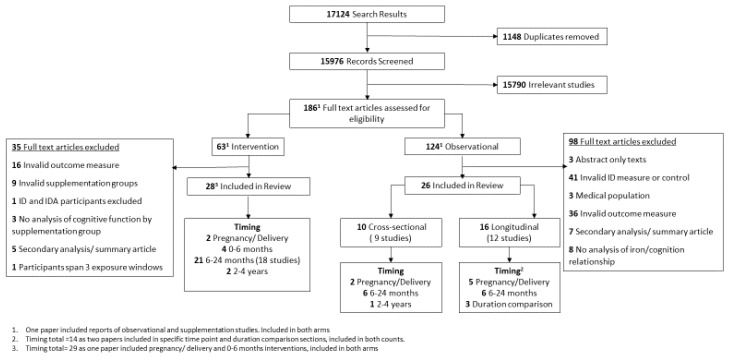
One-third of children falter in cognitive development by pre-school age. Iron plays an important role in many neurodevelopmental processes, and animal studies suggest that iron sufficiency in pregnancy and infancy is particularly important for neurodevelopment. However, it is not clear whether iron deficiency directly impacts developmental outcomes, and, if so, whether impact differs by timing of exposure or developmental domain. We searched four databases for studies on iron deficiency or iron supplementation in pregnancy, or at 0-6 months, 6-24 months, or 2-4 years of age. All studies included neurodevelopmental assessments in infants or children up to 4 years old. We then qualitatively synthesized the literature. There was no clear relationship between iron status and developmental outcomes across any of the time windows or domains included. We identified a large quantity of low-quality studies, significant heterogeneity in study design and a lack of research focused on pregnancy and early infancy. In summary, despite good mechanistic evidence for the role of iron in brain development, evidence for the impact of iron deficiency or iron supplementation on early development is inconsistent. Further high-quality research is needed, particularly within pregnancy and early infancy, which has previously been neglected.
三分之一的儿童在学前年龄出现认知发育迟缓。铁在许多神经发育过程中发挥着重要作用,动物研究表明,妊娠和婴儿期铁充足对于神经发育尤为重要。然而,目前尚不清楚缺铁是否直接影响发育结果,如果有影响,那么暴露时间或发育领域是否存在差异。我们在四个数据库中搜索了关于妊娠期间或 0-6 个月、6-24 个月或 2-4 岁期间缺铁或铁补充的研究。所有研究均纳入了婴儿或 4 岁以下儿童的神经发育评估。然后我们对文献进行了定性综合分析。在任何时间窗口或领域,铁状态与发育结果之间均无明确关系。我们发现大量低质量的研究,研究设计存在很大的异质性,并且缺乏专注于妊娠和婴儿期早期的研究。总之,尽管有充分的机制证据表明铁在大脑发育中的作用,但缺铁或铁补充对早期发育的影响的证据并不一致。需要开展更多高质量的研究,特别是在以前被忽视的妊娠和婴儿期早期。