Roldão da Silva Paula, Castilho Dos Santos Géssika, Marcio da Silva Jadson, Ferreira de Faria Waynne, Gonçalves de Oliveira Raphael, Stabelini Neto Antonio
State University of Londrina, Physical Education and Sport Center, Londrina, PR, Brazil.
State University Northern of Parana, Health Science Center, Jacarezinho, PR, Brazil.
J Exerc Sci Fit. 2020 Sep;18(3):162-167. doi: 10.1016/j.jesf.2020.06.002. Epub 2020 Jun 18.
BACKGROUND/OBJECTIVE: This study examined relationships between health-related physical fitness indicators and clustered cardiometabolic risk factors in adolescents between 2014 and 2017.
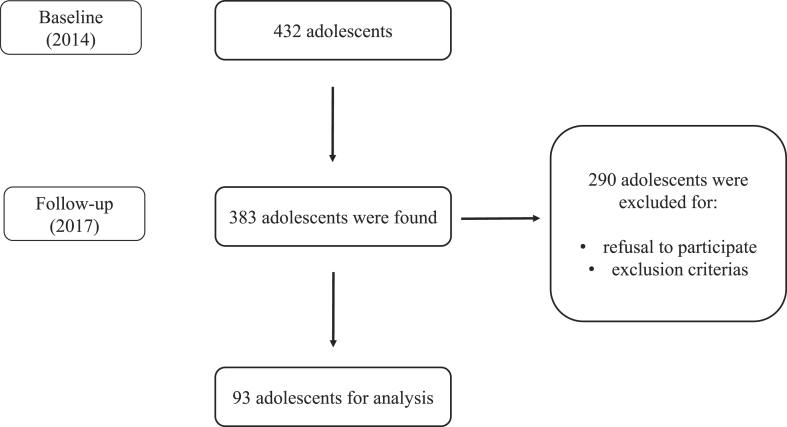
The sample consisted of 93 students (60% girls), with complete data sets in both 2014 and 2017. The physical fitness components evaluated were: flexibility (s), muscular fitness ( and ), cardiorespiratory fitness (), and body fat (BMI). The cardiometabolic risk factors were: waist circumference, blood pressure, high-density lipoprotein cholesterol (HDL-C), triglycerides and fasting blood glucose. Z were calculated for each risk factor, with the sum of risk factor values used to represent clustered cardiometabolic risk.
The results of cross-sectional analysis indicated that muscle fitness (: β = -0.37, < 0.001; β = -0.38, < 0.005) and cardiorespiratory fitness (β = -0.56, < 0.001) were inversely associated with clustered cardiometabolic risk, with BMI positively associated (β = 0.58, < 0.001). In the longitudinal analysis, cardiorespiratory fitness (β = -0.33; p < 0.005) and body fat (β = 0.46, p < 0.001) demonstrated a significant association with clustered cardiometabolic risk. However, no significant associations between the health-related physical fitness and clustered cardiometabolic risk were observed after adjustment for baseline values.
Our cross-sectional findings highlight the importance of health-related physical fitness indicators to adolescents. In regarding the longitudinal analysis, further studies are needed in order to clarify the influence of physical fitness in the adolescence and cardiometabolic risk later in life.
背景/目的:本研究调查了2014年至2017年青少年健康相关体能指标与聚集性心脏代谢危险因素之间的关系。
样本包括93名学生(60%为女生),他们在2014年和2017年都有完整的数据集。评估的体能成分包括:柔韧性(秒)、肌肉力量(和)、心肺功能()和体脂(BMI)。心脏代谢危险因素包括:腰围、血压、高密度脂蛋白胆固醇(HDL-C)、甘油三酯和空腹血糖。为每个危险因素计算Z值,用危险因素Z值的总和来表示聚集性心脏代谢风险。
横断面分析结果表明,肌肉力量(:β = -0.37,<0.001;β = -0.38,<0.005)和心肺功能(β = -0.56,<0.001)与聚集性心脏代谢风险呈负相关,BMI呈正相关(β = 0.58,<0.001)。在纵向分析中,心肺功能(β = -0.33;p < 0.005)和体脂(β = 0.46,p < 0.001)与聚集性心脏代谢风险有显著关联。然而,在对基线值进行调整后,未观察到健康相关体能与聚集性心脏代谢风险之间存在显著关联。
我们的横断面研究结果凸显了健康相关体能指标对青少年的重要性。关于纵向分析,需要进一步研究以阐明青少年时期体能对生命后期心脏代谢风险的影响。