Department of Pediatrics, Emma Children's Hospital, Amsterdam Reproduction and Development, Amsterdam Public Health Research Institute, Amsterdam UMC, Vrije Universiteit Amsterdam, De Boelelaan 1118, Room KTC 4-021, 1081 HZ, Amsterdam, The Netherlands.
Department of Gynecology and Obstetrics, Department of Clinical Epidemiology, Biostatistics and Bioinformatics, Amsterdam Reproduction and Development, Amsterdam Public Health Research Institute, Amsterdam UMC, University of Amsterdam, Meibergdreef 5, 1105 AZ, Amsterdam, The Netherlands.
Sports Med. 2018 Nov;48(11):2577-2605. doi: 10.1007/s40279-018-0974-5.
Although cardiorespiratory fitness (CRF) in childhood and adolescence may be linked to future cardiovascular health, there is currently limited evidence for a longitudinal association.
To provide a systematic review on the prospective association between CRF in childhood and adolescence and cardiovascular disease (CVD) risk factors at least 2 years later.
Using a systematic search of Medline, Embase, and SPORTDiscus, relevant articles were identified by the following criteria: generally healthy children and adolescents between 3 and 18 years of age with CRF assessed at baseline, and a follow-up period of ≥ 2 years. The outcome measures were CVD risk factors. We appraised quality of the included articles with STROBE and QUIPS checklists.
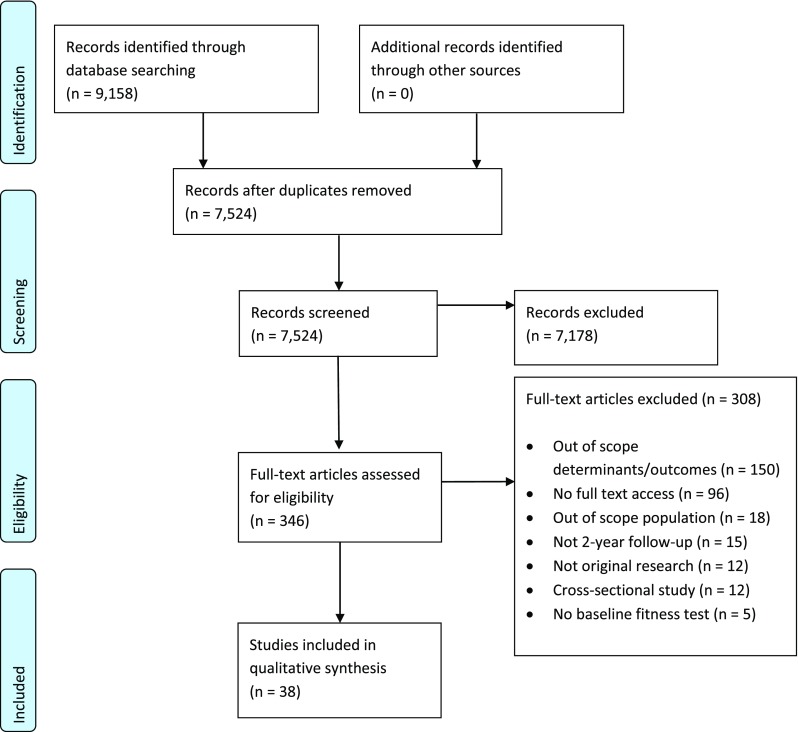
After screening 7524 titles and abstracts, we included 38 articles, assessing 44,169 children and adolescents followed up for a median of 6 years. Eleven articles were of high quality. There was considerable heterogeneity in methodology, measurement of CRF, and outcomes, which hampered meta-analysis. In approximately half of the included articles higher CRF in childhood and adolescence was associated with lower body mass index (BMI), waist circumference, body fatness and lower prevalence of metabolic syndrome in later life. No associations between CRF in childhood and adolescence and future waist-to-hip ratio, blood pressure, lipid profile, and glucose homeostasis were observed.
Although about half of the included articles reported inverse associations between CRF in childhood and adolescence and future BMI, body fatness, and metabolic syndrome, evidence for other CVD risk factors was unconvincing. Many articles did not account for important confounding factors such as adiposity. Recommendations for future research include standardizing the measurement of CRF, i.e. by reporting VO, using standardized outcome assessments, and performing individual patient data meta-analyses.
尽管儿童和青少年时期的心肺适能(CRF)可能与未来的心血管健康有关,但目前仅有有限的证据表明存在纵向关联。
提供一项系统综述,评估儿童和青少年时期的 CRF 与至少 2 年后心血管疾病(CVD)风险因素之间的前瞻性关联。
通过系统检索 Medline、Embase 和 SPORTDiscus,根据以下标准确定相关文章:基线时评估有 CRF 的一般健康的 3 至 18 岁儿童和青少年,以及随访时间≥2 年。结局指标为 CVD 风险因素。我们使用 STROBE 和 QUIPS 清单评估纳入文章的质量。
经过筛选 7524 篇标题和摘要,我们纳入了 38 篇文章,评估了 44169 名儿童和青少年,中位随访时间为 6 年。11 篇文章质量较高。由于方法学、CRF 测量和结局存在较大异质性,妨碍了荟萃分析。在大约一半的纳入文章中,儿童和青少年时期较高的 CRF 与较低的体重指数(BMI)、腰围、体脂率以及以后生活中代谢综合征的发生率较低相关。儿童和青少年时期的 CRF 与未来的腰臀比、血压、血脂谱和葡萄糖稳态之间没有关联。
尽管约一半的纳入文章报告了儿童和青少年时期的 CRF 与未来的 BMI、体脂率和代谢综合征之间存在负相关,但对于其他 CVD 风险因素的证据并不令人信服。许多文章没有考虑到重要的混杂因素,如肥胖。未来研究的建议包括通过报告 VO、使用标准化的结局评估以及进行个体患者数据荟萃分析来标准化 CRF 的测量。