Faculty of Physical Education, China West Normal University, Nanchong 637001, China.
China Volleyball College, Beijing Sport University, Beijing 100084, China.
Int J Environ Res Public Health. 2022 May 10;19(10):5783. doi: 10.3390/ijerph19105783.
Much evidence has indicated that adherence to the 24 h movement guidelines (physical activity, screen time and sleep) is associated with physical health, while little is known about the adherence to the 24 h movement guidelines and self-reported physical fitness in adolescents. This study, therefore, aims to explore the association between the 24 h movement guidelines (in isolation or combination) and self-reported physical fitness in a sample of Chinese adolescents in an age range of 10-17.
A convenient sample of 3807 children and adolescents from 12 schools was adopted in the present study. A questionnaire based on the Health Behaviour in School-aged Children was used to assess physical activity and screen time, and the Pittsburgh Sleep Scale was utilized to measure sleep duration. The International Fitness Scale was used to assess physical fitness in study participants. Ordinal logistic regression was performed to estimate the association between adherence to the 24 h movement guidelines and self-reported physical fitness.
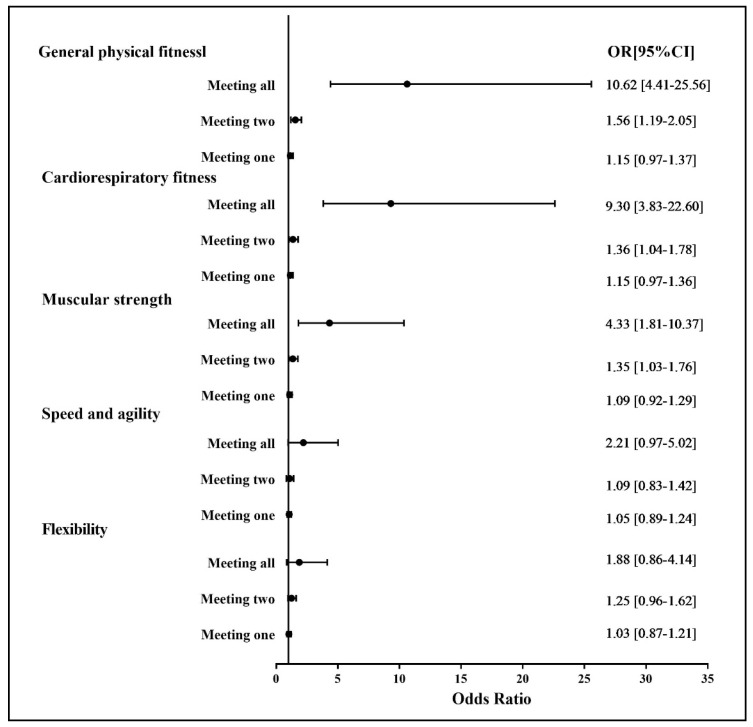
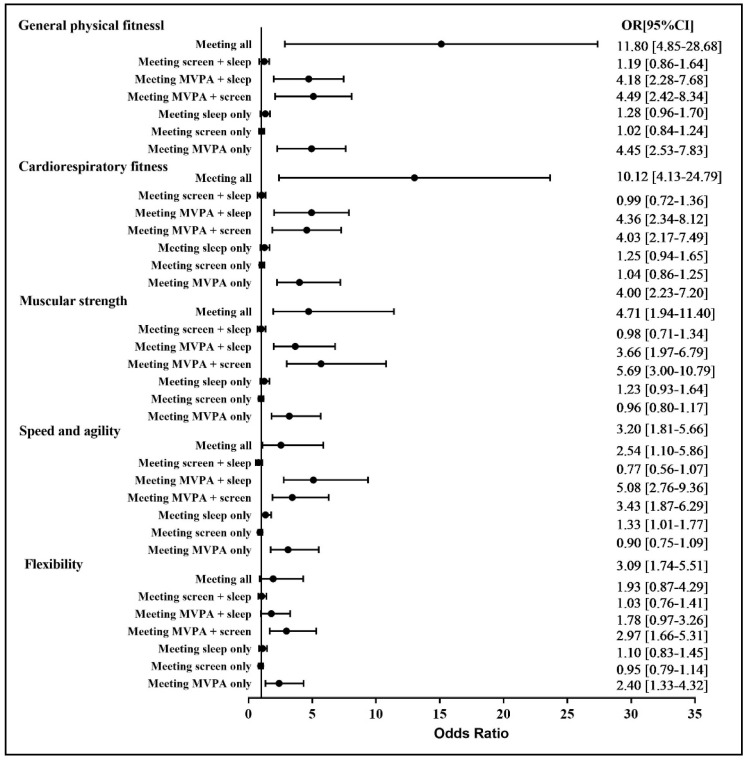
Of all study participants, 0.9% of them met the 24 h movement guidelines, and meeting the guidelines was significantly associated with higher levels of self-reported physical fitness. The analysis for the association between specific combinations of 24 h movement guidelines and self-reported physical fitness underscored the importance of meeting the physical activity recommendations.
Adherence to more recommendations contained in the 24 h movement guidelines was associated with higher self-reported physical fitness, especially cardiorespiratory fitness and muscular strength. Our study also stressed the importance of promoting moderate to vigorous physical activity in children and adolescents. Further works should focus on the association of a recommendation of adherence with other health indicators and replicate this study on larger samples among Chinese children and adolescents. Additionally, longitudinal or interventional studies that include more socio-demographic factors are needed to explore the association between 24 h movement guidelines and self-reported physical fitness, and the 24 h movement guidelines also should be promoted on a large scale in Chinese children and adolescents. Moreover, it is also needed to gain better insights into the directionality of the relationship between compliance with 24 h movement guidelines and self-reported physical fitness, as well as the mechanisms underlying the associations in Chinese children and adolescents.
大量证据表明,遵循 24 小时运动指南(体力活动、屏幕时间和睡眠)与身体健康有关,而对于青少年遵循 24 小时运动指南和自我报告的身体健康之间的关系知之甚少。因此,本研究旨在探讨在 10-17 岁的中国青少年样本中,24 小时运动指南(单独或组合)与自我报告的身体健康之间的关联。
本研究采用了来自 12 所学校的 3807 名儿童和青少年的便利样本。使用基于《青少年健康行为》的问卷评估体力活动和屏幕时间,使用匹兹堡睡眠量表测量睡眠时间。使用国际健身量表评估研究参与者的身体素质。使用有序逻辑回归估计遵守 24 小时运动指南与自我报告的身体健康之间的关联。
在所有研究参与者中,有 0.9%的人符合 24 小时运动指南,而遵守该指南与更高水平的自我报告身体健康显著相关。分析特定 24 小时运动指南组合与自我报告身体健康之间的关联强调了满足体力活动建议的重要性。
遵守 24 小时运动指南中包含的更多建议与更高的自我报告身体健康水平相关,尤其是心肺健康和肌肉力量。我们的研究还强调了在儿童和青少年中促进适度到剧烈体力活动的重要性。进一步的工作应侧重于遵守建议与其他健康指标的关联,并在更大的中国儿童和青少年样本中复制这项研究。此外,需要进行包括更多社会人口因素的纵向或干预性研究,以探讨 24 小时运动指南与自我报告的身体健康之间的关联,以及在广大中国儿童和青少年中推广 24 小时运动指南。此外,还需要更好地了解遵守 24 小时运动指南与自我报告的身体健康之间的关系的方向性,以及中国儿童和青少年中关联的机制。