Abdali Zainab I, Roberts Tracy E, Barton Pelham, Hawkey Peter M
Health Economics Unit, Institute of Applied Health Research, University of Birmingham, Edgbaston, Birmingham, B15 2TT, United Kingdom.
Institute of Microbiology and Infection, College of Medical and Dental Sciences, University of Birmingham, United Kingdom.
EClinicalMedicine. 2020 Jun 27;24:100420. doi: 10.1016/j.eclinm.2020.100420. eCollection 2020 Jul.
infection (CDI) is a hospital acquired disease associated with significant morbidity, hospitalisation and mortality. Almost 30% of treated patients experience at least one recurrence after treatment of their first episode. Treatment of recurrent CDI (rCDI) utilises vancomycin or fidaxomicin, however, a newer treatment option is faecal microbial transplantation (FMT) administered by nasogastric tube (NGT) or colonoscopy. It is associated with higher cure and lower recurrence rates than fidaxomicin or vancomycin. The aim of this analysis is to evaluate the cost effectiveness of FMT for rCDI using the latest and best evidence.
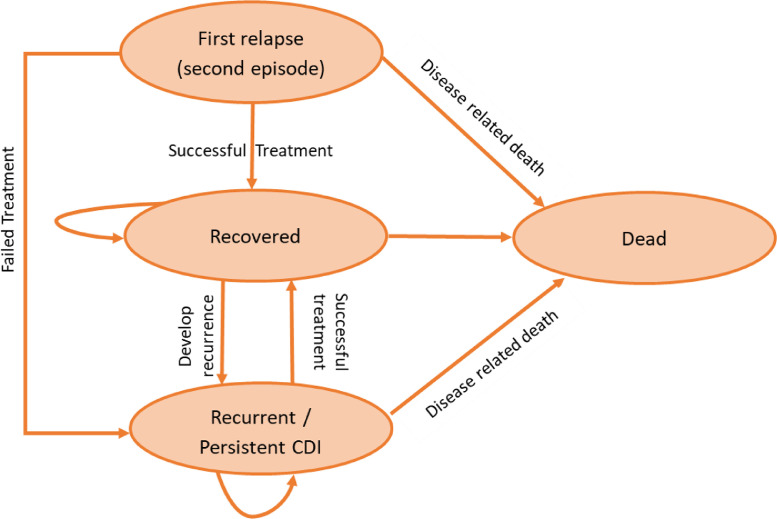
A cost utility analysis was conducted using a decision model representing the cost per additional Quality Adjusted Life Year (QALY) from a National Health Service (NHS) perspective. A Markov model was constructed to compare FMT NGT and colonoscopy to antibiotic treatment (fidaxomicin or vancomycin). The model was informed by a literature review of clinical evidence, specifically focussing on hospitalised patients with rCDI over 65 years. Both deterministic and probabilistic sensitivity analyses were performed to assess uncertainties around the model inputs and assumptions.
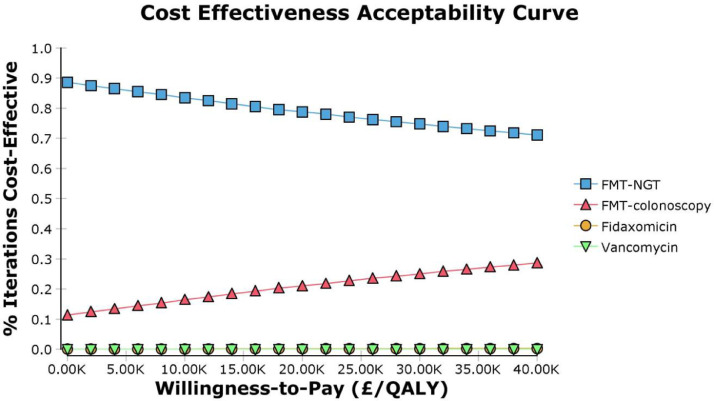
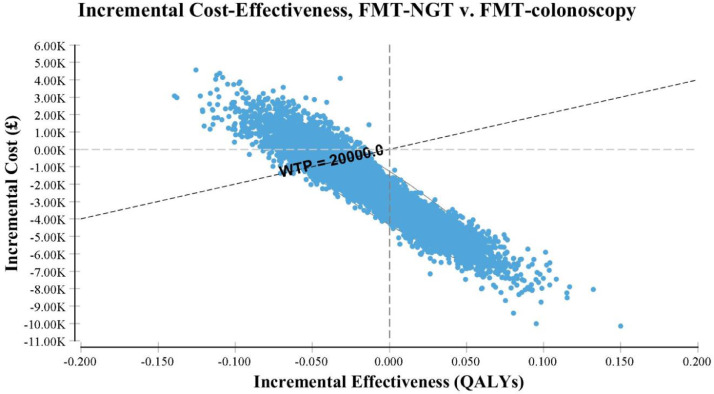
The base case analysis showed that FMT is a less costly and more effective treatment than either fidaxomicin or vancomycin. FMT colonoscopy was slightly more effective than FMT NGT leading to an additional 0.012 QALYs but more expensive and the incremental cost effectiveness ratio (ICER) was £242,514/QALY. The Probabilistic sensitivity analysis based on 10,000 simulations suggested the probability of FMT NGT being cost effective was almost 78% at £20,000/QALY Willingness-To-Pay (WTP) threshold.
FMT is both more effective and less costly option than antimicrobial therapy. FMT NGT was the preferred route of administration and is likely to be considered the most cost-effective strategy by decision makers given current acceptable thresholds.
艰难梭菌感染(CDI)是一种与高发病率、住院率和死亡率相关的医院获得性疾病。近30%接受治疗的患者在首次发作治疗后至少经历一次复发。复发性CDI(rCDI)的治疗使用万古霉素或非达霉素,然而,一种新的治疗选择是通过鼻胃管(NGT)或结肠镜进行粪便微生物移植(FMT)。与非达霉素或万古霉素相比,它具有更高的治愈率和更低的复发率。本分析的目的是利用最新和最佳证据评估FMT治疗rCDI的成本效益。
采用决策模型进行成本效用分析,从英国国家医疗服务体系(NHS)的角度计算每增加一个质量调整生命年(QALY)的成本。构建马尔可夫模型,将FMT NGT和结肠镜检查与抗生素治疗(非达霉素或万古霉素)进行比较。该模型以临床证据的文献综述为依据,特别关注65岁以上住院的rCDI患者。进行了确定性和概率敏感性分析,以评估模型输入和假设的不确定性。
基础病例分析表明,FMT比非达霉素或万古霉素成本更低、效果更好。FMT结肠镜检查比FMT NGT稍有效,可额外增加0.012个QALY,但成本更高,增量成本效益比(ICER)为242,514英镑/QALY。基于10,000次模拟的概率敏感性分析表明,在20,000英镑/QALY的支付意愿(WTP)阈值下,FMT NGT具有成本效益的概率接近78%。
FMT是比抗菌治疗更有效且成本更低的选择。FMT NGT是首选给药途径,鉴于当前可接受的阈值,决策者可能会认为这是最具成本效益的策略。