Hemorio, Rio de Janeiro, RJ, Brasil.
Instituto de Comunicação e Informação Científica e Tecnológica em Saúde, Fundação Instituto Oswaldo Cruz, Rio de Janeiro, RJ, Brasil.
Rev Saude Publica. 2020;54:69. doi: 10.11606/s1518-8787.2020054002643. Epub 2020 Jul 6.
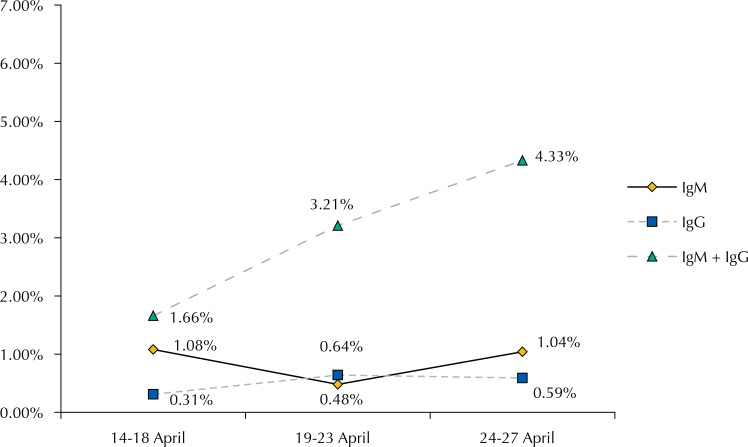
OBJECTIVE To estimate the seroprevalence of antibodies to SARS-CoV-2 among blood donors in the state of Rio de Janeiro, Brazil. METHODS Data were collected on 2,857 blood donors from April 14 to 27, 2020. This study reports crude prevalence of antibodies to SARS-CoV-2, population weighted prevalence for the state, and prevalence adjusted for test sensitivity and specificity. Logistic regression models were used to establish the correlates of SARS-CoV-2 prevalence. For the analysis, we considered collection period and site, sociodemographic characteristics, and place of residence. RESULTS The proportion of positive tests for SARS-Cov-2, without any adjustment, was 4.0% (95%CI 3.3-4.7%), and the weighted prevalence was 3.8% (95%CI 3.1-4.5%). We found lower estimates after adjusting for test sensitivity and specificity: 3.6% (95%CI 2.7-4.4%) for the non-weighted prevalence, and 3.3% (95%CI 2.6-4.1%) for the weighted prevalence. Collection period was the variable most significantly associated with crude prevalence: the later the period, the higher the prevalence. Regarding sociodemographic characteristics, the younger the blood donor, the higher the prevalence, and the lower the education level, the higher the odds of testing positive for SARS-Cov-2 antibody. We found similar results for weighted prevalence. CONCLUSIONS Our findings comply with some basic premises: the increasing trend over time, as the epidemic curve in the state is still on the rise; and the higher prevalence among both the youngest, for moving around more than older age groups, and the less educated, for encountering more difficulties in following social distancing recommendations. Despite the study limitations, we may infer that Rio de Janeiro is far from reaching the required levels of herd immunity against SARS-CoV-2.
估计巴西里约热内卢州献血者中 SARS-CoV-2 抗体的血清流行率。
本研究于 2020 年 4 月 14 日至 27 日收集了 2857 名献血者的数据。本研究报告了 SARS-CoV-2 抗体的粗流行率、该州的人群加权流行率以及根据检测敏感性和特异性进行调整的流行率。使用逻辑回归模型确定 SARS-CoV-2 流行率的相关因素。在分析中,我们考虑了采集时间和地点、社会人口统计学特征以及居住地。
未经任何调整,SARS-CoV-2 检测阳性率为 4.0%(95%CI 3.3-4.7%),加权流行率为 3.8%(95%CI 3.1-4.5%)。在调整了检测敏感性和特异性后,我们发现了较低的估计值:非加权流行率为 3.6%(95%CI 2.7-4.4%),加权流行率为 3.3%(95%CI 2.6-4.1%)。采集时间是与粗流行率最显著相关的变量:时间越晚,流行率越高。关于社会人口统计学特征,献血者年龄越小,流行率越高,受教育程度越低,SARS-CoV-2 抗体检测阳性的几率越高。我们在加权流行率方面也得到了类似的结果。
我们的发现符合一些基本前提:随着该州的疫情曲线仍在上升,时间上呈上升趋势;以及在最年轻的人群中以及受教育程度较低的人群中,流行率更高,因为他们比年龄较大的人群更频繁地外出,并且更难以遵守社会隔离建议。尽管存在研究局限性,但我们可以推断,里约热内卢州远未达到对 SARS-CoV-2 产生所需群体免疫的水平。