Aleksova Aneta, Ferro Federico, Gagno Giulia, Padoan Laura, Saro Riccardo, Santon Daniela, Stenner Elisabetta, Barbati Giulia, Cappelletto Chiara, Rossi Maddalena, Beltrami Antonio Paolo, Sinagra Gianfranco
Cardiovascular Department, Azienda Sanitaria Universitaria Giuliano Isontina (ASUGI) and Department of Medical Surgical and Health Sciences, University of Trieste, 34100 Trieste, Italy.
Azienda Ospedaliera di Perugia and University of Perugia, Cardiology and Cardiovascular Physiopathology, 06156 Perugia, Italy.
J Clin Med. 2020 Jul 6;9(7):2127. doi: 10.3390/jcm9072127.
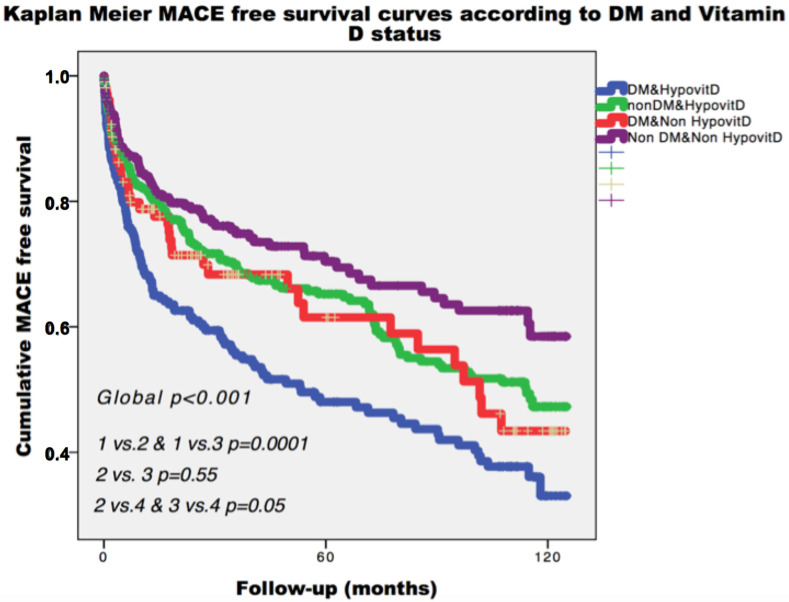
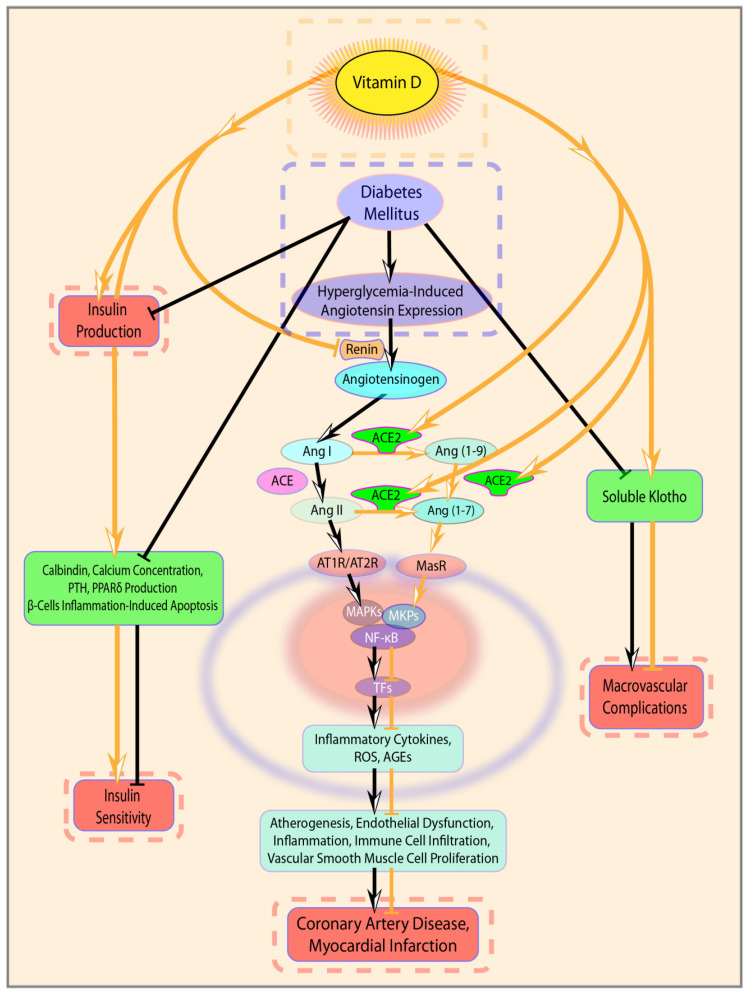
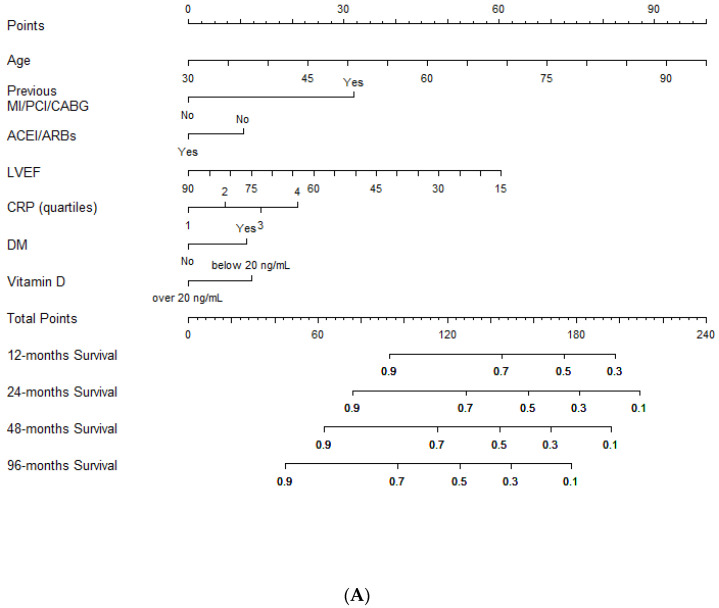
Survivors after a myocardial infarction (MI), especially those with diabetes mellitus (DM),remain at high risk of further events. Identifying and treating factors that may influence survivalmay open new therapeutic strategies. We assessed the impact on prognosis of DM andhypovitaminosis D (hypovitD), alone or combined. In this prospective, observational study, 1081patients were enrolled surviving an MI and divided into four groups according to their diabetic andVitD status. The primary end-point was composite of all-cause mortality, angina/MI and heartfailure (HF). Secondary outcomes were mortality, HF and angina/MI. During a follow-up of 26.1months (IQR 6.6-64.5), 391 subjects experienced the primary end-point. Patients with DM orhypovitD had similar rate of the composite end-point. Patients with only hypovitD or DM did notdiffer regarding components of composite end-point (angina p = 0.97, HF p = 0.29, mortality p = 0.62).DM and VitD deficiency had similarly adjusted risks for primary end-point (HR 1.3, 95%CI 1.05-1.61; HR 1.3, 95% CI 1.04-1.64). The adjusted HR for primary composite end-point for patients withhypovitD and DM was 1.69 (95%CI 1.25-2.29, p = 0.001) in comparison to patients with neitherhypoD nor DM. In conclusion, DM and hypovitD, individually and synergistically, are associatedwith a worse outcome after MI.
心肌梗死(MI)后的幸存者,尤其是糖尿病(DM)患者,仍面临进一步发病的高风险。识别和治疗可能影响生存的因素或许能开启新的治疗策略。我们评估了糖尿病和维生素D缺乏症(维生素D缺乏)单独或联合对预后的影响。在这项前瞻性观察研究中,1081名心肌梗死后存活的患者根据其糖尿病和维生素D状态分为四组。主要终点是全因死亡率、心绞痛/心肌梗死和心力衰竭(HF)的复合终点。次要结局是死亡率、心力衰竭和心绞痛/心肌梗死。在26.1个月(四分位间距6.6 - 64.5)的随访期间,391名受试者出现了主要终点。糖尿病患者或维生素D缺乏患者的复合终点发生率相似。仅患有维生素D缺乏或糖尿病的患者在复合终点的各个组成部分方面没有差异(心绞痛p = 0.97,心力衰竭p = 0.29,死亡率p = 0.62)。糖尿病和维生素D缺乏对主要终点的调整风险相似(风险比1.3,95%置信区间1.05 - 1.61;风险比1.3,95%置信区间1.04 - 1.64)。与既无维生素D缺乏也无糖尿病的患者相比,维生素D缺乏且患有糖尿病的患者主要复合终点的调整风险比为1.69(95%置信区间1.25 - 2.29,p = 0.001)。总之,糖尿病和维生素D缺乏单独或协同作用均与心肌梗死后更差的结局相关。