Division of Cardiovascular Medicine, Saitama Medical Center, Jichi Medical University, 1-847 Amanuma, Omiya-ku, Saitama, 330-8503, Japan.
Heart Vessels. 2021 Oct;36(10):1445-1456. doi: 10.1007/s00380-021-01827-w. Epub 2021 Mar 14.
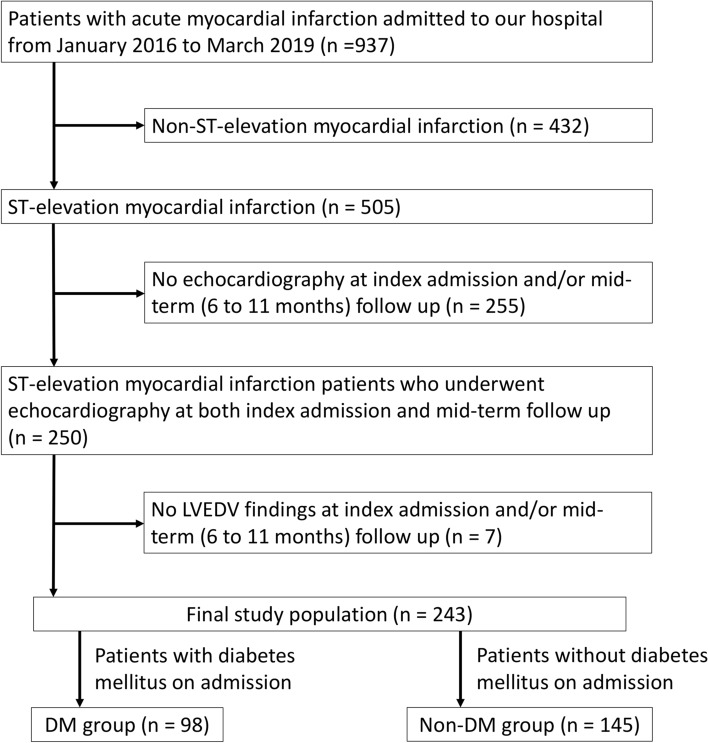
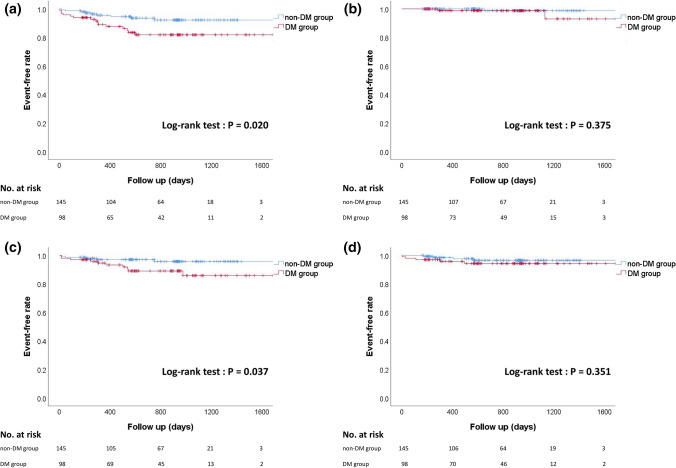
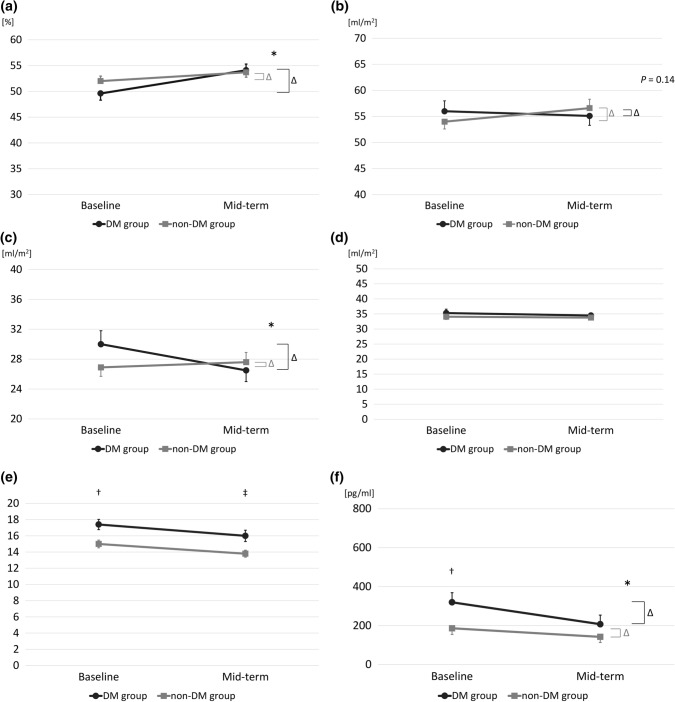
Left ventricular remodeling (LVR) after ST-elevation myocardial infarction (STEMI) is generally thought to be an adaptive but compromising phenomenon particularly in patients with diabetes mellitus (DM). However, whether the extent of LVR is associated with poor prognostic outcome with or without DM after STEMI in the modern era of reperfusion therapy has not been elucidated. This was a single-center retrospective observational study. Altogether, 243 patients who were diagnosed as having STEMI between January 2016 and March 2019, and examined with echocardiography at baseline (at the time of index admission) and mid-term (from 6 to 11 months after index admission) follow-up were included and divided into the DM (n = 98) and non-DM groups (n = 145). The primary outcome was major adverse cardiovascular events (MACEs) defined as the composite of all-cause death, heart failure (HF) hospitalization, and non-fatal myocardial infarction. The median follow-up duration was 621 days (interquartile range: 304-963 days). The DM group was significantly increased the rate of MACEs (P = 0.020) and HF hospitalization (P = 0.037) compared with the non-DM group, despite of less LVR. Multivariate Cox regression analyses revealed that the patients with DM after STEMI were significantly associated with MACEs (Hazard ratio [HR] 2.79, 95% confidence interval [CI] 1.20-6.47, P = 0.017) and HF hospitalization (HR 3.62, 95% CI 1.19-11.02, P = 0.023) after controlling known clinical risk factors. LVR were also significantly associated with MACEs (HR 2.44, 95% CI 1.03-5.78, P = 0.044) and HF hospitalization (HR 3.76, 95% CI 1.15-12.32, P = 0.029). The patients with both DM and LVR had worse clinical outcomes including MACEs and HF hospitalization, suggesting that it is particularly critical to minimize LVR after STEMI in patients with DM.
左心室重构(LVR)在 ST 段抬高型心肌梗死(STEMI)后通常被认为是一种适应性但有缺陷的现象,尤其是在糖尿病患者中。然而,在现代再灌注治疗时代,STEMI 后 LVR 的程度是否与合并或不合并糖尿病的不良预后相关尚未阐明。这是一项单中心回顾性观察性研究。共纳入 243 例 2016 年 1 月至 2019 年 3 月期间诊断为 STEMI 的患者,在基线(指数入院时)和中期(指数入院后 6 至 11 个月)随访时进行超声心动图检查,并分为糖尿病组(n=98)和非糖尿病组(n=145)。主要终点为主要不良心血管事件(MACEs),定义为全因死亡、心力衰竭(HF)住院和非致命性心肌梗死的复合终点。中位随访时间为 621 天(四分位间距:304-963 天)。尽管 LVR 较少,但糖尿病组的 MACEs 发生率(P=0.020)和 HF 住院率(P=0.037)均显著高于非糖尿病组。多变量 Cox 回归分析显示,STEMI 后合并糖尿病的患者与 MACEs(危险比[HR] 2.79,95%置信区间[CI] 1.20-6.47,P=0.017)和 HF 住院(HR 3.62,95% CI 1.19-11.02,P=0.023)显著相关,在控制已知临床危险因素后。LVR 也与 MACEs(HR 2.44,95% CI 1.03-5.78,P=0.044)和 HF 住院(HR 3.76,95% CI 1.15-12.32,P=0.029)显著相关。合并糖尿病和 LVR 的患者临床结局更差,包括 MACEs 和 HF 住院,这表明在糖尿病患者中,STEMI 后尽可能减少 LVR 尤为重要。