Laboratório de Planejamento e Desenvolvimento de Fármacos, Instituto de Ciências Exatas e Naturais, Universidade Federal do Pará, Belém, Pará 66075-110, Brazil.
Catalysis and Peptide Research Unit, University of KwaZulu-Natal, Durban 4000, South Africa.
Int J Mol Sci. 2020 Jul 6;21(13):4783. doi: 10.3390/ijms21134783.
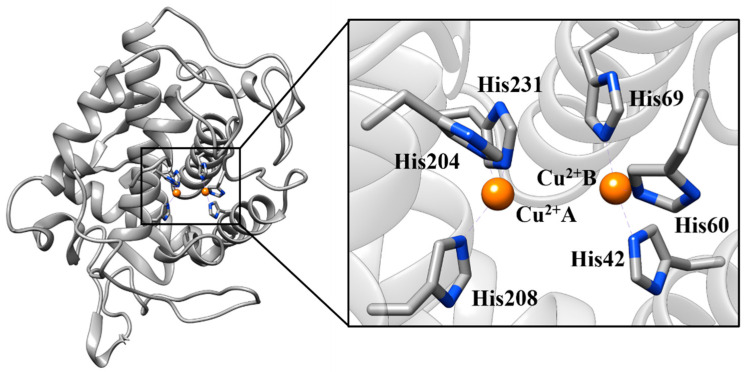
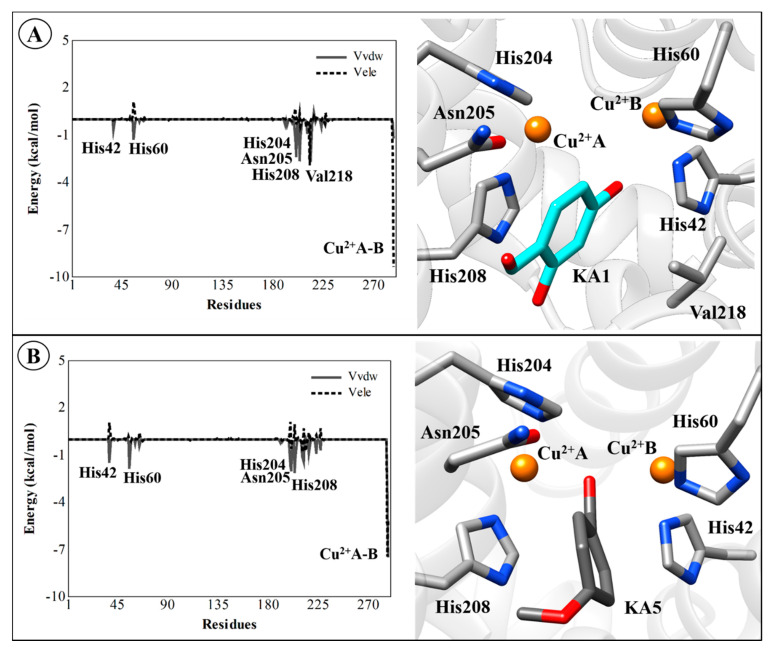
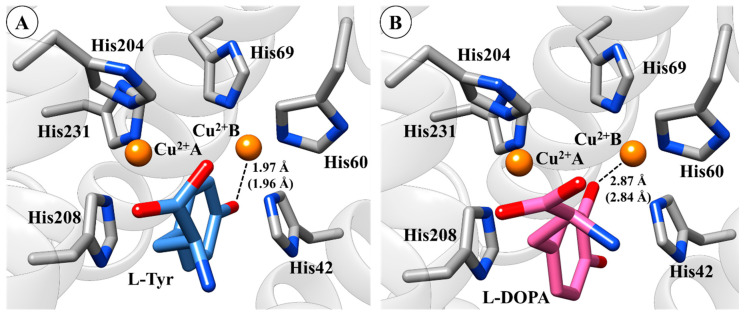
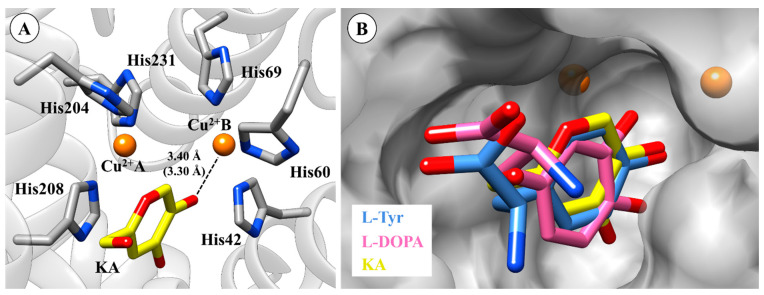
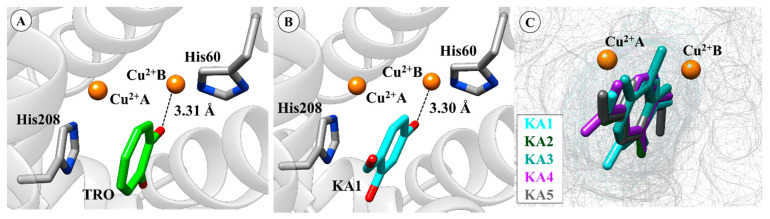
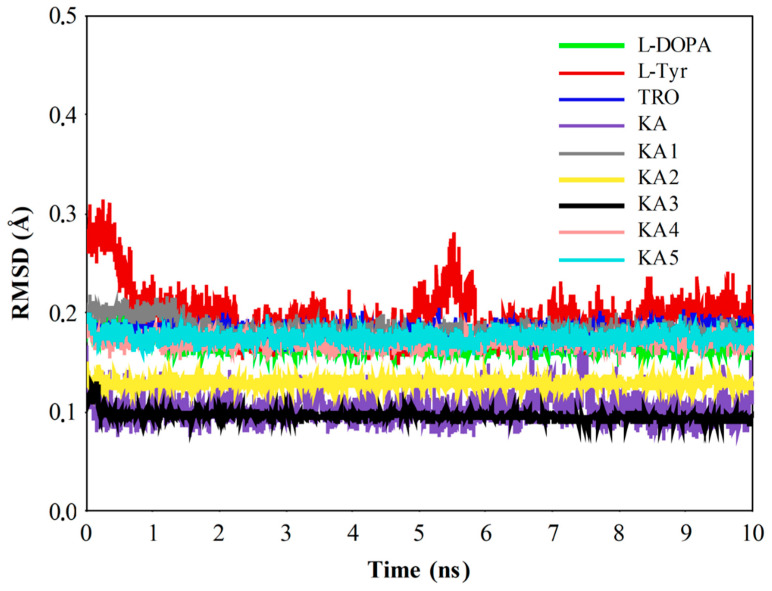
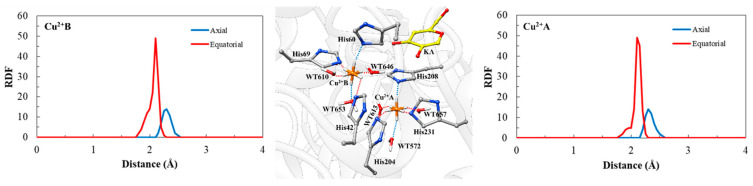
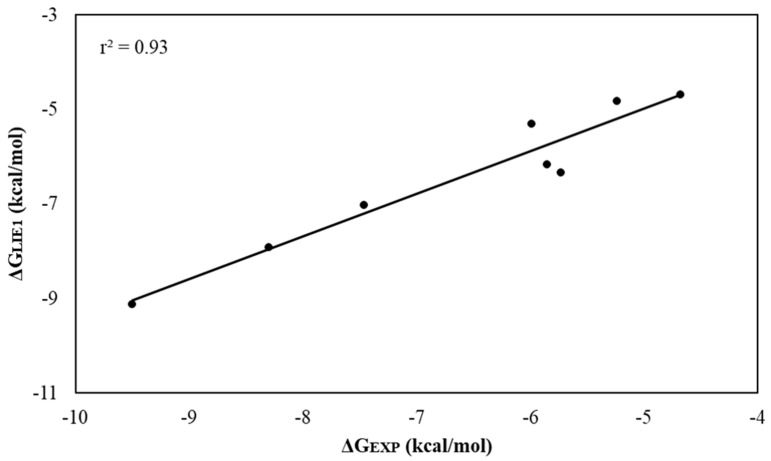
Tyrosinase (TYR) is a metalloenzyme classified as a type-3 copper protein, which is involved in the synthesis of melanin through a catalytic process beginning with the conversion of the amino acid l-Tyrosine (l-Tyr) to l-3,4-dihydroxyphenylalanine (l-DOPA). It plays an important role in the mechanism of melanogenesis in various organisms including mammals, plants, and fungi. Herein, we used a combination of computational molecular modeling techniques including molecular dynamic (MD) simulations and the linear interaction energy (LIE) model to evaluate the binding free energy of a set of analogs of kojic acid (KA) in complex with TYR. For the MD simulations, we used a dummy model including the description of the Jahn-Teller effect for Cu ions in the active site of this enzyme. Our results show that the LIE model predicts the TYR binding affinities of the inhibitor in close agreement to experimental results. Overall, we demonstrate that the classical model provides a suitable description of the main interactions between analogs of KA and Cu ions in the active site of TYR.
酪氨酸酶(TYR)是一种金属酶,归类为 3 型铜蛋白,通过催化过程参与黑色素的合成,该过程从氨基酸 l-酪氨酸(l-Tyr)转化为 l-3,4-二羟基苯丙氨酸(l-DOPA)开始。它在包括哺乳动物、植物和真菌在内的各种生物体的黑色素生成机制中起着重要作用。在此,我们使用了组合计算分子建模技术,包括分子动力学(MD)模拟和线性相互作用能(LIE)模型,来评估一组曲酸(KA)类似物与 TYR 结合的结合自由能。对于 MD 模拟,我们使用了一个虚拟模型,其中包括对该酶活性部位中 Cu 离子 Jahn-Teller 效应的描述。我们的结果表明,LIE 模型预测抑制剂与 TYR 的结合亲和力与实验结果非常吻合。总的来说,我们证明了经典模型为 KA 类似物与 TYR 活性部位中 Cu 离子之间的主要相互作用提供了合适的描述。