Georgetown University-Lombardi Comprehensive Cancer Center, Cancer Prevention and Control Program, 3300 Whitehaven St. NW, Washington, DC, USA.
Department of Epidemiology, University of Michigan School of Public Health, 1415 Washington Heights, Ann Arbor, MI, USA.
BMC Public Health. 2020 Jul 9;20(1):1055. doi: 10.1186/s12889-020-09055-z.
The United States (US) Food and Drug Administration (FDA), under the 2009 Family Smoking Prevention and Tobacco Control Act, banned characterizing flavors in cigarettes; however, mentholated tobacco products were exempt. Since 2009, over 20 US jurisdictions and numerous countries around the world have extended this restriction to menthol. Currently, the FDA is reconsidering its position on a nation-wide menthol cigarette ban. However, the effects of such a ban remain unclear. We conducted a scoping review to explore the impact of a menthol cigarette ban on individual behaviors (initiation, cessation, and product switching), sales, and compliance.
We conducted a search of the international literature using PubMed, EBSCO, and Web of Science (to November 25, 2019). We retrieved articles relevant to the impacts of an implemented or hypothetical menthol ban. We also included studies of flavored tobacco product bans due to their potential relevance in gauging compliance and product substitutability.
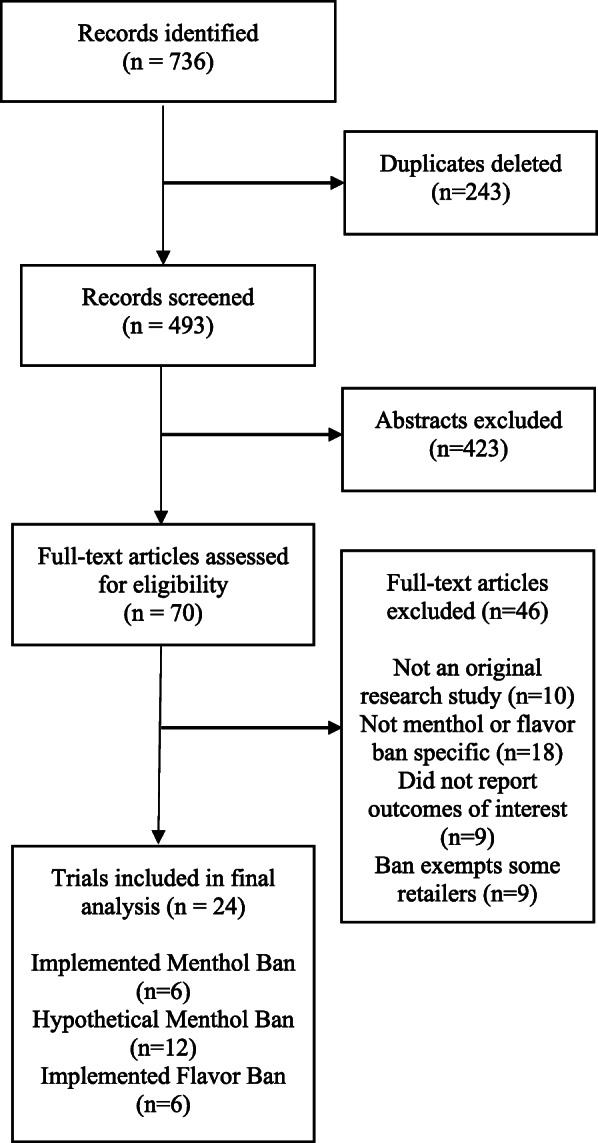
The search identified 493 articles, of which 24 were included. Studies examined the effects of implemented menthol bans (n = 6), hypothetical menthol bans (n = 12) and implemented flavor bans that exclude menthol (n = 6). Menthol bans were found to reduce sales and increase smoking cessation with only partial substitution for non-menthol cigarettes. US smokers' reactions to a hypothetical ban indicate that about 25-64% would attempt to quit smoking and 11-46% would consider switching to other tobacco products, including 15-30% to e-cigarettes. Flavor ban studies indicate reductions in initiation of 6%. Ban compliance was high, but studies indicate that the tobacco industry and retailers have attempted to circumvent their impact via packaging changes and online sales.
Our review finds that extending the US cigarette flavor ban to menthol products would promote smoking cessation and reduce initiation. This evidence supports further action by the FDA towards mentholated tobacco products. However, few studies have been conducted in the vaping era.
根据 2009 年《家庭吸烟预防和烟草控制法》,美国食品和药物管理局(FDA)禁止在香烟中使用特征风味;然而,薄荷醇烟草制品被豁免。自 2009 年以来,超过 20 个美国司法管辖区和全球许多国家已将这一限制扩大到薄荷醇。目前,FDA 正在重新考虑其在全国范围内禁止薄荷醇香烟的立场。然而,这种禁令的效果仍不清楚。我们进行了范围界定审查,以探讨薄荷醇香烟禁令对个人行为(起始、戒烟和产品转换)、销售和合规的影响。
我们使用 PubMed、EBSCO 和 Web of Science(截至 2019 年 11 月 25 日)对国际文献进行了搜索。我们检索了与实施或假设的薄荷醇禁令影响相关的文章。我们还包括了调味烟草制品禁令的研究,因为它们在评估合规性和产品可替代性方面具有潜在的相关性。
搜索确定了 493 篇文章,其中 24 篇被纳入。研究考察了实施的薄荷醇禁令(n=6)、假设的薄荷醇禁令(n=12)和不包括薄荷醇的实施风味禁令(n=6)的影响。薄荷醇禁令被发现减少了销售并增加了戒烟率,只是对非薄荷醇香烟的部分替代。美国吸烟者对假设禁令的反应表明,约 25-64%的人会试图戒烟,11-46%的人会考虑改用其他烟草产品,包括 15-30%的人会改用电子烟。禁令研究表明,起始率降低了 6%。禁令的合规性很高,但研究表明,烟草业和零售商试图通过包装改变和在线销售来规避其影响。
我们的审查发现,将美国香烟风味禁令扩大到薄荷醇产品将促进戒烟并减少起始吸烟。这一证据支持 FDA 对薄荷醇烟草制品采取进一步行动。然而,在电子烟时代,很少有研究进行。