Letamo Gobopamang
Population Studies, University of Botswana, Gaborone, Botswana
BMJ Open. 2020 Jul 8;10(7):e038614. doi: 10.1136/bmjopen-2020-038614.
To estimate the prevalence and trends in underweight, overweight/obesity and identify their sociodemographic correlates among adults in Botswana from 2007 to 2017.
The study analysed cross-sectional and nationally representative data from 2007 to 2014 Botswana STEPS Surveys and the 2017 Botswana Demographic Survey.
Botswana.
Botswana adults aged 25-64 years (n=4003 in 2007, n=2983 in 2014 and n=11 550 in 2017).
Underweight and overweight/obesity.
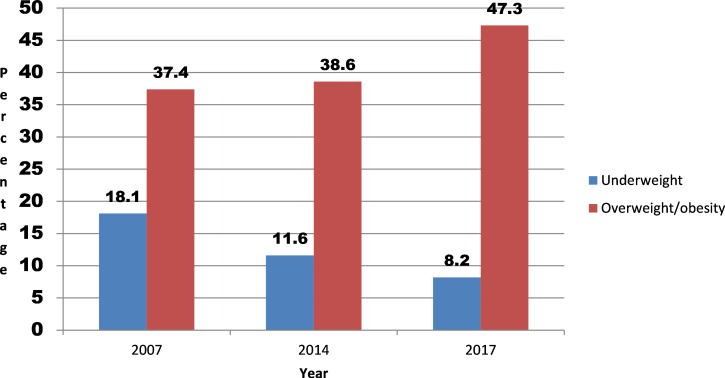
The prevalence of underweight decreased from 18.1% (95% CI 12.0% to 26.3%) in 2007 to 11.6% (95% CI 9.5% to 13.9%) in 2014 and further dropped to 8.1% (95% CI 7.5% to 8.8%) in 2017. The prevalence of overweight/obesity increased slightly from 37.4% (95% CI 34.3% to 40.7%) in 2007 to 38.6% (95% CI 35.9% to 41.3%) in 2014 to 47.3% (95% CI 46.1% to 48.4%) in 2017. Underweight was more prevalent among males than females while overweight and obesity were more prevalent among females than males. The key risk factor for underweight was being male (adjusted OR (AOR) 2.21: 95% CI 1.80 to 2.72 in 2007, AOR 1.54: 95% CI 1.06 to 2.22 in 2014 and AOR 1.51: 95% CI 1.45 to 1.58 in 2017). For overweight/obesity, the main risk factors were being female (male AOR 0.23: 95% CI 0.15 to 0.35 in 2007, AOR 0.32: 95% CI 0.25 to 0.42 in 2014 and AOR 0.30: 95% CI 0.29 to 0.31 in 2017), being old (AOR 2.18: 95% CI 1.58 to 3.01 in 2007, AOR 2.37: 95% CI 1.71 to 3.29 in 2014) and AOR 2.10: 95% CI 1.94 to 2.27 in 2017 among those aged 55-64 years) and not working (AOR 1.70: 95% CI 1.20 to 2.42 in 2007, AOR 2.05: 95% CI 1.55 to 2.69 in 2014 and AOR 1.34: 95% CI 1.27 to 1.40 in 2017).
The findings presented in this study indicate coexistence of the double burden of underweight and overweight/obesity among adults aged 25-64 years in Botswana. Although underweight prevalence is on the decline, overweight/obesity is increasing over time. The problem of underweight and overweight/obesity needs immediate and effective interventions.
评估2007年至2017年博茨瓦纳成年人中体重不足、超重/肥胖的患病率及趋势,并确定其社会人口学相关因素。
该研究分析了2007年至2014年博茨瓦纳成人生活方式与健康行为监测调查(STEPS)以及2017年博茨瓦纳人口调查的横断面数据,这些数据具有全国代表性。
博茨瓦纳。
年龄在25 - 64岁的博茨瓦纳成年人(2007年n = 4003,2014年n = 2983,2017年n = 11550)。
体重不足和超重/肥胖。
体重不足的患病率从2007年的18.1%(95%置信区间12.0%至26.3%)降至2014年的11.6%(95%置信区间9.5%至13.9%),并在2017年进一步降至8.1%(95%置信区间7.5%至8.8%)。超重/肥胖的患病率从2007年的37.4%(95%置信区间34.3%至40.7%)略有上升至2014年的38.6%(95%置信区间35.9%至41.3%),再到2017年的47.3%(95%置信区间46.1%至48.4%)。体重不足在男性中比女性更普遍,而超重和肥胖在女性中比男性更普遍。体重不足的关键风险因素是男性(2007年调整后比值比(AOR)2.21:95%置信区间1.80至2.72,2014年AOR 1.54:95%置信区间1.06至2.22,2017年AOR 1.51:95%置信区间1.45至1.58)。对于超重/肥胖,主要风险因素是女性(2007年男性AOR 0.23:95%置信区间0.15至0.35,2014年AOR 0.32:95%置信区间0.25至0.42,2017年AOR 0.30:95%置信区间0.29至0.31)、年龄较大(2007年AOR 2.18:95%置信区间1.58至3.01,2014年AOR 2.37:95%置信区间1.71至3.29,2017年55 - 64岁人群中AOR 2.10:95%置信区间1.94至2.27)以及未工作(2007年AOR 1.70:95%置信区间1.20至2.42,2014年AOR