South London and Maudsley NHS Foundation Trust, London, UK
South London and Maudsley NHS Foundation Trust, London, UK.
BMJ Open. 2020 Jul 7;10(7):e035884. doi: 10.1136/bmjopen-2019-035884.
Linkage of electronic health records (EHRs) to Hospital Episode Statistics (HES)-Office for National Statistics (ONS) mortality data has provided compelling evidence for lower life expectancy in people with severe mental illness. However, linkage error may underestimate these estimates. Using a clinical sample (n=265 300) of individuals accessing mental health services, we examined potential biases introduced through missed matching and examined the impact on the association between clinical disorders and mortality.
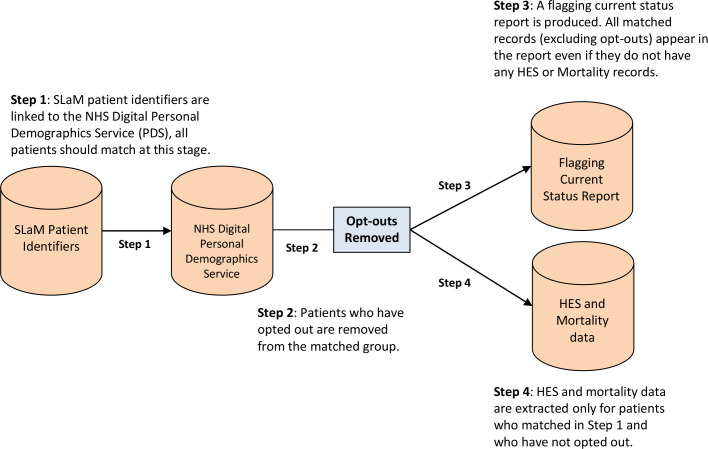
The South London and Maudsley NHS Foundation Trust (SLaM) is a secondary mental healthcare provider in London. A deidentified version of SLaM's EHR was available via the Clinical Record Interactive Search system linked to HES-ONS mortality records.
Records from SLaM for patients active between January 2006 and December 2016.
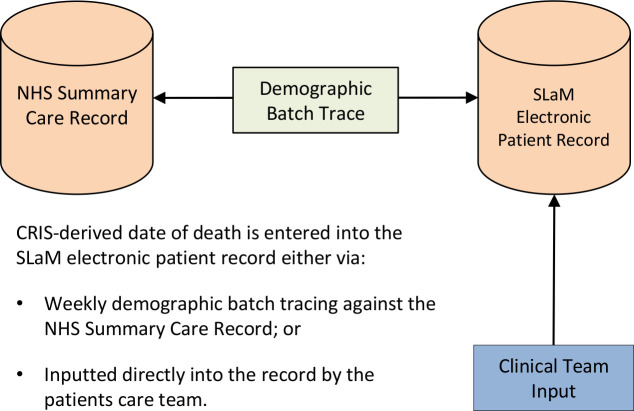
Two sources of death data were available for SLaM participants: accurate and contemporaneous date of death via local batch tracing (gold standard) and date of death via linked HES-ONS mortality data. The effect of linkage error on mortality estimates was evaluated by comparing sociodemographic and clinical risk factor analyses using gold standard death data against HES-ONS mortality records.
Of the total sample, 93.74% were successfully matched to HES-ONS records. We found a number of statistically significant administrative, sociodemographic and clinical differences between matched and unmatched records. Of note, schizophrenia diagnosis showed a significant association with higher mortality using gold standard data (OR 1.08; 95% CI 1.01 to 1.15; p0.02) but not in HES-ONS data (OR 1.05; 95% CI 0.98 to 1.13; p0.16). Otherwise, little change was found in the strength of associated risk factors and mortality after accounting for missed matching bias.
Despite significant clinical and sociodemographic differences between matched and unmatched records, changes in mortality estimates were minimal. However, researchers and policy analysts using HES-ONS linked resources should be aware that administrative linkage processes can introduce error.
将电子健康记录(EHR)与医院病例统计(HES)-国家统计局(ONS)死亡率数据进行链接,为严重精神疾病患者预期寿命较低提供了有力证据。然而,链接错误可能会低估这些估计值。我们使用一个临床样本(n=265300),该样本中的个体正在接受心理健康服务,研究了错过匹配引入的潜在偏差,并检查了其对临床疾病与死亡率之间关联的影响。
伦敦南伦敦和莫兹利国民保健信托基金会(SLaM)是一家二级精神保健服务提供商。通过 Clinical Record Interactive Search 系统,可以获得 SLaM 的 EHR 的匿名版本,该系统与 HES-ONS 死亡率记录相链接。
SLaM 患者在 2006 年 1 月至 2016 年 12 月期间的活动记录。
SLaM 参与者有两种死亡数据来源:通过本地批量跟踪获得的准确和同期死亡日期(黄金标准)以及通过链接的 HES-ONS 死亡率数据获得的死亡日期。通过将使用黄金标准死亡数据的社会人口统计学和临床危险因素分析与 HES-ONS 死亡率记录进行比较,评估了链接错误对死亡率估计的影响。
在总样本中,93.74%的患者成功与 HES-ONS 记录相匹配。我们发现匹配和不匹配记录之间存在许多具有统计学意义的行政、社会人口统计学和临床差异。值得注意的是,使用黄金标准数据,精神分裂症诊断与更高的死亡率呈显著相关(OR 1.08;95%CI 1.01 至 1.15;p0.02),但在 HES-ONS 数据中则不然(OR 1.05;95%CI 0.98 至 1.13;p0.16)。然而,在考虑到错过匹配偏差后,相关风险因素和死亡率的变化很小。
尽管匹配和不匹配记录之间存在显著的临床和社会人口统计学差异,但死亡率估计值的变化很小。然而,使用 HES-ONS 链接资源的研究人员和政策分析师应该意识到,行政链接过程可能会引入错误。