• 文献检索
  • 文档翻译
  • 深度研究
  • 学术资讯
  • Suppr Zotero 插件Zotero 插件
  • 邀请有礼
  • 套餐&价格
  • 历史记录
应用&插件
Suppr Zotero 插件Zotero 插件浏览器插件Mac 客户端Windows 客户端微信小程序
定价
高级版会员购买积分包购买API积分包
服务
文献检索文档翻译深度研究API 文档MCP 服务
关于我们
关于 Suppr公司介绍联系我们用户协议隐私条款
关注我们

Suppr 超能文献

核心技术专利:CN118964589B侵权必究
粤ICP备2023148730 号-1Suppr @ 2026

文献检索

告别复杂PubMed语法,用中文像聊天一样搜索,搜遍4000万医学文献。AI智能推荐,让科研检索更轻松。

立即免费搜索

文件翻译

保留排版,准确专业,支持PDF/Word/PPT等文件格式,支持 12+语言互译。

免费翻译文档

深度研究

AI帮你快速写综述,25分钟生成高质量综述,智能提取关键信息,辅助科研写作。

立即免费体验

复发性 WHO 分级 I 级脑膜瘤的组织学转化。

Histological transformation in recurrent WHO grade I meningiomas.

机构信息

Department of Neurosurgery, Geneva University Hospitals, Rue Gabrielle Perret Gentil 4, 1205, Geneva, Switzerland.

Department of Neurosurgery, Angers University Hospitals, Rue Larrey 4, 49100, Angers, France.

出版信息

Sci Rep. 2020 Jul 8;10(1):11220. doi: 10.1038/s41598-020-68177-x.

DOI:10.1038/s41598-020-68177-x
PMID:32641701
原文链接:https://pmc.ncbi.nlm.nih.gov/articles/PMC7343790/
Abstract

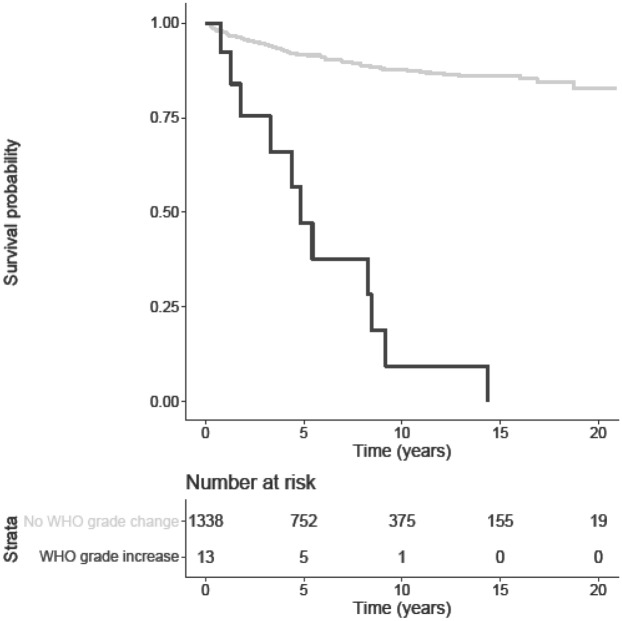
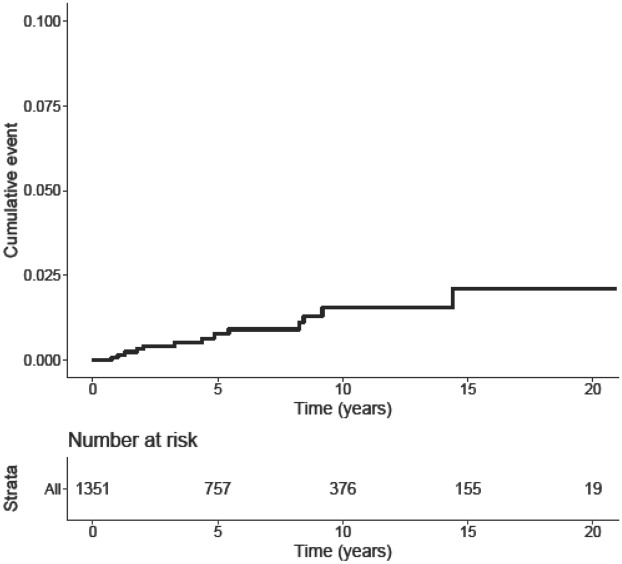
Atypical or malignant transformation (AT/MT) has been described in WHO grade I meningiomas. Our aim was to identify predictive factors of AT/MT at recurrence. A total of N = 15 WHO grade increases were observed in N = 13 patients (0.96% of the study population, risk of transformation of 0.12% per patient-year follow-up). Patients with and without progression at recurrence were similar regarding age, gender distribution, skull-base location, bone infiltration, and Simpson grades. Recurrence-free survival was lower in patients with transformation (5 ± 4.06 years versus 7.3 ± 5.4 years; p = 0.03). Among patient age, gender, skull base location, extent of resection or post-operative RT, no predictor of AT/MT was identified, despite a follow-up of 10,524 patient-years. The annual risk of transformation of WHO grade I meningiomas was 0.12% per patient-year follow-up. Despite the important number of patients included and their extended follow-up, we did not identify any risk factor for transformation. A total of 1,352 patients with surgically managed WHO grade I meningioma from a mixed retro-and prospective database with mean follow-up of 9.2 years ± 5.7 years (0.3-20.9 years) were reviewed. Recurring tumors at the site of initial surgery were considered as recurrence.

摘要

非典型或恶性转化(AT/MT)已在 WHO 分级 I 脑膜瘤中描述。我们的目的是确定复发时 AT/MT 的预测因素。在 N = 13 名患者(研究人群的 0.96%,每位患者每年随访的转化风险为 0.12%)中观察到总共 N = 15 次 WHO 分级增加。复发时进展和无进展的患者在年龄、性别分布、颅底位置、骨浸润和 Simpson 分级方面相似。转化患者的无复发生存率较低(5 ± 4.06 年与 7.3 ± 5.4 年;p = 0.03)。尽管随访时间长达 10,524 患者年,但在患者年龄、性别、颅底位置、切除程度或术后放疗方面,没有发现 AT/MT 的预测因素。WHO 分级 I 脑膜瘤的年转化风险为每位患者每年随访 0.12%。尽管纳入了大量患者并进行了延长随访,但我们未发现任何转化的危险因素。我们回顾了来自回顾性和前瞻性混合数据库的 1,352 名接受手术治疗的 WHO 分级 I 脑膜瘤患者,平均随访 9.2 ± 5.7 年(0.3-20.9 年)。将初始手术部位的复发性肿瘤视为复发。
https://cdn.ncbi.nlm.nih.gov/pmc/blobs/0fee/7343790/b40f8693a41f/41598_2020_68177_Fig2_HTML.jpg
https://cdn.ncbi.nlm.nih.gov/pmc/blobs/0fee/7343790/47ddc439185b/41598_2020_68177_Fig1_HTML.jpg
https://cdn.ncbi.nlm.nih.gov/pmc/blobs/0fee/7343790/b40f8693a41f/41598_2020_68177_Fig2_HTML.jpg
https://cdn.ncbi.nlm.nih.gov/pmc/blobs/0fee/7343790/47ddc439185b/41598_2020_68177_Fig1_HTML.jpg
https://cdn.ncbi.nlm.nih.gov/pmc/blobs/0fee/7343790/b40f8693a41f/41598_2020_68177_Fig2_HTML.jpg

相似文献

1
Histological transformation in recurrent WHO grade I meningiomas.复发性 WHO 分级 I 级脑膜瘤的组织学转化。
Sci Rep. 2020 Jul 8;10(1):11220. doi: 10.1038/s41598-020-68177-x.
2
The Simpson grading in meningioma surgery: does the tumor location influence the prognostic value?脑膜瘤手术中的辛普森分级:肿瘤位置会影响其预后价值吗?
J Neurooncol. 2017 Jul;133(3):641-651. doi: 10.1007/s11060-017-2481-1. Epub 2017 May 19.
3
WHO grade 1 meningioma recurrence: Are location and Simpson grade still relevant?世界卫生组织1级脑膜瘤复发:位置和辛普森分级仍然相关吗?
Clin Neurol Neurosurg. 2016 Feb;141:117-21. doi: 10.1016/j.clineuro.2016.01.006. Epub 2016 Jan 8.
4
Intracranial Clear Cell Meningiomas: Study on Clinical Features and Predictors of Recurrence.颅内透明细胞型脑膜瘤:临床特征及复发预测因素研究
World Neurosurg. 2017 Jan;97:693-700.e11. doi: 10.1016/j.wneu.2016.10.010. Epub 2016 Oct 12.
5
Is the Simpson Grading System Applicable to Estimate the Risk of Tumor Progression After Microsurgery for Recurrent Intracranial Meningioma?辛普森分级系统是否适用于评估复发性颅内脑膜瘤显微手术后的肿瘤进展风险?
World Neurosurg. 2018 Nov;119:e589-e597. doi: 10.1016/j.wneu.2018.07.215. Epub 2018 Aug 4.
6
Necrosis is a consistent factor to recurrence of meningiomas: should it be a stand-alone grading criterion for grade II meningioma?坏死是脑膜瘤复发的一个一致因素:它是否应该成为 II 级脑膜瘤的独立分级标准?
J Neurooncol. 2018 Apr;137(2):331-336. doi: 10.1007/s11060-017-2721-4. Epub 2017 Dec 21.
7
Long-term survival analysis of atypical meningiomas: survival rates, prognostic factors, operative and radiotherapy treatment.非典型脑膜瘤的长期生存分析:生存率、预后因素、手术及放射治疗
Acta Neurochir (Wien). 2014 Aug;156(8):1475-81. doi: 10.1007/s00701-014-2156-z. Epub 2014 Jun 26.
8
Recurrence Interval Within 1 Year Leads to Death in Patients with Grade 2 Meningioma.1 年内复发会导致 2 级脑膜瘤患者死亡。
World Neurosurg. 2020 Oct;142:e58-e65. doi: 10.1016/j.wneu.2020.05.145. Epub 2020 May 23.
9
Impact of postoperative radiotherapy on recurrence of primary intracranial atypical meningiomas.术后放疗对原发性颅内非典型脑膜瘤复发的影响。
J Neurooncol. 2020 Jan;146(2):347-355. doi: 10.1007/s11060-019-03382-x. Epub 2020 Jan 3.
10
The Simpson grading revisited: aggressive surgery and its place in modern meningioma management.辛普森分级再探讨:积极手术及其在现代脑膜瘤管理中的地位。
J Neurosurg. 2016 Sep;125(3):551-60. doi: 10.3171/2015.9.JNS15754. Epub 2016 Jan 29.

引用本文的文献

1
The role of adjuvant radiotherapy for intracranial malignant meningiomas: analysis of a nationwide database.颅内恶性脑膜瘤辅助放疗的作用:全国性数据库分析。
J Neurooncol. 2024 Sep;169(2):369-378. doi: 10.1007/s11060-024-04720-4. Epub 2024 May 30.
2
Spatial genomic, biochemical and cellular mechanisms underlying meningioma heterogeneity and evolution.脑膜瘤异质性和演变背后的空间基因组、生化和细胞机制。
Nat Genet. 2024 Jun;56(6):1121-1133. doi: 10.1038/s41588-024-01747-1. Epub 2024 May 17.
3
Postoperative [Ga]Ga-DOTA-TATE PET/CT imaging is prognostic for progression-free survival in meningioma WHO grade 1.

本文引用的文献

1
Extent of Resection in Meningioma: Predictive Factors and Clinical Implications.脑膜瘤切除术范围:预测因素与临床意义。
Sci Rep. 2019 Apr 11;9(1):5944. doi: 10.1038/s41598-019-42451-z.
2
Posterior fossa meningiomas: perioperative predictors of extent of resection, overall survival and progression-free survival.后颅窝脑膜瘤:手术切除范围、总生存率和无进展生存率的围手术期预测因素。
Acta Neurochir (Wien). 2019 May;161(5):1003-1011. doi: 10.1007/s00701-019-03862-z. Epub 2019 Mar 11.
3
Meningioma Surgery-Are We Making Progress?脑膜瘤手术——我们有进展吗?
术后 [Ga]Ga-DOTA-TATE PET/CT 成像对 1 级脑膜瘤无进展生存期具有预后价值。
Eur J Nucl Med Mol Imaging. 2023 Dec;51(1):206-217. doi: 10.1007/s00259-023-06400-3. Epub 2023 Aug 29.
4
Spatial genomic, biochemical, and cellular mechanisms drive meningioma heterogeneity and evolution.空间基因组、生化和细胞机制驱动脑膜瘤的异质性和进化。
Res Sq. 2023 May 15:rs.3.rs-2921804. doi: 10.21203/rs.3.rs-2921804/v1.
5
Surgical strategies for intracranial meningioma in the molecular era.分子时代颅内脑膜瘤的手术策略。
J Neurooncol. 2023 Apr;162(2):253-265. doi: 10.1007/s11060-023-04272-z. Epub 2023 Apr 3.
6
De Novo Skull Base Atypical Meningioma: Incidence and Outcome.原发性颅底非典型脑膜瘤:发病率及预后
J Neurol Surg B Skull Base. 2022 Mar 8;84(2):113-118. doi: 10.1055/a-1757-3212. eCollection 2023 Apr.
7
Long-term outcomes of fractionated proton beam therapy for benign or radiographic intracranial meningioma.分次质子束治疗良性或放射性颅内脑膜瘤的长期结果。
J Neurooncol. 2023 Feb;161(3):481-489. doi: 10.1007/s11060-022-04207-0. Epub 2023 Jan 24.
8
Bone Invasive Meningioma: Recent Advances and Therapeutic Perspectives.骨侵袭性脑膜瘤:最新进展与治疗前景
Front Oncol. 2022 Jun 30;12:895374. doi: 10.3389/fonc.2022.895374. eCollection 2022.
9
Why we need new classification models in meningioma management.为什么我们在脑膜瘤治疗中需要新的分类模型。
Acta Neurochir (Wien). 2022 May;164(5):1381-1383. doi: 10.1007/s00701-022-05127-8. Epub 2022 Jan 24.
10
The integrated multiomic diagnosis of sporadic meningiomas: a review of its clinical implications.散发性脑膜瘤的综合多组学诊断:临床意义的综述。
J Neurooncol. 2022 Jan;156(2):205-214. doi: 10.1007/s11060-021-03874-9. Epub 2021 Nov 30.
World Neurosurg. 2019 May;125:e205-e213. doi: 10.1016/j.wneu.2019.01.042. Epub 2019 Jan 24.
4
Malignant Transformation and Spine Metastasis of an Intracranial Grade I Meningioma: In Situ Immunofluorescence Analysis of Cancer Stem Cells Case Report and Literature Review.颅内I级脑膜瘤的恶性转化与脊柱转移:癌症干细胞的原位免疫荧光分析 病例报告及文献综述
World Neurosurg. 2018 Dec;120:274-289. doi: 10.1016/j.wneu.2018.09.004. Epub 2018 Sep 8.
5
Meningiomas: skull base versus non-skull base.脑膜瘤:颅底与非颅底
Neurosurg Rev. 2019 Mar;42(1):163-173. doi: 10.1007/s10143-018-0976-7. Epub 2018 Apr 7.
6
Risk Factors for Malignant Transformation of Low-Grade Glioma.低级别胶质瘤恶变的危险因素。
Int J Radiat Oncol Biol Phys. 2018 Mar 15;100(4):965-971. doi: 10.1016/j.ijrobp.2017.12.258. Epub 2017 Dec 21.
7
Recurrent intraventricular meningioma with malignant transformation.复发性脑室内脑膜瘤伴恶性转化。
Asian J Neurosurg. 2017 Jul-Sep;12(3):551-555. doi: 10.4103/1793-5482.149996.
8
DNA methylation-based classification and grading system for meningioma: a multicentre, retrospective analysis.基于 DNA 甲基化的脑膜瘤分类和分级系统:一项多中心回顾性分析。
Lancet Oncol. 2017 May;18(5):682-694. doi: 10.1016/S1470-2045(17)30155-9. Epub 2017 Mar 15.
9
EANO guidelines for the diagnosis and treatment of meningiomas.EANO 指南:脑膜瘤的诊断与治疗。
Lancet Oncol. 2016 Sep;17(9):e383-91. doi: 10.1016/S1470-2045(16)30321-7. Epub 2016 Aug 30.
10
The 2016 World Health Organization Classification of Tumors of the Central Nervous System: a summary.2016 年世界卫生组织中枢神经系统肿瘤分类:概述。
Acta Neuropathol. 2016 Jun;131(6):803-20. doi: 10.1007/s00401-016-1545-1. Epub 2016 May 9.