Schulze Arik Bernard, Evers Georg, Görlich Dennis, Mohr Michael, Marra Alessandro, Hillejan Ludger, Rehkämper Jan, Schmidt Lars Henning, Heitkötter Birthe
Department of Medicine A, Hematology, Oncology and Pulmonary Medicine, University Hospital Muenster, Muenster, Germany.
Institute of Biostatistics and Clinical Research, Westfaelische-Wilhelms University Muenster, Muenster, Germany.
J Thorac Dis. 2020 May;12(5):1824-1842. doi: 10.21037/jtd-19-3414a.
T cell infiltration in non-small cell lung cancer (NSCLC) is essential for the immunological response to malignant tissue, especially in the era of immune-checkpoint inhibition. To investigate the prognostic impact of CD4 T helper cells (T), CD8 cytotoxic (T) and FOXP3 regulatory T (T) cells in NSCLC, we performed this analysis.
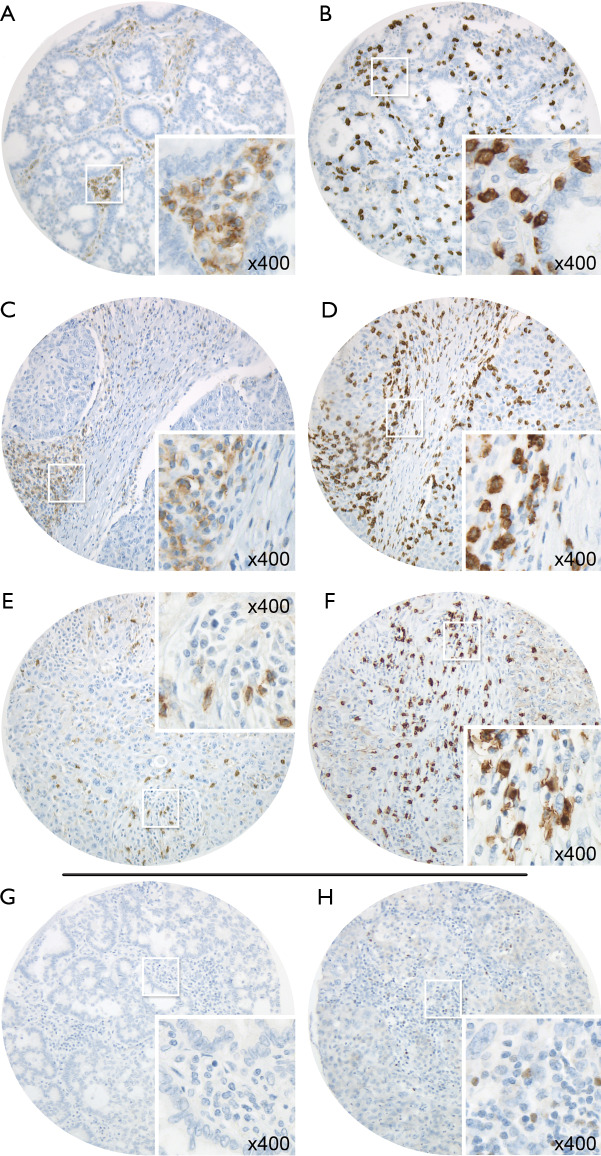
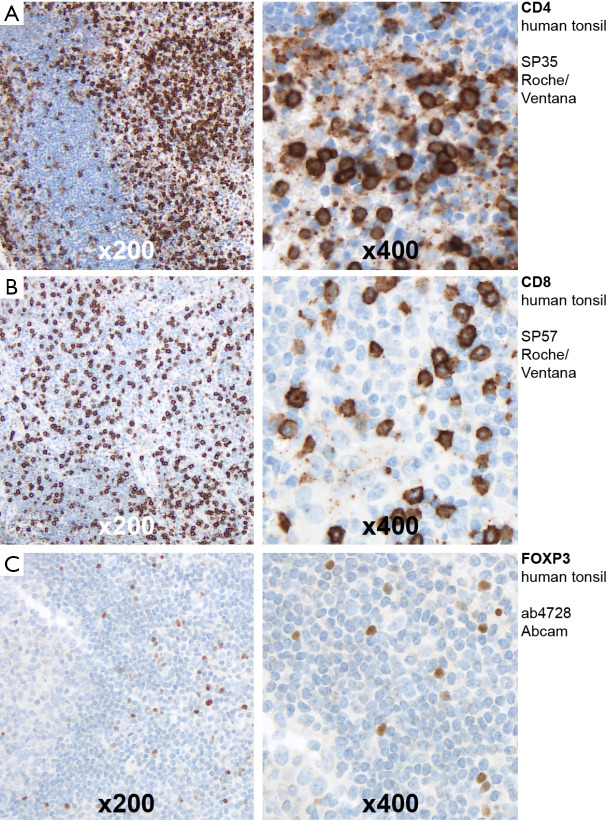
By counterstaining of CD4, CD8 and FOXP3 we used immunohistochemistry on tissue microarrays (TMA) to evaluate peritumoral T cells, T cells and T cells in n=294 NSCLC patients with pTNM stage I-III disease.
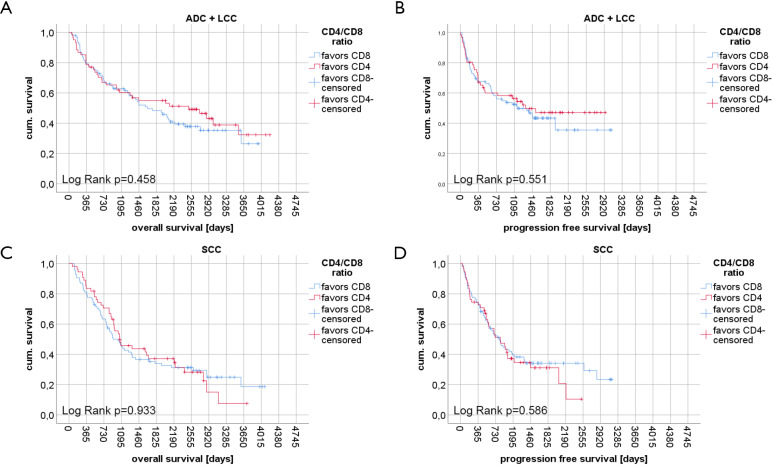
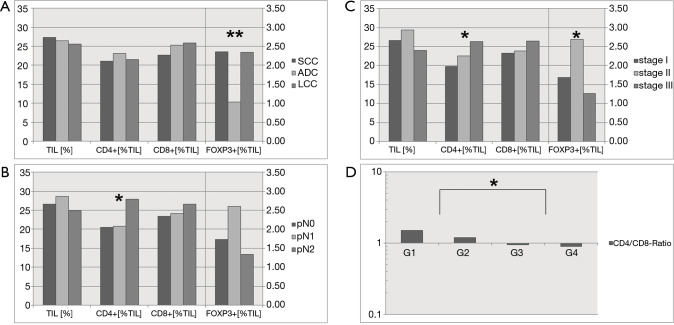
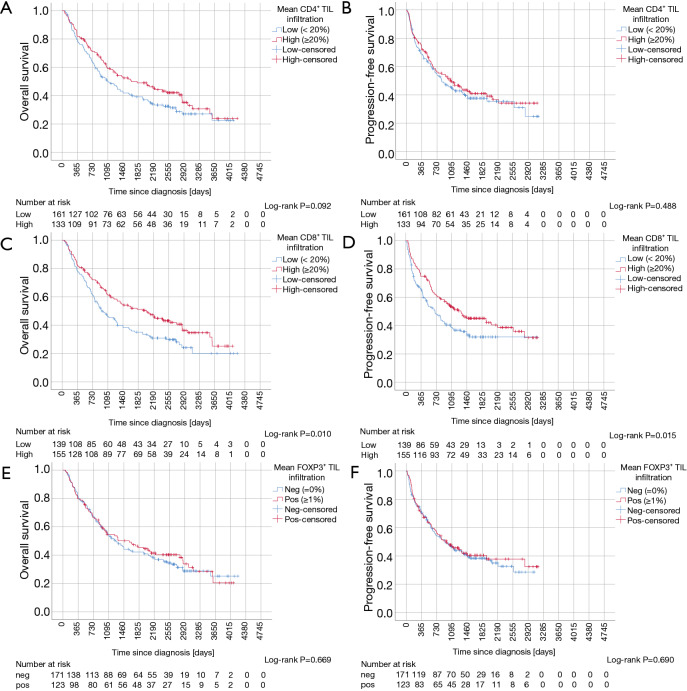
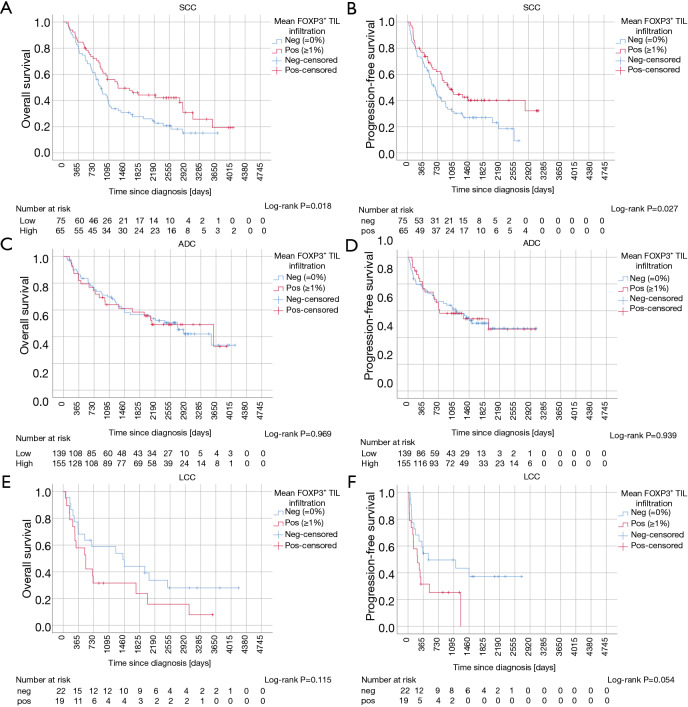
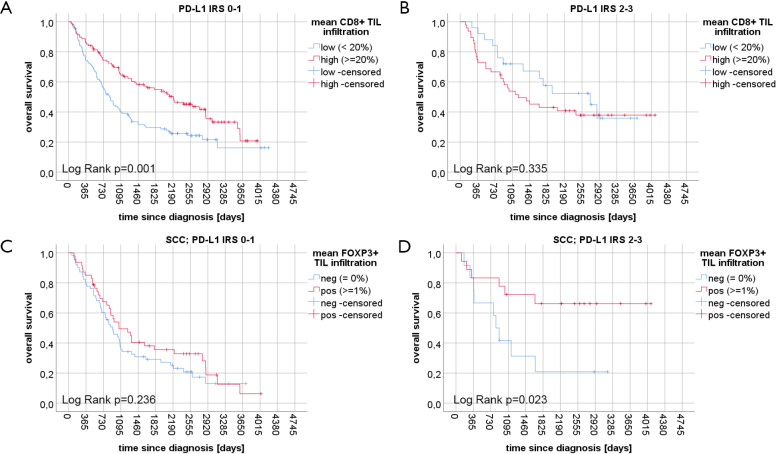
Strong CD4 infiltration was associated with higher tumor stages and lymphonodal spread. However, strong CD4 infiltration yielded improved overall survival (OS) (P=0.014) in adenocarcinoma (ADC) and large cell carcinoma (LCC) but not in squamous cell carcinoma (SCC). A CD4/CD8 ratio <1 was associated with high grade NSCLC tumors (P=0.020). High CD8 T cell infiltration was an independent prognostic factor for OS (P=0.040) and progression-free survival (PFS) (P=0.012) in the entire study collective. The OS benefit of high CD8 infiltration was especially prominent in PD-L1 negative NSCLC (P=0.001) but not in PD-L1 positive tissue (P=0.335). Moreover, positive FOXP3 expression in tumor infiltrating lymphocytes was associated with increased OS (P=0.007) and PFS (P=0.014) in SCC but not in ADC and LCC (all P>0.05). Here, prognostic effects were prominent in PD-L1 positive SCC (P=0.023) but not in PD-L1 negative SCC (P=0.236).
High proportion of CD8 T cells correlated with improved prognostic outcome in stage I-III NSCLC. T cells and T cells have implications on outcome with respect to tumor histology and biology.
在非小细胞肺癌(NSCLC)中,T细胞浸润对于对恶性组织的免疫反应至关重要,尤其是在免疫检查点抑制时代。为了研究CD4辅助性T细胞(Th)、CD8细胞毒性T细胞(Tc)和FOXP3调节性T细胞(Treg)在NSCLC中的预后影响,我们进行了此项分析。
通过对CD4、CD8和FOXP3进行复染,我们使用免疫组织化学方法检测组织微阵列(TMA),以评估n = 294例pTNM分期为I - III期疾病的NSCLC患者瘤旁的Th细胞、Tc细胞和Treg细胞。
强烈的CD4浸润与更高的肿瘤分期和淋巴结转移相关。然而,强烈的CD4浸润在腺癌(ADC)和大细胞癌(LCC)中可提高总生存期(OS)(P = 0.014),但在鳞状细胞癌(SCC)中则不然。CD4/CD8比值<1与高级别NSCLC肿瘤相关(P = 0.020)。在整个研究队列中,高CD8 T细胞浸润是OS(P = 0.040)和无进展生存期(PFS)(P = 0.012)的独立预后因素。高CD8浸润对OS的益处在PD-L1阴性的NSCLC中尤为显著(P = 0.001),但在PD-L1阳性组织中则不然(P = 0.335)。此外,肿瘤浸润淋巴细胞中FOXP3阳性表达与SCC的OS增加(P = 0.007)和PFS增加(P = 0.014)相关,但在ADC和LCC中则不然(所有P>0.05)。在此,预后效应在PD-L1阳性的SCC中显著(P = 0.023),但在PD-L1阴性的SCC中则不然(P = 0.236)。
在I - III期NSCLC中,高比例的CD8 T细胞与改善的预后结果相关。Th细胞和Treg细胞对肿瘤组织学和生物学方面的预后有影响。