Kang Hye Seon, Shin Ah Young, Yeo Chang Dong, Park Chan Kwon, Kim Ju Sang, Kim Jin Woo, Kim Seung Joon, Lee Sang Haak, Kim Sung Kyoung
Division of Pulmonary, Allergy and Critical Care Medicine, Department of Internal Medicine, Bucheon St. Mary's Hospital, College of Medicine, The Catholic University of Korea, Seoul, Republic of Korea.
Division of Pulmonary and Critical Care Medicine, Department of Internal Medicine, Incheon St. Mary's Hospital, College of Medicine, The Catholic University of Korea, Seoul, Republic of Korea.
J Thorac Dis. 2020 May;12(5):1895-1902. doi: 10.21037/jtd-19-3932.
Anemia is a frequent finding in cancer patients. Pre-treatment anemia is known to be associated with poor survival after surgery or stereotactic body radiation therapy of non-small cell lung cancer (NSCLC). However, little study was conducted in NSCLC with activating epidermal growth factor receptor (EGFR) mutations.
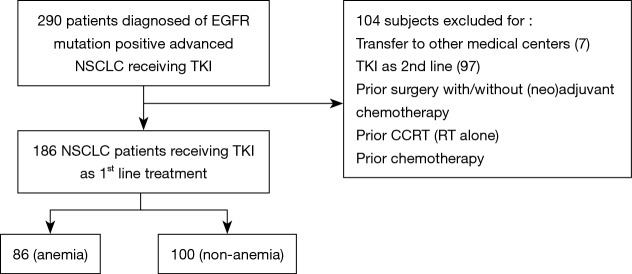
This was a multicenter retrospective study conducted in seven university teaching hospitals in the Republic of Korea from January 2009 to February 2016. A total of 290 patients were diagnosed with NSCLC harboring sensitizing EGFR mutations and treated with EGFR-tyrosine kinase inhibitor (TKI) as 1st line. Of these patients, 104 met the exclusion criteria. Pre-treatment anemia was defined according to World Health Organization criteria (Hb concentration <13 g/dL for men and <12 g/dL for women).
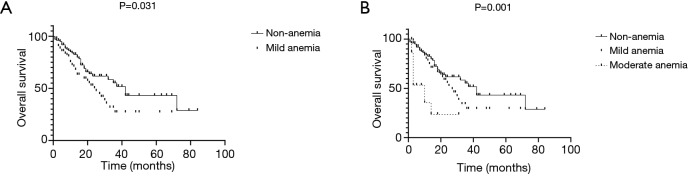
A total of 186 patients were finally included for analysis. Of these patients, 86 (46.2%) and 100 (53.8%) patients were classified into anemia and non-anemia groups, respectively. The anemia group had shorter median overall survival (OS) than the non-anemia group [24.83 (95% CI, 17.49-32.17) months 42.10 (95% CI, 31.87-52.34) months, P=0.031]. In multivariate analysis, anemia (aHR, 2.573; 95% CI, 1.122-5.901; P=0.026) was only independent factors for poor OS.
Our study suggests that pre-treatment anemia is a significant poor prognostic factor for OS of NSCLC patients with EGFR mutations treated with EGFR-TKI.
贫血在癌症患者中很常见。已知非小细胞肺癌(NSCLC)患者术前贫血与手术或立体定向体部放疗后的不良生存相关。然而,针对具有激活表皮生长因子受体(EGFR)突变的NSCLC患者的研究较少。
这是一项多中心回顾性研究,于2009年1月至2016年2月在韩国7家大学教学医院进行。共有290例被诊断为携带敏感EGFR突变的NSCLC患者接受了一线EGFR酪氨酸激酶抑制剂(TKI)治疗。其中,104例患者符合排除标准。根据世界卫生组织标准(男性血红蛋白浓度<13 g/dL,女性<12 g/dL)定义术前贫血。
最终纳入186例患者进行分析。其中,86例(46.2%)和100例(53.8%)患者分别被分为贫血组和非贫血组。贫血组的中位总生存期(OS)短于非贫血组[24.83(95%CI,17.49 - 32.17)个月对42.10(95%CI,31.87 - 52.34)个月,P = 0.031]。在多变量分析中,贫血(调整后风险比,2.573;95%CI,1.122 - 5.901;P = 0.026)是OS不良的唯一独立因素。
我们的研究表明,术前贫血是接受EGFR - TKI治疗的EGFR突变NSCLC患者OS的一个显著不良预后因素。