Bulbul Ajaz, Leal Alessandro, Husain Hatim
University of California San Diego, La Jolla, CA, USA.
Johns Hopkins University, Baltimore, MD, USA.
J Thorac Dis. 2020 May;12(5):2877-2882. doi: 10.21037/jtd.2020.01.66.
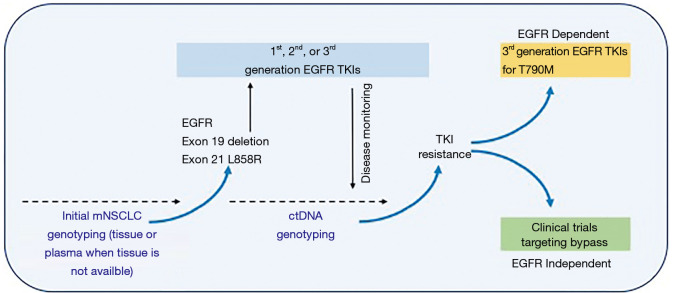
Analyses of cell-free tumor DNA (ctDNA) have provided a non-invasive strategy for cancer diagnosis, the identification of molecular aberrations for treatment identification, and evaluation of tumor response. Sensitive and specific ctDNA sequencing strategies have allowed for implementation into clinical practice for the initial genotyping of patients and resistance monitoring. The specific need for EGFR mutation detection for the management of lung cancer patients has been an early imperative and has set the stage for non-invasive molecular profiling across other oncogenic drivers. Ongoing efforts are demonstrating the utility of ctDNA analyses in the initial genotyping of patients, the monitoring resistance clones, and the initial evaluation of response.
游离肿瘤DNA(ctDNA)分析为癌症诊断、确定用于治疗选择的分子畸变以及评估肿瘤反应提供了一种非侵入性策略。灵敏且特异的ctDNA测序策略已得以应用于临床实践,用于患者的初始基因分型及耐药监测。肺癌患者管理中对表皮生长因子受体(EGFR)突变检测的特殊需求一直是早期的当务之急,并为跨其他致癌驱动因素的非侵入性分子分析奠定了基础。正在进行的研究表明,ctDNA分析在患者初始基因分型、监测耐药克隆以及反应的初始评估中具有实用价值。