Okekunle Akinkunmi Paul, Gao Jian, Wu Xiaoyan, Feng Rennan, Sun Changhao
Department of Nutrition and Food Hygiene, School of Public Health, Harbin Medical University, 157 Baojian Road, Nangang District, Harbin, Heilongjiang 150081, People's Republic of China.
Department of Epidemiology and Medical Statistics, College of Medicine, University of Ibadan, 200284, Nigeria.
Heliyon. 2020 Jul 2;6(7):e04228. doi: 10.1016/j.heliyon.2020.e04228. eCollection 2020 Jul.
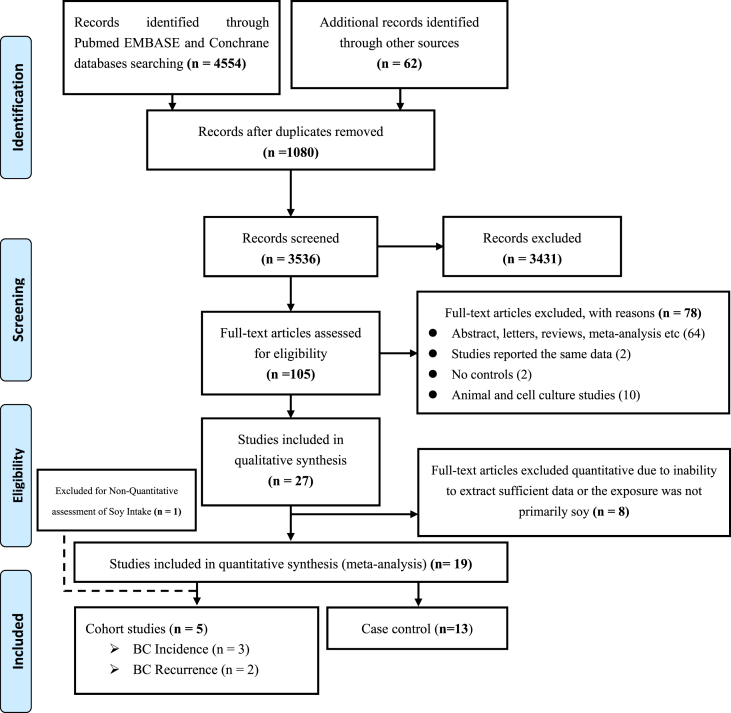
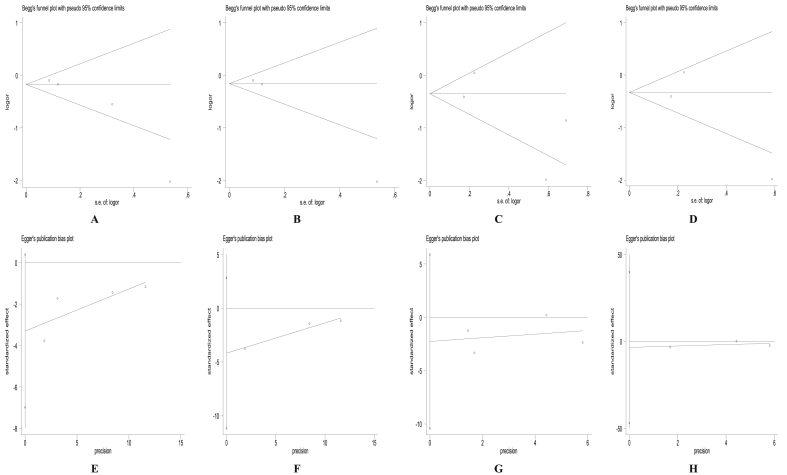
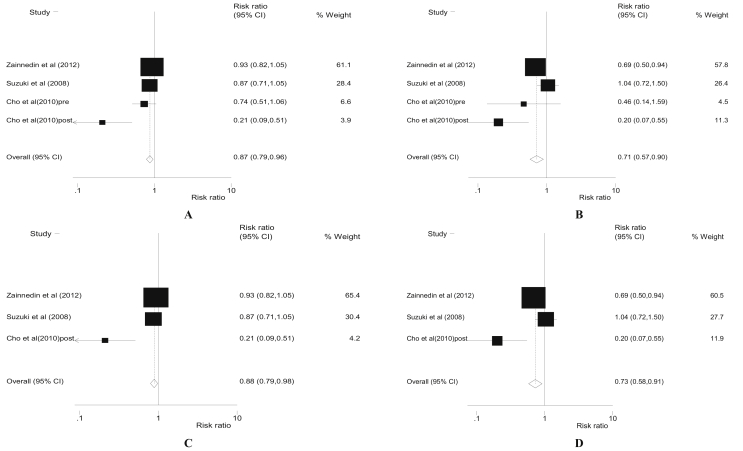
The relationship between soy intake (SI) and breast cancer (BC) has been widely investigated with limited information on the significance of hormone receptor status of BC on the association. This study assessed the relationship between SI and BC risk in the context of oestrogen receptor (ER) status of BC. We meta-analyzed data from published studies on SI and BC after a methodical search of EMBASE, PubMed and Cochrane Library through December 2019. Summary estimates with 95% confidence intervals (CI) were presented using a random-effects model. Eighteen (5 cohorts and 13 case-control) studies, were included in this meta-analysis and SI was inversely associated with BC risk [OR (95%) for highest vs. lowest soy food intake = 0.88 (0.84-0.92), , = 76.1%, Egger's = 0.425] among all women. The inverse relationship was stronger among premenopausal women [OR (95%) = 0.79 (0.71-0.87), , = 77.3%, Egger's = 0.644]. In addition, SI was inversely associated with BC risk among ER-negative (-) BC women [OR (95%) = 0.71 (0.57-0.90), ., = 72.0%, Egger's = 0.355] and among ER-positive (+) BC women [OR (95%) = 0.87 (0.79-0.96), = 74.6%, Egger's = 0.061]. SI appears inversely associated with BC risk, with a stronger inverse association among pre-menopausal and ER-negative BC women.
大豆摄入量(SI)与乳腺癌(BC)之间的关系已得到广泛研究,但关于BC激素受体状态对该关联的意义的信息有限。本研究在BC雌激素受体(ER)状态的背景下评估了SI与BC风险之间的关系。我们在对EMBASE、PubMed和Cochrane图书馆进行系统检索直至2019年12月之后,对已发表的关于SI和BC的研究数据进行了荟萃分析。使用随机效应模型呈现了95%置信区间(CI)的汇总估计值。本荟萃分析纳入了18项研究(5项队列研究和13项病例对照研究),在所有女性中,SI与BC风险呈负相关[最高与最低大豆食品摄入量的OR(95%)=0.88(0.84 - 0.92),I² = 76.1%,Egger's检验P值 = 0.425]。在绝经前女性中,这种负相关更强[OR(95%)=0.79(0.71 - 0.87),I² = 77.3%,Egger's检验P值 = 0.644]。此外,在ER阴性(-)的BC女性中[OR(95%)=0.71(0.57 - 0.90),I² = 72.0%,Egger's检验P值 = 0.355]以及ER阳性(+)的BC女性中[OR(95%)=0.87(0.79 - 0.96),I² = 74.6%,Egger's检验P值 = 0.061],SI均与BC风险呈负相关。SI似乎与BC风险呈负相关,在绝经前和ER阴性的BC女性中负相关更强。