Department of Medicine II, Division of Gastroenterology, Rostock University Medical Center, Rostock, Germany.
Lübeck Institute of Experimental Dermatology and Center for Research on Inflammation of the Skin, University of Lübeck, Lübeck, Germany.
J Cell Mol Med. 2020 Aug;24(15):8862-8870. doi: 10.1111/jcmm.15540. Epub 2020 Jul 8.
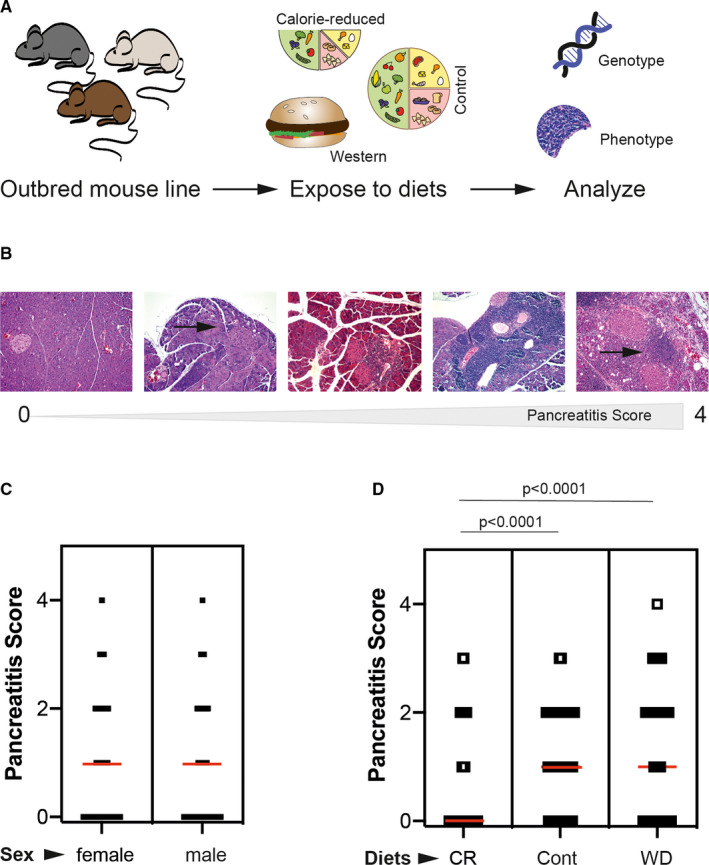
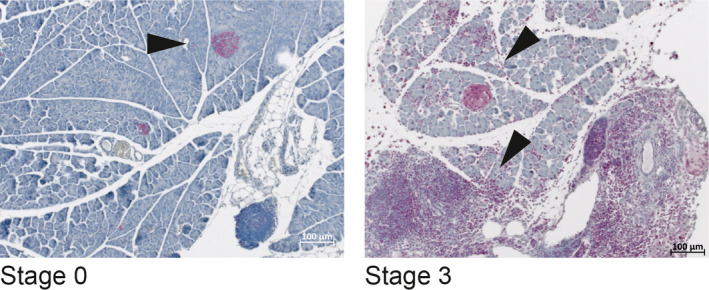
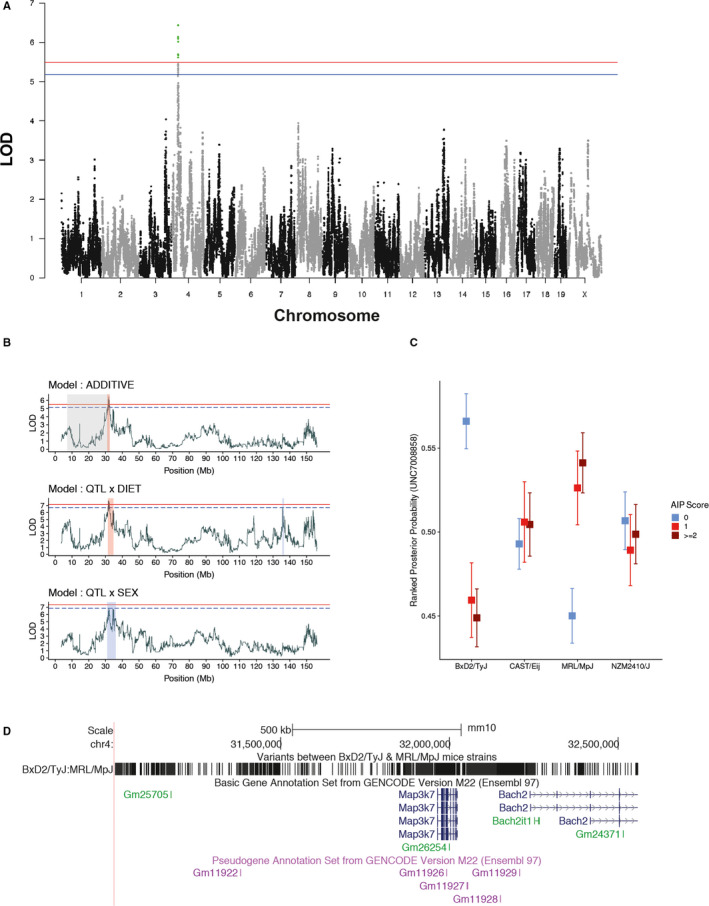
The impact of environmental factors, such as diet, and the genetic basis of autoimmune pancreatitis (AIP) are largely unknown. Here, we used an experimental murine AIP model to identify the contribution of diet to AIP development, as well as to fine-map AIP-associated genes in outbred mice prone to develop the disease. For this purpose, we fed mice of an autoimmune-prone intercross line (AIL) three different diets (control, calorie-reduced and western diet) for 6 months, at which point the mice were genotyped and phenotyped for AIP. Overall, 269 out of 734 mice (36.6%) developed AIP with signs of parenchymal destruction, equally affecting mice of both sexes. AIP prevalence and severity were reduced by approximately 50% in mice held under caloric restriction compared to those fed control or western diet. We identified a quantitative trait locus (QTL) on chromosome 4 to be associated with AIP, which is located within a previously reported QTL. This association does not change when considering diet or sex as an additional variable for the mapping. Using whole-genome sequences of the AIL founder strains, we resolved this QTL to a single candidate gene, namely Map3k7. Expression of Map3k7 was largely restricted to islet cells as well as lymphocytes found in the exocrine pancreas of mice with AIP. Our studies suggest a major impact of diet on AIP. Furthermore, we identify Map3k7 as a novel susceptibility gene for experimental AIP. Both findings warrant clinical translation.
环境因素(如饮食)和自身免疫性胰腺炎(AIP)的遗传基础在很大程度上尚不清楚。在这里,我们使用实验性鼠 AIP 模型来确定饮食对 AIP 发展的贡献,以及在外向型易患该疾病的小鼠中精细映射与 AIP 相关的基因。为此,我们用三种不同的饮食(对照、低热量和西方饮食)喂养易发生自身免疫的杂交系(AIL)的小鼠 6 个月,此时对小鼠进行基因分型并对 AIP 进行表型分析。总的来说,734 只小鼠中有 269 只(36.6%)发生了具有实质破坏迹象的 AIP,雌雄小鼠的发生率相等。与对照组或西方饮食组相比,热量限制组的 AIP 发生率和严重程度降低了约 50%。我们在第 4 号染色体上确定了一个与 AIP 相关的数量性状基因座(QTL),该基因座位于先前报道的 QTL 内。当考虑饮食或性别作为映射的附加变量时,这种关联不会改变。使用 AIL 创始系的全基因组序列,我们将该 QTL 解析为单个候选基因,即 Map3k7。Map3k7 的表达主要局限于胰岛细胞以及患有 AIP 的小鼠外分泌胰腺中的淋巴细胞。我们的研究表明饮食对 AIP 有重大影响。此外,我们确定 Map3k7 为实验性 AIP 的新易感基因。这两个发现都值得临床转化。