Department of Integrated Biological Science, Pusan National University, Busan, Korea.
Department of Systems Biotechnology, Chung-Ang University, Anseong, Korea.
Mol Plant Pathol. 2020 Aug;21(8):1055-1069. doi: 10.1111/mpp.12966. Epub 2020 Jul 9.
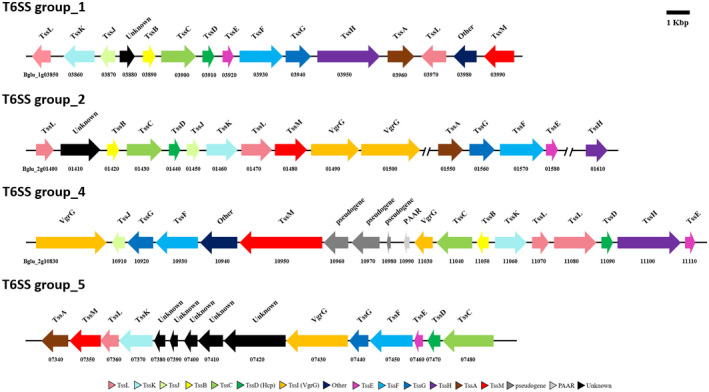
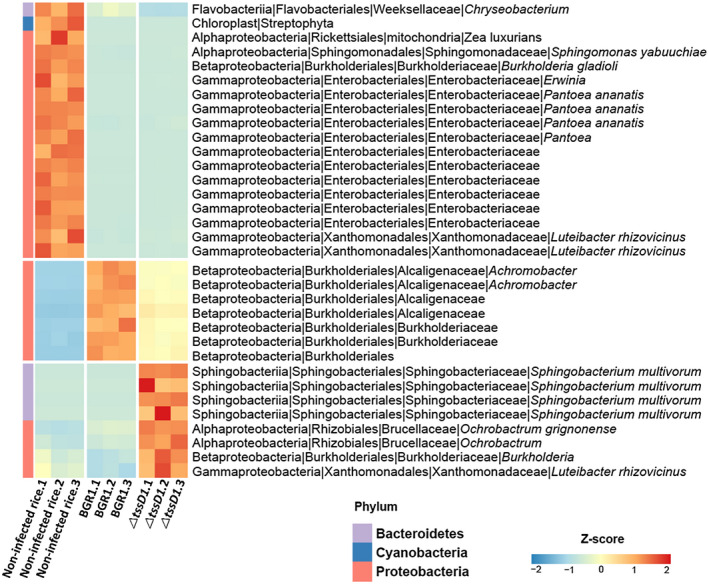
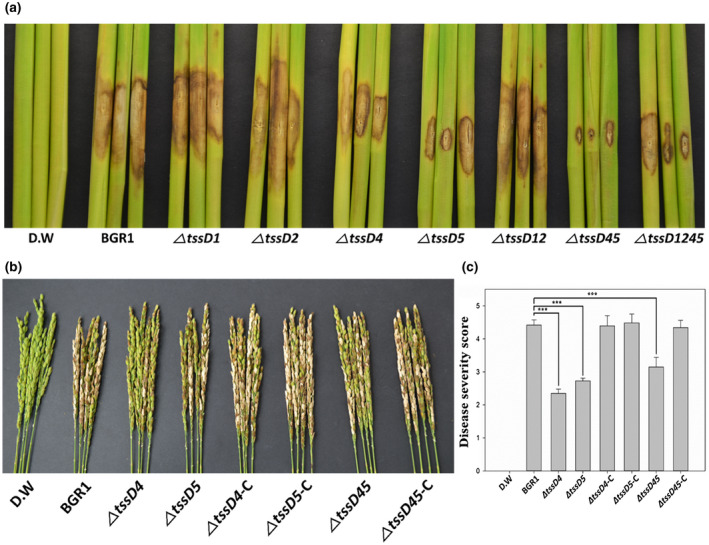
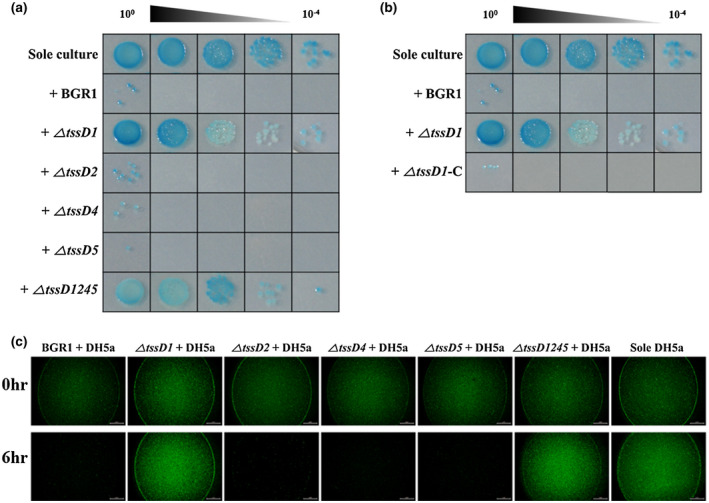
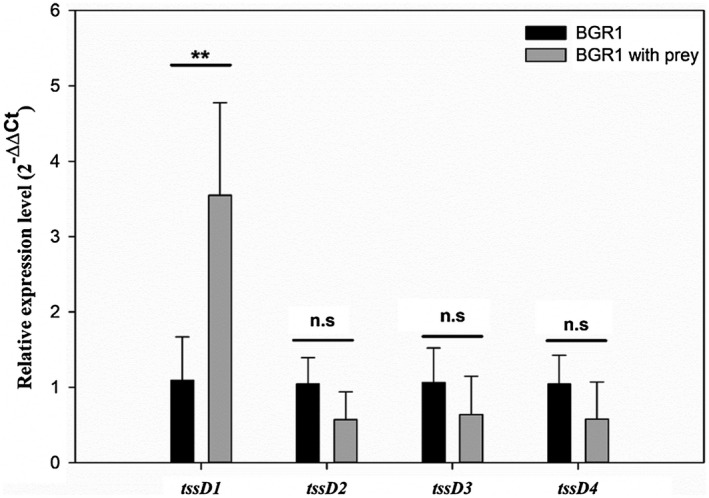
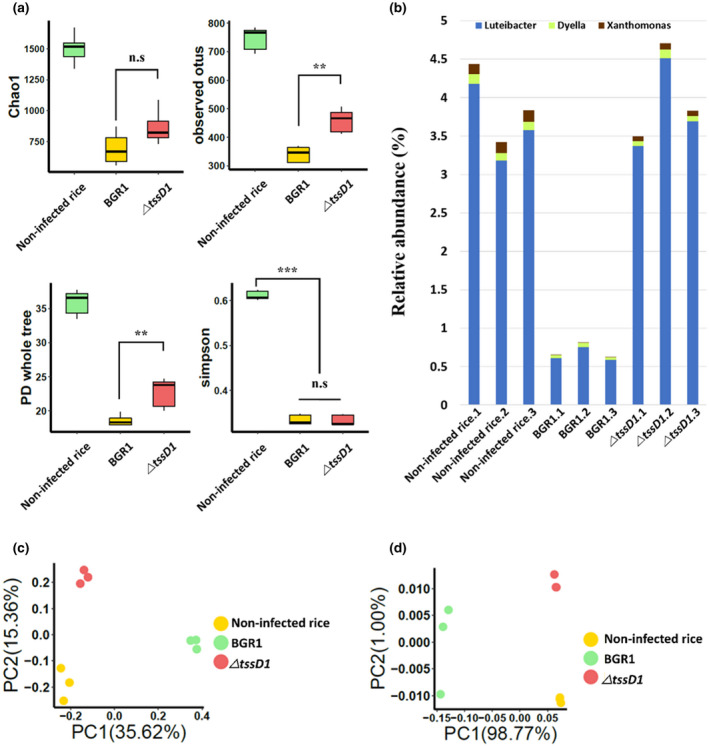
In the environment, bacteria show close association, such as interspecies interaction, with other bacteria as well as host organisms. The type VI secretion system (T6SS) in gram-negative bacteria is involved in bacterial competition or virulence. The plant pathogen Burkholderia glumae BGR1, causing bacterial panicle blight in rice, has four T6SS gene clusters. The presence of at least one T6SS gene cluster in an organism indicates its distinct role, like in the bacterial and eukaryotic cell targeting system. In this study, deletion mutants targeting four tssD genes, which encode the main component of T6SS needle formation, were constructed to functionally dissect the four T6SSs in B. glumae BGR1. We found that both T6SS group_4 and group_5, belonging to the eukaryotic targeting system, act independently as bacterial virulence factors toward host plants. In contrast, T6SS group_1 is involved in bacterial competition by exerting antibacterial effects. The ΔtssD1 mutant lost the antibacterial effect of T6SS group_1. The ΔtssD1 mutant showed similar virulence as the wild-type BGR1 in rice because the ΔtssD1 mutant, like the wild-type BGR1, still has key virulence factors such as toxin production towards rice. However, metagenomic analysis showed different bacterial communities in rice infected with the ΔtssD1 mutant compared to wild-type BGR1. In particular, the T6SS group_1 controls endophytic plant-associated bacteria such as Luteibacter and Dyella in rice plants and may have an advantage in competing with endophytic plant-associated bacteria for settlement inside rice plants in the environment. Thus, B. glumae BGR1 causes disease using T6SSs with functionally distinct roles.
在环境中,细菌与其他细菌以及宿主生物表现出密切的关联,例如种间相互作用。革兰氏阴性菌中的 VI 型分泌系统(T6SS)参与细菌竞争或毒力。引起水稻细菌性穗枯病的植物病原体 Burkholderia glumae BGR1 有四个 T6SS 基因簇。生物体中至少存在一个 T6SS 基因簇表明其具有独特的作用,就像在细菌和真核细胞靶向系统中一样。在这项研究中,构建了针对四个 tssD 基因(编码 T6SS 针形成的主要成分)的缺失突变体,以对 B. glumae BGR1 中的四个 T6SS 进行功能剖析。我们发现,属于真核靶向系统的 T6SS 组_4 和组_5 独立作为宿主植物的细菌毒力因子发挥作用。相比之下,T6SS 组_1 通过发挥抗菌作用参与细菌竞争。ΔtssD1 突变体失去了 T6SS 组_1 的抗菌作用。ΔtssD1 突变体在水稻中的毒力与野生型 BGR1 相似,因为ΔtssD1 突变体和野生型 BGR1 一样,仍然具有针对水稻的毒素产生等关键毒力因子。然而,宏基因组分析显示,感染ΔtssD1 突变体的水稻与野生型 BGR1 的细菌群落不同。特别是,T6SS 组_1 控制着水稻中的内生植物相关细菌,如 Luteibacter 和 Dyella,并且可能在与内生植物相关的细菌竞争以在环境中定居在水稻植物中具有优势。因此,B. glumae BGR1 利用具有不同功能的 T6SS 引起疾病。