Bloomberg School of Public Health, Johns Hopkins University, 615 North Wolfe Street Room E8638, Baltimore, United States of America.
Johns Hopkins University, 3400 North Charles Street, Baltimore, MD, United States of America.
Health Res Policy Syst. 2020 Jul 9;18(1):78. doi: 10.1186/s12961-020-00546-4.
Evidence-based decision-making is crucial to leadership in the health sector to identify country-level priorities and generate solutions supported by rigorous research. Barriers and enablers have been explored, but limited evidence about what works to strengthening capacity at individual and institutional levels within countries has been reported, and inconsistent use of evidence to inform policy-making is a persistent challenge and concern.
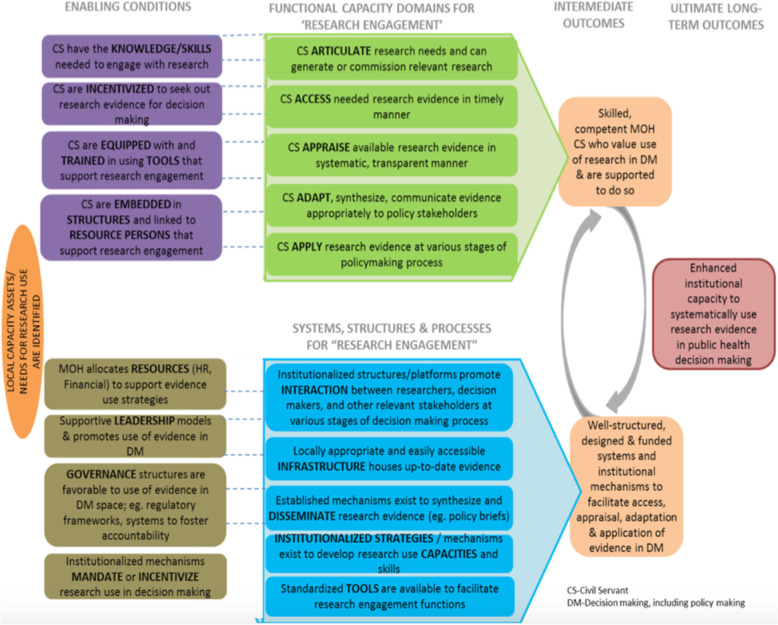
We conducted a framework analysis comparing experiences of nine purposively selected countries (Chile, Ethiopia, Ghana, Kyrgyzstan, Lebanon, Mozambique, Rwanda, South Africa and Sri Lanka). We utilised qualitative case studies developed by in-country teams to explore enablers and barriers described across components of a predefined theory of change and then identified six cross-cutting themes and recommendations for relevant stakeholders associated with each theme.
The cross-cutting themes included (1) leadership and political will, (2) incentives and resources, (3) infrastructure and access to health data, (4) designated structures and processes, (5) interaction and relationships, and (6) capacity strengthening and engagement. While each case country's context and experience was different, common enablers and barriers surfaced across each of these themes, with Ministries of Health and other government agencies having strong roles to play, but also recognising the need for other stakeholders, including researchers, donors and civil society, to serve as essential collaborators in order to strengthen evidence uptake. Substantial and sustained investment in research capacities, able leaders and stronger engagement of civil servants are needed to further this progress and strengthen processes of health decision-making.
All countries represented in this study have made commendable progress in increasing evidence uptake and strengthening supportive systems. Establishing and strengthening necessary structures and the relationships that underpin them takes time as well as resources. Going forward, the findings from this study can help guide and support advocacy to increase domestic funding for health research, especially health policy and systems research, and ensure that civil servants as well as researchers have the capacity and support to collaborate and continue to bolster evidence uptake.
循证决策对于卫生部门的领导力至关重要,有助于确定国家层面的优先事项,并制定基于严谨研究的解决方案。已经探讨了障碍和促进因素,但据报道,关于如何在国家内部加强个人和机构能力的证据有限,而且不一致地使用证据来为决策提供信息仍然是一个持续存在的挑战和关注点。
我们采用框架分析法比较了九个有针对性选择的国家(智利、埃塞俄比亚、加纳、吉尔吉斯斯坦、黎巴嫩、莫桑比克、卢旺达、南非和斯里兰卡)的经验。我们利用由国内团队制定的定性案例研究,探讨了预先设定的变革理论各组成部分中描述的促进因素和障碍,然后确定了与每个主题相关的六个跨领域主题和建议,供相关利益攸关方参考。
这些跨领域主题包括:(1)领导力和政治意愿;(2)激励措施和资源;(3)基础设施和获取卫生数据的途径;(4)指定的结构和流程;(5)互动和关系;(6)能力建设和参与。虽然每个案例国家的情况和经验不同,但这些主题中的常见促进因素和障碍都浮出水面,卫生部和其他政府机构发挥着重要作用,但也认识到需要包括研究人员、捐助者和民间社会在内的其他利益攸关方作为重要的合作伙伴,以加强对证据的采用。需要对研究能力、有能力的领导者和公务员的更强参与进行大量和持续的投资,以进一步推动这一进展并加强卫生决策过程。
参与本研究的所有国家在增加证据采用和加强支持系统方面都取得了值得称赞的进展。建立和加强必要的结构以及支撑它们的关系需要时间和资源。展望未来,本研究的结果可以帮助指导和支持宣传工作,以增加国内卫生研究资金,特别是卫生政策和系统研究资金,并确保公务员和研究人员有能力和支持进行合作,并继续加强证据采用。