Erasmus Ermin, Lehmann Uta, Agyepong Irene Akua, Alwar John, de Savigny Don, Kamuzora Peter, Mirzoev Tolib, Nxumalo Nonhlanhla, Tomson Göran, Uzochukwu Benjamin, Gilson Lucy
Health Policy and Systems Division, School of Public Health and Family Medicine, University of Cape Town, Cape Town, South Africa.
School of Public Health, Faculty of Community and Health, University of the Western Cape, Cape Town, South Africa.
Health Res Policy Syst. 2016 Apr 12;14:29. doi: 10.1186/s12961-016-0097-0.
The last 5-10 years have seen significant international momentum build around the field of health policy and systems research and analysis (HPSR + A). Strengthening post-graduate teaching is seen as central to the further development of this field in low- and middle-income countries. However, thus far, there has been little reflection on and documentation of what is taught in this field, how teaching is carried out, educators' challenges and what future teaching might look like.
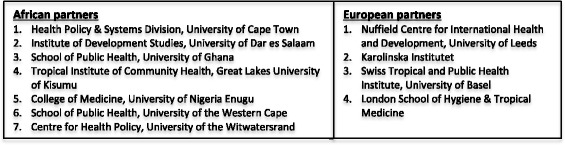
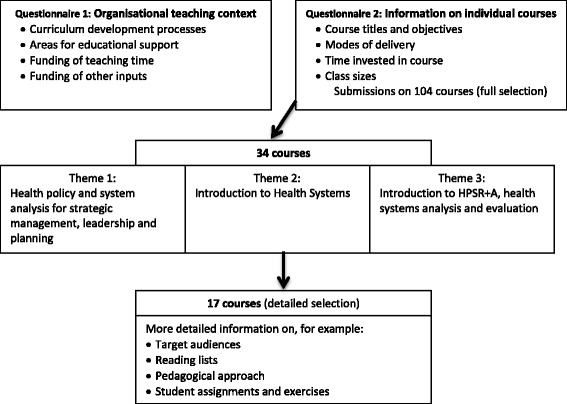
Contributing to such reflection and documentation, this paper reports on a situation analysis and inventory of HPSR + A post-graduate teaching conducted among the 11 African and European partners of the Consortium for Health Policy and Systems Analysis in Africa (CHEPSAA), a capacity development collaboration. A first questionnaire completed by the partners collected information on organisational teaching contexts, while a second collected information on 104 individual courses (more in-depth information was subsequently collected on 17 of the courses). The questionnaires yielded a mix of qualitative and quantitative data, which were analysed through counts, cross-tabulations, and the inductive grouping of material into themes. In addition, this paper draws information from internal reports on CHEPSAA's activities, as well as its external evaluation.
The analysis highlighted the fluid boundaries of HPSR + A and the range and variability of the courses addressing the field, the important, though not exclusive, role of schools of public health in teaching relevant material, large variations in the time investments required to complete courses, the diversity of student target audiences, the limited availability of distance and non-classroom learning activities, and the continued importance of old-fashioned teaching styles and activities.
This paper argues that in order to improve post-graduate teaching and continue to build the field of HPSR + A, key questions need to be addressed around educational practice issues such as the time allocated for HPSR + A courses, teaching activities, and assessments, whether HPSR + A should be taught as a cross-cutting theme in post-graduate degrees or an area of specialisation, and the organisation of teaching given the multi-disciplinary nature of the field. It ends by describing some of CHEPSAA's key post-graduate teaching development activities and how these activities have addressed the key questions.
在过去5至10年里,国际上围绕卫生政策与系统研究及分析(HPSR+A)领域形成了显著的发展势头。加强研究生教学被视为中低收入国家该领域进一步发展的核心。然而,迄今为止,对于该领域所教授的内容、教学方式、教育工作者面临的挑战以及未来教学可能的样子,几乎没有反思和记录。
为促进此类反思和记录,本文报告了对非洲卫生政策与系统分析联盟(CHEPSAA)的11个非洲和欧洲合作伙伴开展的HPSR+A研究生教学情况分析和盘点,CHEPSAA是一个能力发展合作项目。合作伙伴填写的第一份问卷收集了有关组织教学背景的信息,第二份问卷收集了有关104门个人课程的信息(随后又对其中17门课程收集了更深入的信息)。问卷产生了定性和定量数据的混合,通过计数、交叉制表以及将材料归纳分组为主题进行分析。此外,本文还借鉴了CHEPSAA活动的内部报告及其外部评估的信息。
分析突出了HPSR+A的模糊边界以及涉及该领域课程的范围和多样性、公共卫生学院在教授相关材料方面的重要但非排他性作用、完成课程所需时间投入的巨大差异、学生目标受众的多样性、远程和非课堂学习活动的有限可用性,以及传统教学风格和活动的持续重要性。
本文认为,为了改进研究生教学并继续发展HPSR+A领域,需要围绕教育实践问题解决一些关键问题,如为HPSR+A课程、教学活动和评估分配的时间,HPSR+A应作为研究生学位的交叉主题还是专业领域进行教学,以及鉴于该领域的多学科性质如何组织教学。文章最后描述了CHEPSAA的一些关键研究生教学发展活动以及这些活动如何解决关键问题。