Department of Radiology, Union Hospital, Tongji Medical College, Huazhong University of Science and Technology, Jiefang Avenue 1277#, Wuhan, 430022, China.
Hubei Province Key Laboratory of Molecular Imaging, Wuhan, 430022, China.
Sci Rep. 2020 Jul 9;10(1):11336. doi: 10.1038/s41598-020-68057-4.
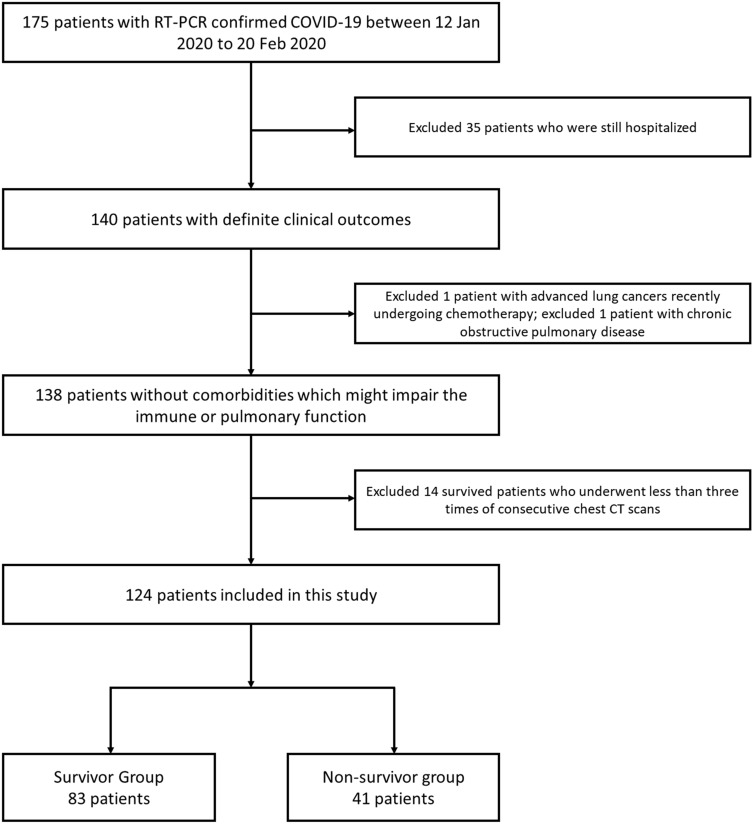
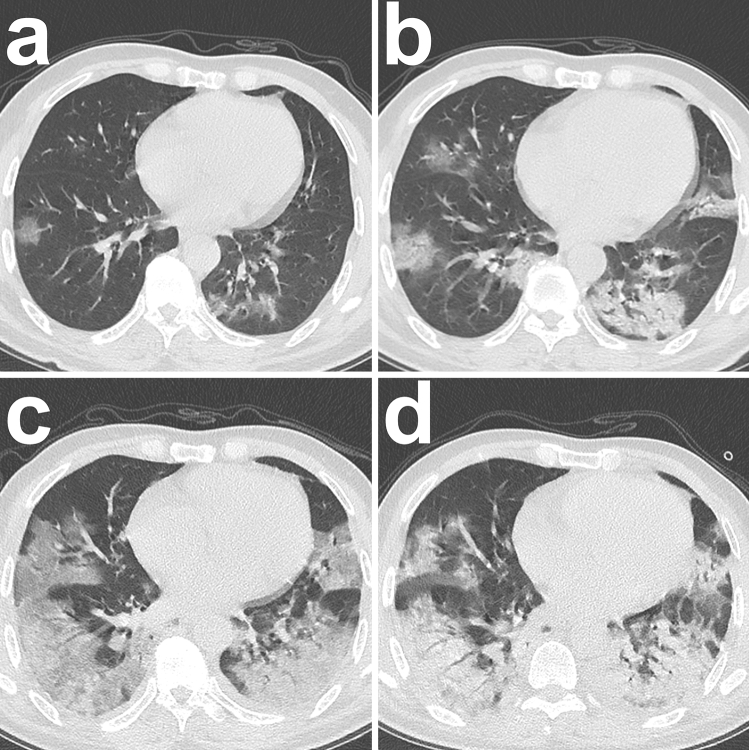
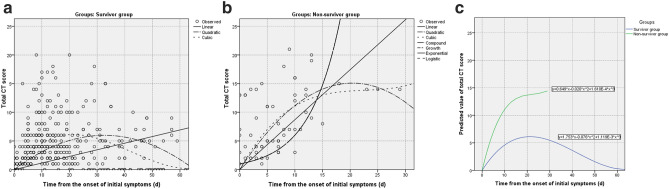
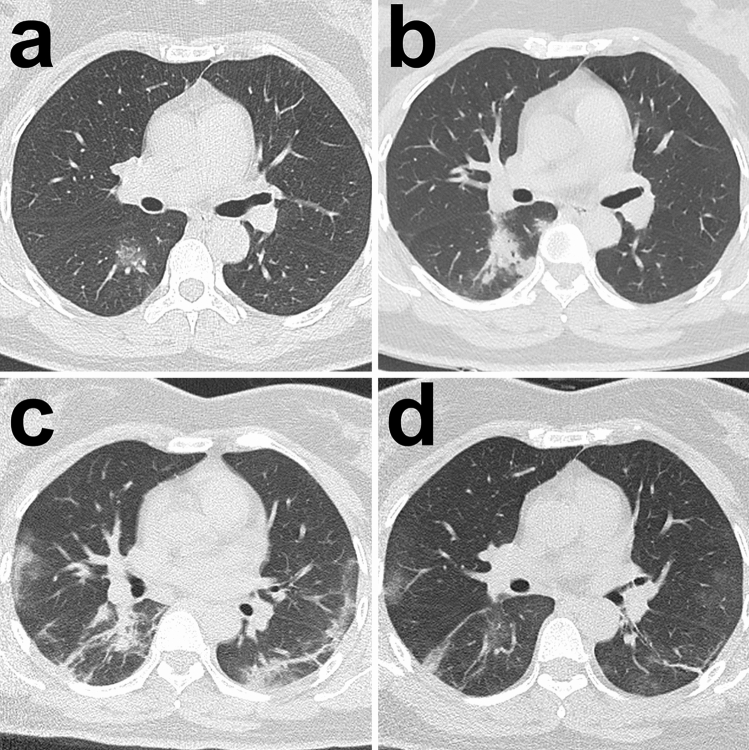
This study aimed to compare the chest computed tomography (CT) findings between survivors and non-survivors with Coronavirus Disease 2019 (COVID-19). Between 12 January 2020 and 20 February 2020, the records of 124 consecutive patients diagnosed with COVID-19 were retrospectively reviewed and divided into survivor (83/124) and non-survivor (41/124) groups. Chest CT findings were qualitatively compared on admission and serial chest CT scans were semi-quantitively evaluated between two groups using curve estimations. On admission, significantly more bilateral (97.6% vs. 73.5%, p = 0.001) and diffuse lesions (39.0% vs. 8.4%, p < 0.001) with higher total CT score (median 10 vs. 4, p < 0.001) were observed in non-survivor group compared with survivor group. Besides, crazy-paving pattern was more predominant in non-survivor group than survivor group (39.0% vs. 12.0%, p < 0.001). From the prediction of curve estimation, in survivor group total CT score increased in the first 20 days reaching a peak of 6 points and then gradually decreased for more than other 40 days (R = 0.545, p < 0.001). In non-survivor group, total CT score rapidly increased over 10 points in the first 10 days and gradually increased afterwards until ARDS occurred with following death events (R = 0.711, p < 0.001). In conclusion, persistent progression with predominant crazy-paving pattern was the major manifestation of COVID-19 in non-survivors. Understanding this CT feature could help the clinical physician to predict the prognosis of the patients.
本研究旨在比较新冠肺炎(COVID-19)幸存者和非幸存者的胸部计算机断层扫描(CT)表现。2020 年 1 月 12 日至 2 月 20 日,回顾性分析了 124 例连续确诊 COVID-19 患者的记录,并将其分为幸存者(83/124)和非幸存者(41/124)两组。入院时定性比较了胸部 CT 表现,并用曲线估计对两组进行了连续胸部 CT 扫描的半定量评估。入院时,非幸存者组双侧(97.6% vs. 73.5%,p = 0.001)和弥漫性病变(39.0% vs. 8.4%,p < 0.001)明显更多,总 CT 评分更高(中位数 10 分 vs. 4 分,p < 0.001)。此外,非幸存者组的铺路石征更为常见(39.0% vs. 12.0%,p < 0.001)。从曲线估计的预测来看,在幸存者组中,总 CT 评分在前 20 天增加,达到 6 分的峰值,然后在 40 多天后逐渐下降(R = 0.545,p < 0.001)。在非幸存者组中,总 CT 评分在前 10 天迅速增加超过 10 分,随后逐渐增加,直到发生急性呼吸窘迫综合征(ARDS)并随后死亡(R = 0.711,p < 0.001)。总之,持续进展且以铺路石征为主是非幸存者 COVID-19 的主要表现。了解这一 CT 特征有助于临床医生预测患者的预后。