Department of Nutrition, Harvard T.H. Chan School of Public Health, Boston, Massachusetts.
Department of Neurology, University of Florida, Gainesville.
JAMA Netw Open. 2020 Jul 1;3(7):e209250. doi: 10.1001/jamanetworkopen.2020.9250.
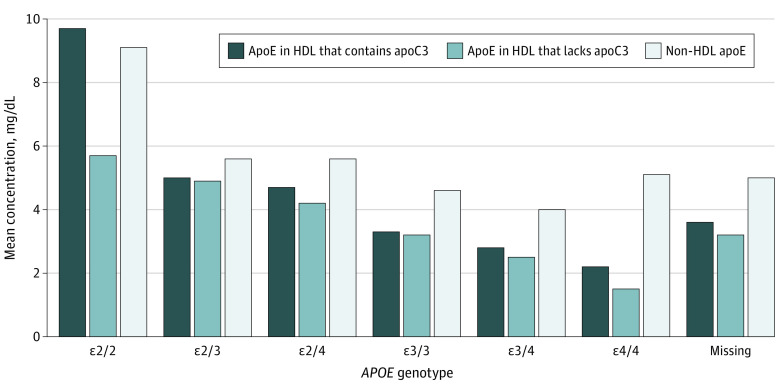
The ε4 allele of the apolipoprotein E (APOE) gene and lower apolipoprotein E (apoE) protein levels in plasma are risk factors for Alzheimer disease, but the underlying biological mechanisms are not fully understood. Half of plasma apoE circulates on high-density lipoproteins (HDLs). Higher apoE levels in plasma HDL were previously found to be associated with lower coronary heart disease risk, but the coexistence of another apolipoprotein, apoC3, modified this lower risk.
To investigate associations between the presence of apoE in different lipoproteins with cognitive function, particularly the risk of dementia.
DESIGN, SETTING, AND PARTICIPANTS: This prospective case-cohort study embedded in the Ginkgo Evaluation of Memory Study (2000-2008) analyzed data from 1351 community-dwelling participants 74 years and older. Of this group, 995 participants were free of dementia at baseline (recruited from September 2000 to June 2002) and 521 participants were diagnosed with incident dementia during follow-up until 2008. Data analysis was performed from January 2018 to December 2019.
Enzyme-linked immunosorbent assay-measured concentration of apoE in whole plasma, HDL-depleted plasma (non-HDL), HDL, and HDL subspecies that contain or lack apoC3 or apoJ.
Adjusted hazard ratios for risk of dementia and Alzheimer disease during follow-up and adjusted differences (β coefficients) in Alzheimer Disease Assessment-Cognitive Subscale (ADAS-cog) and Modified Mini-Mental State Examination scores at baseline.
Among 1351 participants, the median (interquartile range) age was 78 (76-81) years; 639 (47.3%) were women. The median (interquartile range) follow-up time was 5.9 (3.7-6.5) years. Higher whole plasma apoE levels and higher apoE levels in HDL were associated with better cognitive function assessed by ADAS-cog (whole plasma, β coefficient, -0.15; 95% CI, -0.24 to -0.06; HDL, β coefficient, -0.20; 95% CI, -0.30 to -0.10) but were unassociated with dementia or Alzheimer disease risk. When separated by apoC3, a higher apoE level in HDL that lacks apoC3 was associated with better cognitive function (ADAS-cog per SD: β coefficient, 0.17; 95% CI, -0.27 to -0.07; Modified Mini-Mental State Examination score per SD: β coefficient, 0.25; 95% CI, 0.07 to 0.42) and lower risk of dementia (hazard ratio per SD, 0.86; 95% CI, 0.76 to 0.99). In contrast, apoE levels in HDL that contains apoC3 were unassociated with any of these outcomes.
In a prospective cohort of older adults with rigorous follow-up of dementia, the apoE level in HDL that lacked apoC3 was associated with better cognitive function and lower dementia risk. This finding suggests that the cardioprotective associations of this novel lipoprotein extend to dementia.
载脂蛋白 E(APOE)基因的 ε4 等位基因和血浆中较低的载脂蛋白 E(apoE)水平是阿尔茨海默病的风险因素,但潜在的生物学机制尚不完全清楚。一半的血浆 apoE 循环在高密度脂蛋白(HDL)上。先前发现血浆 HDL 中较高的 apoE 水平与较低的冠心病风险相关,但另一种载脂蛋白 apoC3 的存在改变了这种较低的风险。
研究不同脂蛋白中 apoE 的存在与认知功能的关系,特别是痴呆的风险。
设计、设置和参与者:这项前瞻性病例队列研究嵌入在银杏评估记忆研究(2000-2008 年)中,分析了 1351 名 74 岁及以上居住在社区的参与者的数据。其中,995 名参与者在基线时无痴呆(于 2000 年 9 月至 2002 年 6 月招募),521 名参与者在随访期间被诊断为新发痴呆,直到 2008 年。数据分析于 2018 年 1 月至 2019 年 12 月进行。
酶联免疫吸附测定法测量的全血浆、高密度脂蛋白耗尽血浆(非高密度脂蛋白)、高密度脂蛋白和含有或不含 apoC3 或 apoJ 的高密度脂蛋白亚类中的 apoE 浓度。
随访期间痴呆和阿尔茨海默病的风险比,以及基线时阿尔茨海默病评估认知量表(ADAS-cog)和改良的简易精神状态检查评分的调整差异(β 系数)。
在 1351 名参与者中,中位(四分位间距)年龄为 78(76-81)岁;639 名(47.3%)为女性。中位(四分位间距)随访时间为 5.9(3.7-6.5)年。全血浆 apoE 水平较高和 HDL 中 apoE 水平较高与 ADAS-cog 评估的认知功能较好相关(全血浆,β系数,-0.15;95%置信区间,-0.24 至 -0.06;HDL,β系数,-0.20;95%置信区间,-0.30 至 -0.10),但与痴呆或阿尔茨海默病风险无关。当按 apoC3 分离时,缺乏 apoC3 的 HDL 中的 apoE 水平较高与认知功能较好相关(ADAS-cog 每标准差:β系数,0.17;95%置信区间,-0.27 至 -0.07;改良简易精神状态检查评分每标准差:β系数,0.25;95%置信区间,0.07 至 0.42),痴呆风险较低(每标准差的风险比,0.86;95%置信区间,0.76 至 0.99)。相比之下,含有 apoC3 的 HDL 中的 apoE 水平与这些结果均无关。
在一项对痴呆进行严格随访的老年人群的前瞻性队列研究中,缺乏 apoC3 的 HDL 中的 apoE 水平与认知功能较好和痴呆风险较低相关。这一发现表明,这种新型脂蛋白的心脏保护作用延伸至痴呆。