College of Medicine, University of Sharjah, Sharjah, United Arab Emirates.
Emirates Oncology Task Force, Emirates Oncology Society, Dubai, United Arab Emirates.
BMC Cancer. 2020 Jul 10;20(1):641. doi: 10.1186/s12885-020-07115-6.
The COVID-19 pandemic has caused a global health crisis. Numerous cancer patients from non-Western countries, including the United Arab Emirates (UAE), seek cancer care outside their home countries and many are sponsored by their governments for treatment. Many patients interrupted their cancer treatment abruptly and so returned to their home countries with unique challenges. In this review we will discuss practical challenges and recommendations for all cancer patients returning to their home countries from treatment abroad.
Experts from medical, surgical and other cancer subspecialties in the UAE were invited to form a taskforce to address challenges and propose recommendations for patients returning home from abroad after medical tourism during the SARS-COV-19 Pandemic.
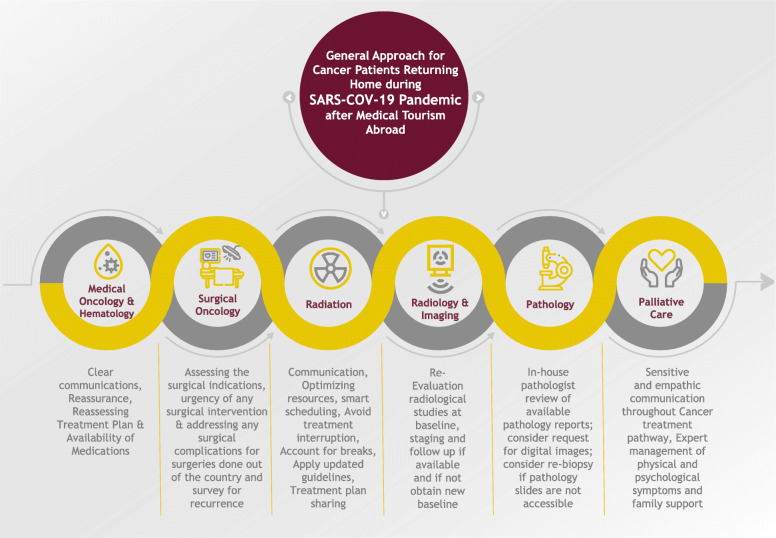
The taskforce which consisted of experts from medical oncology, hematology, surgical oncology, radiation oncology, pathology, radiology and palliative care summarized the current challenges and suggested a practical approaches to address these specific challenges to improve the returning cancer patients care. Lack of medical documentation, pathology specimens and radiology images are one of the major limitations on the continuation of the cancer care for returning patients. Difference in approaches and treatment recommendations between the existing treating oncologists abroad and receiving oncologists in the UAE regarding the optimal management which can be addressed by early and empathic communications with patients and by engaging the previous treating oncologists in treatment planning based on the available resources and expertise in the UAE. Interruption of curative radiotherapy (RT) schedules which can potentially increase risk of treatment failure has been a major challenge, RT dose-compensation calculation should be considered in these circumstances.
The importance of a thorough clinical handover cannot be overstated and regulatory bodies are needed to prevent what can be considered unethical procedure towards returning cancer patients with lack of an effective handover. Clear communication is paramount to gain the trust of returning patients and their families. This pandemic may also serve as an opportunity to encourage patients to receive treatment locally in their home country. Future studies will be needed to address the steps to retain cancer patients in the UAE rather than seeking cancer treatment abroad.
COVID-19 大流行造成了全球卫生危机。包括阿拉伯联合酋长国(阿联酋)在内的许多非西方国家的癌症患者在本国境外寻求癌症治疗,其中许多患者是由政府资助进行治疗的。许多患者突然中断了癌症治疗,因此带着独特的挑战返回本国。在本综述中,我们将讨论所有从国外治疗返回本国的癌症患者所面临的实际挑战和建议。
阿联酋的医学、外科和其他癌症亚专科的专家应邀组成一个工作组,以解决在 SARS-COV-19 大流行期间因医疗旅游从国外返回的患者所面临的挑战,并提出建议。
该工作组由医学肿瘤学、血液学、外科肿瘤学、放射肿瘤学、病理学、放射学和姑息治疗方面的专家组成,总结了目前面临的挑战,并提出了切实可行的方法来解决这些具体挑战,以改善返回癌症患者的护理。缺乏医疗文件、病理标本和放射学图像是影响返回患者继续癌症治疗的主要限制因素之一。对于返回患者的最佳管理,国外现有治疗肿瘤学家和阿联酋接收肿瘤学家之间的方法和治疗建议存在差异,这可以通过与患者进行早期和富有同理心的沟通,并根据阿联酋现有的资源和专业知识让之前的治疗肿瘤学家参与治疗计划来解决。根治性放疗(RT)计划的中断可能会增加治疗失败的风险,在这种情况下应考虑 RT 剂量补偿计算。
彻底的临床交接至关重要,需要监管机构来防止对返回癌症患者缺乏有效交接的不道德行为。清晰的沟通对于赢得返回患者及其家属的信任至关重要。这场大流行也可能是一个鼓励患者在本国接受治疗的机会。需要进一步研究以解决在阿联酋留住癌症患者而不是在国外寻求癌症治疗的步骤。