Department of Biology, University of Missouri-St. Louis, St. Louis, MO, 63121, USA.
Donald Danforth Plant Science Center, St. Louis, MO, 63132, USA.
Nat Commun. 2020 Jul 10;11(1):3439. doi: 10.1038/s41467-020-17311-4.
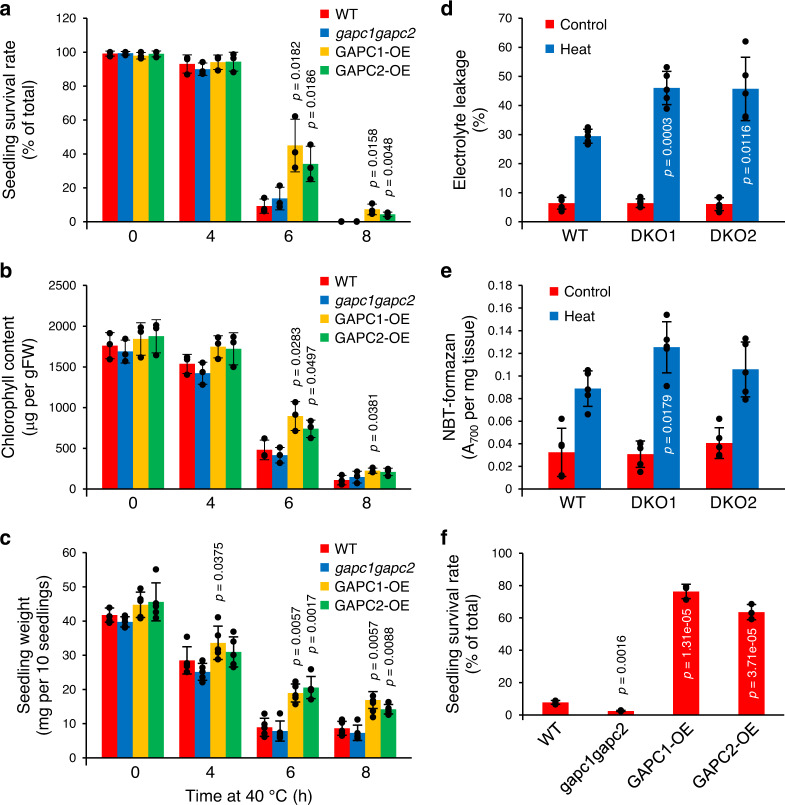
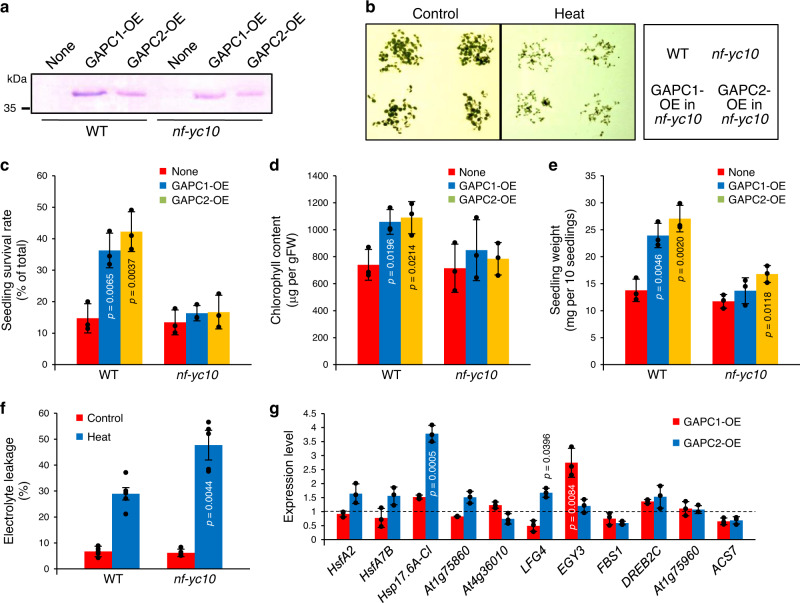
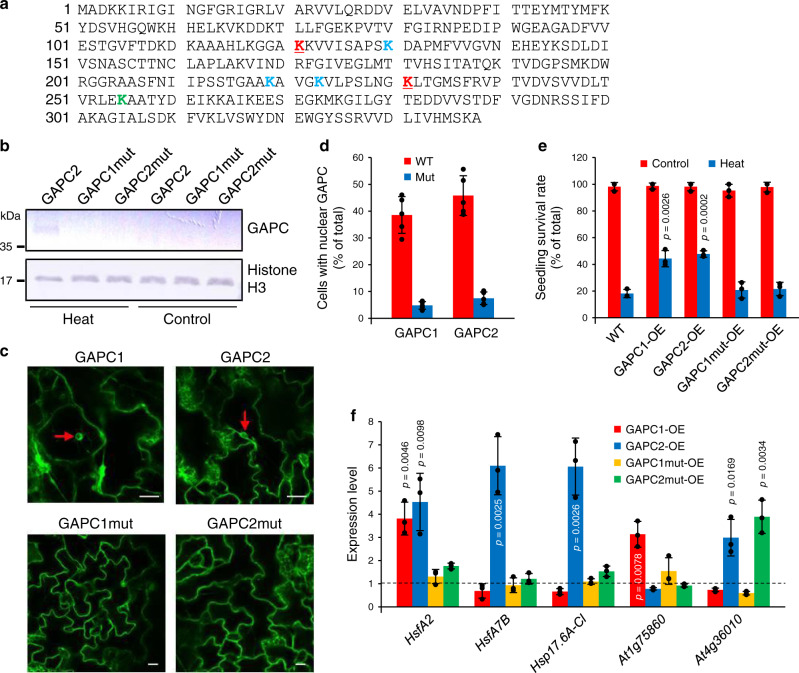
Various stress conditions induce the nuclear translocation of cytosolic glyceraldehyde-3-phosphate dehydrogenase (GAPC), but its nuclear function in plant stress responses remains elusive. Here we show that GAPC interacts with a transcription factor to promote the expression of heat-inducible genes and heat tolerance in Arabidopsis. GAPC accumulates in the nucleus under heat stress. Overexpression of GAPC enhances heat tolerance of seedlings and the expression of heat-inducible genes whereas knockout of GAPCs has opposite effects. Screening of Arabidopsis transcription factors identifies nuclear factor Y subunit C10 (NF-YC10) as a GAPC-binding protein. The effects of GAPC overexpression are abolished when NF-YC10 is deficient, the heat-induced nuclear accumulation of GAPC is suppressed, or the GAPC-NF-YC10 interaction is disrupted. GAPC overexpression also enhances the binding ability of NF-YC10 to its target promoter. The results reveal a cellular and molecular mechanism for the nuclear moonlighting of a glycolytic enzyme in plant response to environmental changes.
各种应激条件诱导细胞质甘油醛-3-磷酸脱氢酶(GAPC)向核内易位,但它在植物应激反应中的核功能仍不清楚。在这里,我们表明 GAPC 与转录因子相互作用,以促进拟南芥中热诱导基因的表达和耐热性。GAPC 在热胁迫下积累在核内。GAPC 的过表达增强了幼苗的耐热性和热诱导基因的表达,而 GAPCs 的敲除则有相反的效果。拟南芥转录因子的筛选鉴定出核因子 Y 亚基 C10(NF-YC10)是 GAPC 的结合蛋白。当 NF-YC10 缺乏时,GAPC 过表达的效果被消除,GAPC 的热诱导核积累被抑制,或 GAPC-NF-YC10 相互作用被破坏。GAPC 过表达也增强了 NF-YC10 与其靶启动子的结合能力。这些结果揭示了一种细胞和分子机制,用于解释糖酵解酶在植物对环境变化的反应中的核双重功能。