Genomic Center for Human Pathologies (GENOPATH), Faculty of Medicine and Pharmacy, University Mohammed V in Rabat, Av. Mohamed Belarbi El Alaoui, 6203, Rabat, Morocco.
Molecular Biology and Functional Genomics Platform, National Center for Scientific and Technical Research, CNRST, Angle Avenue Allal El Fassi, Avenue des FAR, Quartier Er-Ryad, 8027, Rabat, Morocco.
Virus Genes. 2020 Oct;56(5):582-593. doi: 10.1007/s11262-020-01778-w. Epub 2020 Jul 10.
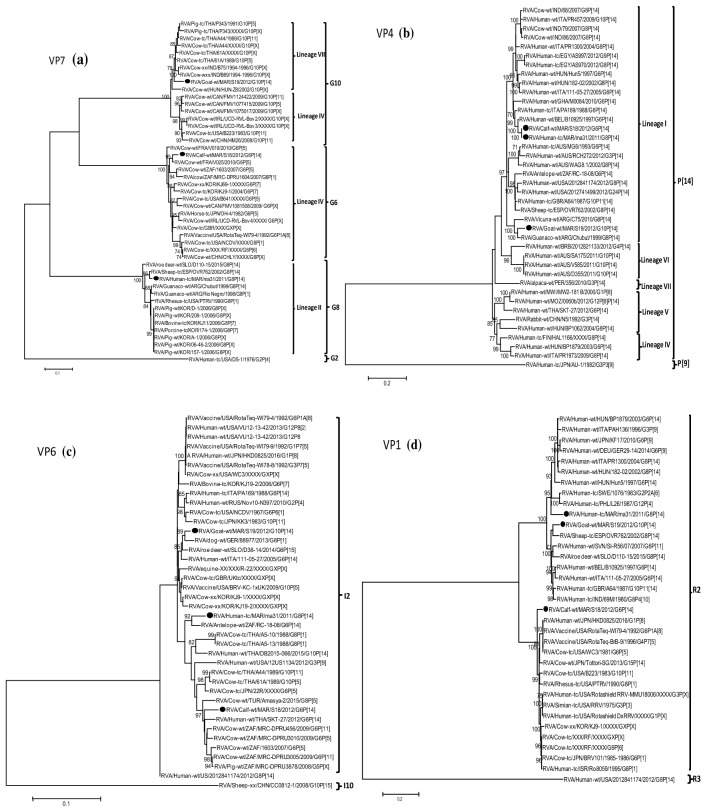
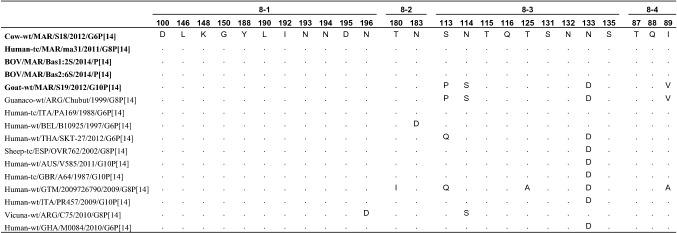
Species A rotaviruses (RVAs) are a leading cause of diarrhea in children and in the young of a large variety of mammalian and avian host species. The purpose of this study was to identify RVA in nomadic goats and calves during severe diarrhea outbreaks in 2012 and 2014 in Bouaarfa, Morocco, and to characterize the complete genomic constellation of two bovine and caprine strains (S18 and S19) and their genetic relatedness with the human strain ma31 detected in 2011 in Morocco. Partial nucleotide sequencing of VP4 and VP7 genes for the twenty-two positive samples revealed three circulating genotypes: G6P[14], G10P[14], and G10P[5] with predominance of G6P[14] genotype. Full-genome sequencing for both strains S18 and S19 presented, respectively, the following genomic constellations: G6-P[14]-I2-R2-C2-M2-A3-N2-T6-E2-H3 and G10-P[14]-I2-R2-C2-M2-A11-N2-T6-E2-H3. Phylogenetic analyses and the analysis of the VP8* antigenic epitopes for S18, S19 and ma31 revealed a shared similarity with bovine, caprine, ovine and human strains from Morocco and other countries. The VP2 and NSP1 genes of the S19 strain were closely related to those of the cognate genes of the human ma31 strain, while the VP4 gene of S18 strain was closely related to the cogent gene of the ma31 strain. Our findings revealed cases of zoonotic transmission and confirmed the risk of emergence of new genotypes in some environments such as nomadic regions, where close physical proximity between human and livestock is common. The present study is novel in reporting whole-genome analyses of RVA isolates obtained from nomadic livestock in Morocco.
A 型轮状病毒(RVAs)是导致儿童和多种哺乳动物和禽类宿主幼仔腹泻的主要原因。本研究旨在鉴定 2012 年和 2014 年摩洛哥布阿法地区严重腹泻爆发期间游牧山羊和牛犊中的 RVA,并对两种牛和山羊株(S18 和 S19)的完整基因组结构及其与 2011 年在摩洛哥检测到的人源株 ma31 的遗传关系进行特征分析。对 22 份阳性样本的 VP4 和 VP7 基因进行部分核苷酸测序,揭示了三种循环基因型:G6P[14]、G10P[14]和 G10P[5],以 G6P[14]基因型为主。对 S18 和 S19 株的全基因组测序分别呈现以下基因组结构:G6-P[14]-I2-R2-C2-M2-A3-N2-T6-E2-H3 和 G10-P[14]-I2-R2-C2-M2-A11-N2-T6-E2-H3。S18、S19 和 ma31 的 VP8*抗原表位的系统进化分析和分析表明,它们与来自摩洛哥和其他国家的牛、山羊、绵羊和人源株具有共同的相似性。S19 株的 VP2 和 NSP1 基因与同源基因的人源 ma31 株密切相关,而 S18 株的 VP4 基因与 ma31 株的相关基因密切相关。我们的研究结果揭示了人畜共患病传播的病例,并证实了在一些环境(如游牧地区)中新基因型出现的风险,在这些地区,人与牲畜之间的身体接近是很常见的。本研究报告了从摩洛哥游牧牲畜中获得的 RVA 分离株的全基因组分析,这是新颖的。