Gloucestershire Hospitals NHS Foundation Trust, Gloucestershire Royal Hospital, Great Western Road, Gloucester, UK, GL1 3NN.
Gloucestershire Hospitals NHS Foundation Trust, Gloucestershire Royal Hospital, Great Western Road, Gloucester, UK, GL1 3NN.
Injury. 2020 Oct;51(10):2142-2147. doi: 10.1016/j.injury.2020.07.001. Epub 2020 Jul 7.
The COVID -19 outbreak has had a profound effect on the management of healthcare service provision in the UK. Orthopaedic departments have been no exception to this and have needed to adapt to the changing circumstances by releasing resources and focusing on 'essential' activity. The aim of this study is to quantify the reduction in trauma and, in addition, describe any changes in the type of referrals to the trust which may have been affected by the pandemic itself and the social distancing measures employed by the UK government.
The study was performed in a UK District Hospital which is also a Trauma Unit providing trauma and orthopaedic care to a population of 625,000 people. The trust based electronic database of trauma referrals was used to compare the numbers of, and types of referral to our trauma service during the COVID-19 pandemic and the corresponding time periods in the previous 3 years.
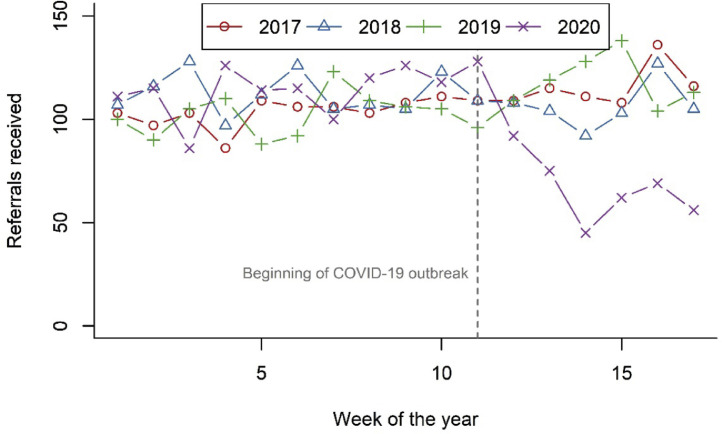
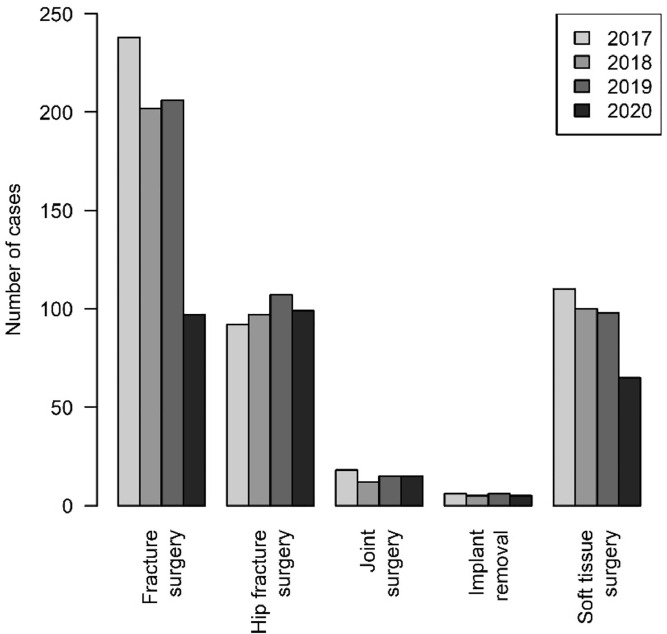
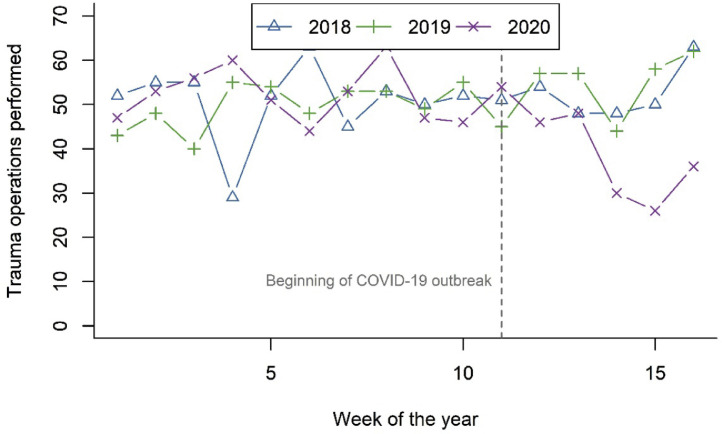
The mean number of referrals per week to the service reduced by 33% in the time period following the confirmation of the outbreak as a pandemic (p<0.0001). Number of operations performed per week reduced by 26% (p = 0.001). There was no change in the number of referrals relating to domestic abuse or non-accidental injury. In addition, numbers of hip fractures, periprosthetic fractures and prosthetic joint dislocations were unchanged. There was a significant reduction in the number of referrals for simple fractures, native joint dislocations, wounds and soft tissue injuries. Within the paediatric population, similarly, a reduction in simple fracture referrals was demonstrated.
An association between the outbreak of the pandemic and a reduction in referral numbers to our department has been demonstrated. The direct cause of this may be multifactorial but proposing that it is, in part, due to the social distancing measures introduced by the government is certainly conceivable. The patterns of injury would reflect this also with low energy and fragility trauma persisting whilst injuries associated with younger people have reduced. We would suggest that information such as this could be useful in healthcare planning and resource allocation in future pandemic situations.
COVID-19 疫情对英国医疗服务提供的管理产生了深远影响。骨科部门也不例外,需要通过释放资源并专注于“必要”活动来适应不断变化的情况。本研究的目的是量化创伤的减少,并描述可能受到疫情本身和英国政府采取的社交距离措施影响的转介类型的任何变化。
该研究在英国一家地区医院进行,该医院也是一家创伤单位,为 62.5 万人口提供创伤和骨科护理。使用基于信托的创伤转介电子数据库,比较 COVID-19 大流行期间和前 3 年同期每周向我们创伤服务的转介数量和类型。
在确认疫情为大流行后,每周向该服务的转介人数减少了 33%(p<0.0001)。每周进行的手术数量减少了 26%(p=0.001)。与家庭暴力或非意外伤害相关的转介数量没有变化。此外,髋部骨折、假体周围骨折和假体关节脱位的数量保持不变。简单骨折、关节脱位、伤口和软组织损伤的转介数量显著减少。在儿科人群中,同样也显示出简单骨折转介减少的情况。
已经证明,疫情爆发与我们部门转介数量减少之间存在关联。这种情况的直接原因可能是多方面的,但可以想象,这在一定程度上是由于政府实施的社交距离措施造成的。损伤模式也会反映这一点,低能量和脆弱性创伤持续存在,而与年轻人相关的损伤则减少。我们建议,在未来的大流行情况下,此类信息可能有助于医疗保健规划和资源分配。