Translational Stem Cell Biology Branch, National Heart, Lung, and Blood Institute.
Molecular Imaging Program, National Cancer Institute.
Blood. 2020 Dec 3;136(23):2667-2678. doi: 10.1182/blood.2020005161.
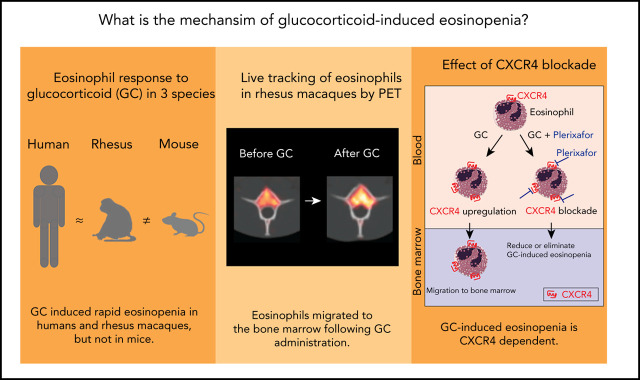
Glucocorticoids are considered first-line therapy in a variety of eosinophilic disorders. They lead to a transient, profound decrease in circulating human eosinophils within hours of administration. The phenomenon of glucocorticoid-induced eosinopenia has been the basis for the use of glucocorticoids in eosinophilic disorders, and it has intrigued clinicians for 7 decades, yet its mechanism remains unexplained. To investigate, we first studied the response of circulating eosinophils to in vivo glucocorticoid administration in 3 species and found that the response in rhesus macaques, but not in mice, closely resembled that in humans. We then developed an isolation technique to purify rhesus macaque eosinophils from peripheral blood and performed live tracking of zirconium-89-oxine-labeled eosinophils by serial positron emission tomography/computed tomography imaging, before and after administration of glucocorticoids. Glucocorticoids induced rapid bone marrow homing of eosinophils. The kinetics of glucocorticoid-induced eosinopenia and bone marrow migration were consistent with those of the induction of the glucocorticoid-responsive chemokine receptor CXCR4, and selective blockade of CXCR4 reduced or eliminated the early glucocorticoid-induced reduction in blood eosinophils. Our results indicate that glucocorticoid-induced eosinopenia results from CXCR4-dependent migration of eosinophils to the bone marrow. These findings provide insight into the mechanism of action of glucocorticoids in eosinophilic disorders, with implications for the study of glucocorticoid resistance and the development of more targeted therapies. The human study was registered at ClinicalTrials.gov as #NCT02798523.
糖皮质激素被认为是多种嗜酸性粒细胞疾病的一线治疗药物。它们在给药后数小时内导致循环人类嗜酸性粒细胞短暂而显著地减少。糖皮质激素诱导的嗜酸性粒细胞减少现象一直是糖皮质激素在嗜酸性粒细胞疾病中应用的基础,这一现象已经引起临床医生的兴趣长达 70 年,但它的机制仍未得到解释。为了研究这一现象,我们首先在 3 个物种中研究了循环嗜酸性粒细胞对体内糖皮质激素给药的反应,发现恒河猴的反应与人类非常相似,但小鼠的反应则不然。然后,我们开发了一种从外周血中分离恒河猴嗜酸性粒细胞的分离技术,并在给予糖皮质激素前后,通过连续正电子发射断层扫描/计算机断层扫描成像对锆-89-oxine 标记的嗜酸性粒细胞进行活体追踪。糖皮质激素诱导嗜酸性粒细胞迅速归巢骨髓。糖皮质激素诱导的嗜酸性粒细胞减少和骨髓迁移的动力学与糖皮质激素反应性趋化因子受体 CXCR4 的诱导一致,选择性阻断 CXCR4 减少或消除了早期糖皮质激素诱导的血液嗜酸性粒细胞减少。我们的结果表明,糖皮质激素诱导的嗜酸性粒细胞减少是由于 CXCR4 依赖性嗜酸性粒细胞向骨髓的迁移所致。这些发现为糖皮质激素在嗜酸性粒细胞疾病中的作用机制提供了深入了解,对糖皮质激素抵抗的研究和更有针对性的治疗方法的发展具有重要意义。这项人体研究在 ClinicalTrials.gov 上注册为 #NCT02798523。