Hall Jean A, Jewell Dennis E, Ephraim Eden
Department of Biomedical Sciences, College of Veterinary Medicine, Oregon State University, Corvallis, OR 97333-4802, USA.
Department of Grain Science and Industry, Kansas State University, Manhattan, KS 66506, USA.
Metabolites. 2020 Jul 9;10(7):281. doi: 10.3390/metabo10070281.
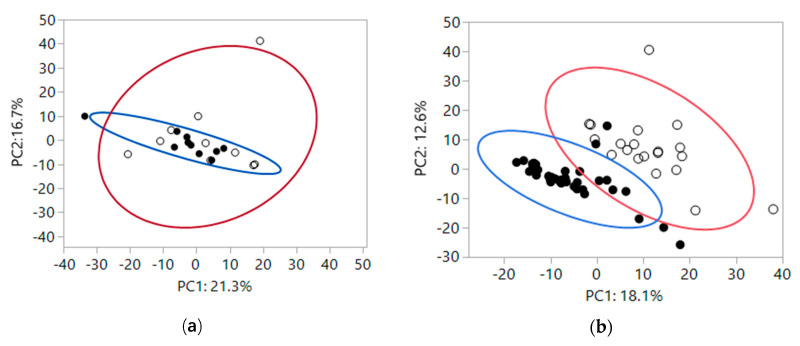
The objective was to determine the effects of feeding different fiber sources to cats with chronic kidney disease (CKD) compared with healthy cats (both n = 10) on fecal metabolites. A cross-over within split-plot study design was performed using healthy and CKD cats (IRIS stage 1, 2, and 3). After cats were fed a complete and balanced dry food designed to aid in the management of renal disease for 14 days during a pre-trial period, they were randomly assigned to two fiber treatments for 4 weeks each. The treatment foods were formulated similar to pre-trial food and contained 0.500% betaine, 0.586% oat beta glucan, and either 0.407% short chain fructooligosaccharides (scFOS) fiber or 3.44% apple pomace. Both treatment foods had similar crude fiber (2.0 and 2.1% for scFOS and apple pomace, respectively) whereas soluble fiber was 0.8 and 1.6%, respectively. At baseline, CKD had very little impact on the fecal metabolome. After feeding both fiber sources, some fecal metabolite concentrations were significantly different compared with baseline. Many fecal uremic toxins decreased, although in healthy cats some increased; and some more so when feeding apple pomace compared with scFOS, e.g., hippurate, 4-hydroxyhippurate, and 4-methylcatechol sulfate; the latter was also increased in CKD cats. Changes in secondary bile acid concentrations were more numerous in healthy compared with CKD cats, and cats in both groups had greater increases in some secondary bile acids after consuming apple pomace compared with scFOS, e.g., tauroursodeoxycholate and hyocholate. Although changes associated with feeding fiber were more significant than changes associated with disease status, differential modulation of the gut-kidney axis using dietary fiber may benefit cats.
目的是确定与健康猫(两组均为n = 10)相比,给患有慢性肾病(CKD)的猫喂食不同纤维来源对粪便代谢物的影响。采用交叉裂区研究设计,纳入健康猫和CKD猫(IRIS 1、2和3期)。在预试验期,猫食用一种旨在辅助肾病管理的全价平衡干粮14天后,随机分为两种纤维处理组,每组为期4周。处理食物的配方与预试验食物相似,含有0.500%的甜菜碱、0.586%的燕麦β-葡聚糖,以及0.407%的短链低聚果糖(scFOS)纤维或3.44%的苹果渣。两种处理食物的粗纤维含量相似(scFOS和苹果渣分别为2.0%和2.1%),而可溶性纤维含量分别为0.8%和1.6%。在基线时,CKD对粪便代谢组的影响很小。喂食两种纤维来源后,一些粪便代谢物浓度与基线相比有显著差异。许多粪便尿毒症毒素减少,尽管在健康猫中有些增加;与scFOS相比,喂食苹果渣时一些毒素增加得更多,例如马尿酸盐、4-羟基马尿酸盐和4-甲基儿茶酚硫酸盐;后者在CKD猫中也增加。与CKD猫相比,健康猫的次级胆汁酸浓度变化更多,并且两组猫在食用苹果渣后,一些次级胆汁酸的增加幅度都大于scFOS,例如牛磺熊去氧胆酸盐和猪胆酸盐。虽然与喂食纤维相关的变化比与疾病状态相关的变化更显著,但使用膳食纤维对肠-肾轴进行差异调节可能对猫有益。